The EDC Toiletry Kit
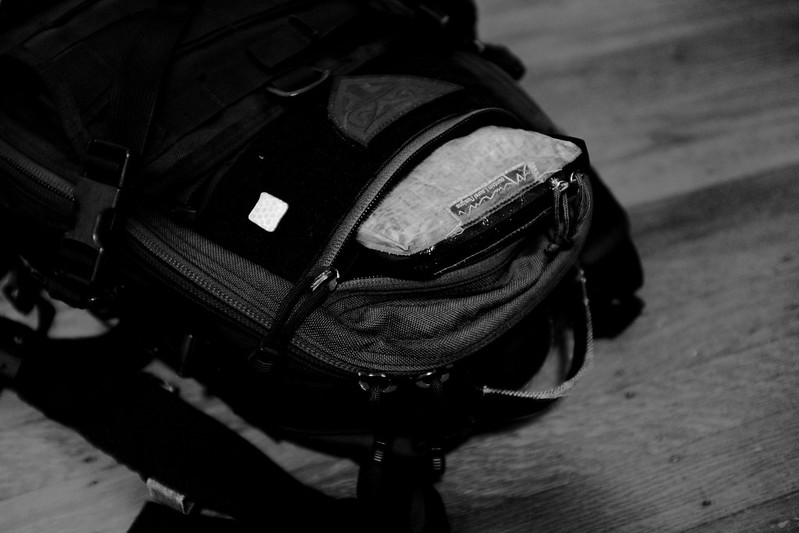
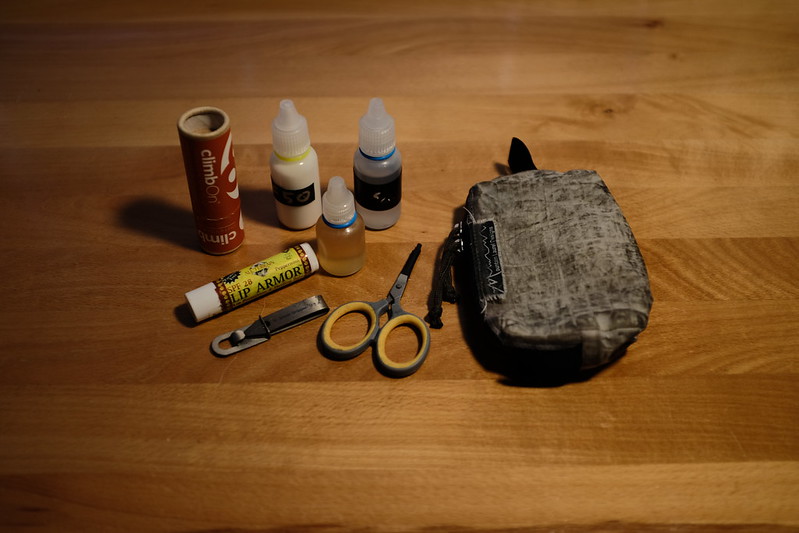
Over the years I’ve developed a small toiletry kit that satisfies the needs for my every day ablutions. I carry it in a small Mountain Laurel Designs Cuben Fiber Packing Cube (the same model pouch I use for my EDC tool kit). There’s some crossover between this kit and my first aid kit, but that is to be expected. Health and cleanliness are closely related.
If I know I’m going to be gone overnight, I’ll grab another MLD cube that I keep packed with a toothbrush, a small bottle of toothpowder, and floss. If I know I’m going to be gone multiple days, I’ll add a bar of soap and shaving supplies. The following is just what I find it worthwhile to carry in my backpack everyday.
Hand Sanitizer
I use hand sanitizer infrequently, always preferring soap and water, but it is still a critical tool to carry.
I carry hand sanitizer in a 15 mL Mini Dropper Bottle with a Streaming Dropper Tip. I don’t have a specific product recommendation here. My all time favorite hand sanitizer was the All Terrain Hand Sanz Gel. It was effective, did not dry out my hands, and did not stink. But I went through the last of my stash last year, and the product has been discontinued. Next I went with Elyptol, which has an EWG rating of 1, but the eucalyptus scent is too overpowering. If they made an unscented version I’d buy it. Currently I use Pipette, which has an EWG rating of 1. It leaves a bit of sticky residue behind, but otherwise seems fine.
Soap
These days it seems like everybody carries hand sanitizer, but few carry soap. I don’t get it. Soap is pretty useful stuff to have when out and about in the world. A good, versatile soap will clean tools, clothes, and body.
I carry Dr. Bronner’s Unscented Pure-Castile Liquid Soap, repackaged in a 10 mL Mini Dropper Bottle. It has an EWG rating of 1.
Sunblock
Protecting the meatsuit from ambient radiation is important. For much of the year my sunblock goes untouched, but if I take it out I’ll forget to put it back in when the seasons change. Or I’ll find myself on a snow field and think “Gee, it sure would be nice to have some sunblock right now.” It’s easier to just leave it in the kit year-round.
I use Thinksport SPF 50, repackaged in a 15 mL Mini Dropper Bottle with a Streaming Dropper Tip. I have also carried it in screw-top capsules, but I’ve found that the plastic containers can be cracked and the tin containers can be dented such that they become difficult to open. So I’m back to using dropper bottles, despite them being impossible to clean out. Thinksport has an EWG rating of 2.
Lip Balm
I rarely have a problem with chapped lips, and thus rarely use lip balm as a moisturizer. My only interest in lip balm is as sunblock.
I use All Terrain Lip Armor SPF 28. All Terrain has been steadily discontinuing all their best products, including this one. I recommend stocking up. This product used to have a high EWG rating, but it seems to no longer be listed.
Skin Balm
Before I started dosing myself with omega, a good skin balm was critical to keeping my hands operational in the dryer months. Now its criticality is diminished, but I think it is still important tool to address small cuts, scrapes, burns, and bites. Balm is best thought of as an artificial scab: it encourages healing, and provides a protective barrier. A good skin balm coupled with some soap, clean water, and bandaging material is going to take care of the vast majority of minor first aid issues. (Throw in a syringe and some steri-strips, benzoin tincture, and a semi-permeable dressing and the world is your oyster.)
climbOn is my favorite skin balm. I find it to be highly effective. It is available in two scents, both of which I find unoffensive. Most important for something that is to be used on the hands, it does not feel greasy. I hate applying a balm on a finger and then feeling like I’m leaving residue on everything I touch. climbOn does not have an EWG rating, but its ingredients are few, easy to understand, and food-grade.
I carry the 0.5 oz climbOn Lotion Bar. I generally find that my happiness is inversely proportional to the amount of cardboard in my life, but I make an exception here. The tube is a more convenient carry format than the old tins.
I have tried using (non-SPF) lip balm as skin balm, since the form-factor of lip balm tends to be great for EDC, but I’ve not found any lip balm that I like as much as the climbOn skin balm. (I have tried the climbOn lip balm and do not like it for this application.) The stuff made for lips tends to have a softer consistency and be too greasy for me to want to use on hands. A good skin balm, however, is perfectly serviceable as a lip balm if you’re not looking for sun protection.
Scissors
As previously discussed, I carry 2.5” Westcott Titanium Scissors.
Tweezers
I carry the titanium version of Uncle Bill’s Sliver Grippers. Tweezers are something I almost never use, but when I need them there is no substitute. The titanium offers no functional advantage over the stainless steel variant, but titanium is cool.