Recent Tweets

Simple Ferrocerium Rods

December 6th, 2009 at 7:29 PM

I don’t like paying for brand-name ferrocerium rods with handles when blanks can be got for much cheaper — usually $5 less than their handled counterparts. But I do like to have a handle on the rod, and I require some sort of lanyard. When it comes to something as important as a ferro rod, I find comfort in knowing that it is secured to this-or-that.

Simple Ferro Rods

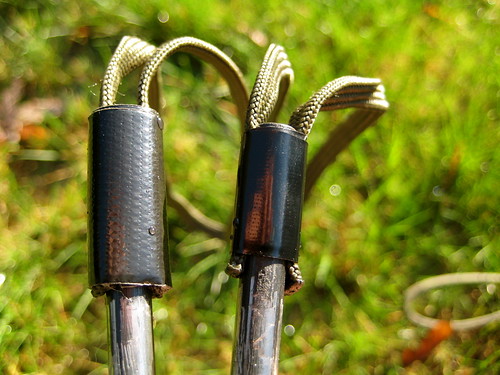
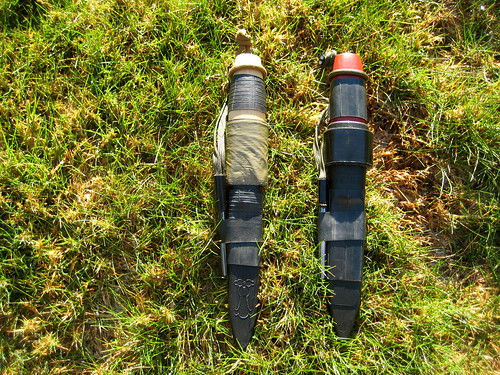
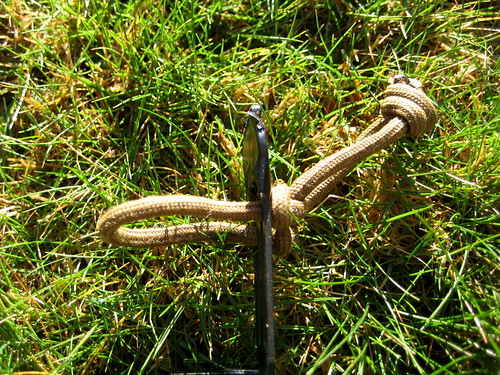
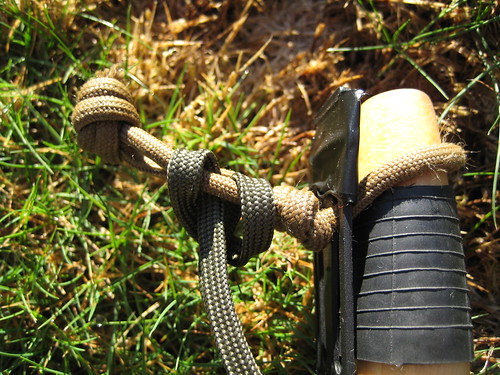
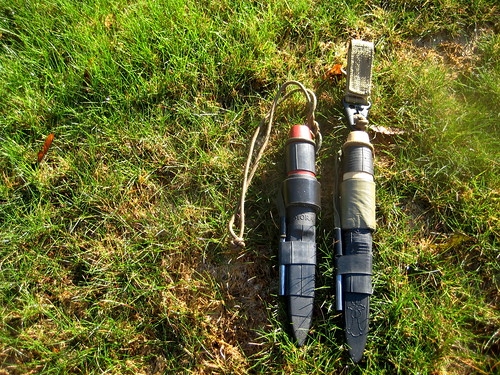
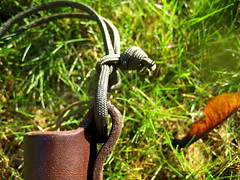
The simplest solution is to tape a loop of paracord to one end of the rod. I use gutted paracord. The tape can be wrapped a few extra times to make a handle however thick I like.

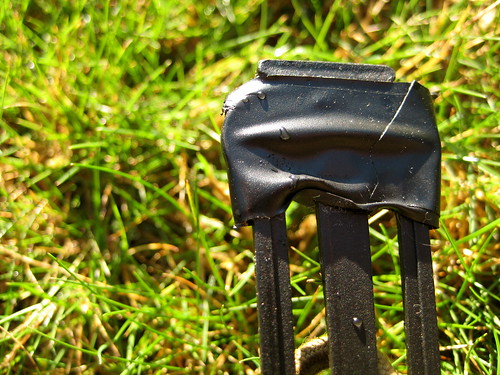
The other rod in the above photo has a similar lanyard attached in a different manner. The paracord is first taped to the rod with a small piece of electrical tape. Then, on top of that, I slid a small piece of heat-shrink tubing (the kind used for electrical wiring). That was blasted with a hair dryer, causing it to shrink.

Drilled Ferro Rod

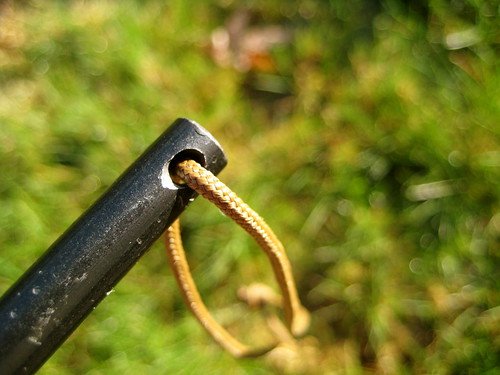
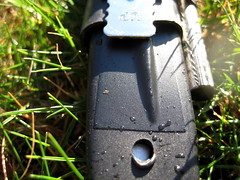
A small hole could also be drilled in one end of the rod. This is something of a fire hazard: the drill and rod will be throwing a whole lot of sparks as the drill works its way through. And it requires access to power tools, which isn’t always practical.

My favorite method is the tape. The lanyard is secure and the tape provides a thick, padded handle.

I like to buy my blanks from Ben’s Backwoods. If you like misch metal blanks, Going Gear is the place to be.

1 Response »

Mora Sheath Modifications

December 5th, 2009 at 5:01 PM

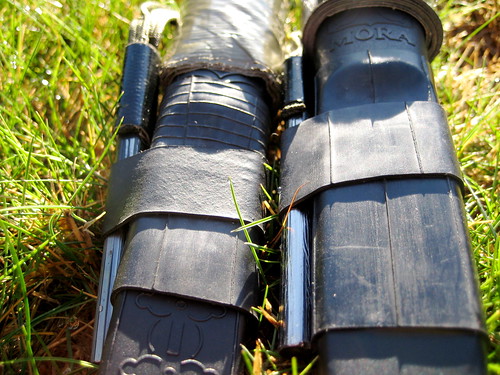
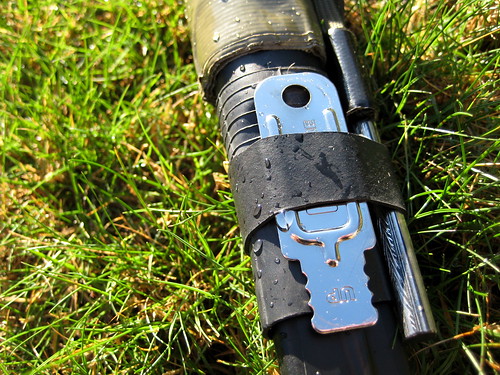
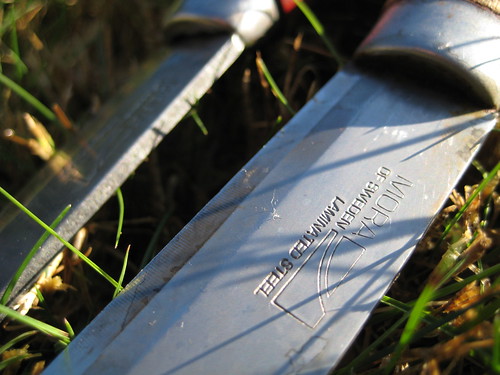
The greatest disappointment about any Mora knife is the sheath: a flimsy, plastic thing that won’t easily fit on a decent sized belt and does not even hold the knife very securely. As they come, I consider them unusable. But a few simple modifications and additions make them quite acceptable.

Mora Sheath Modifications

The Mora knife sheaths are designed to be mounted either on a button on a pair of coveralls or through a belt. Apparently people wear very small, skinny belts in Sweden. Over here in the United States of Gun Belts, that doesn’t fly. The belt slot on the sheath can be forcefully enlarged by shoving in a piece of wood, such as a ruler, and applying heat to cause the plastic to expand, but I don’t trust that such an act will not over weaken the plastic. I’m not a big fan of carrying a Mora directly on my belt, anyway. Usually, I’ll carry the knife either on a lanyard around my neck or as a dangler off my belt. But both of these setups allow the possibility of the knife and sheath to swing freely, accentuating the problem of an insecure fit.

Read more…

3 Responses »

Vargo Triad XE in the Ti-Tri Cone

December 3rd, 2009 at 4:19 PM

Yesterday, Avagdu asked me if the Vargo Triad XE stove could be burned inside the cone of my Trail Designs Ti-Tri Stove System. I’ve used it in the cone a couple of different times, but never performed any direct comparisons between it and the 12-10 alcohol stove that comes with the Ti-Tri system. Today, I spent some time with both stoves to do just that. Temperatures were around 42 degrees Fahrenheit.

I burned both stoves with the same amount of fuel. One of the downsides of the Triad XE stove is that because the main fuel source is enclosed within the inner container, it cannot be directly lit. Instead, some fuel must be placed within the outer section of the stove. This is then lit to prime the main fuel source. On an alcohol stove where the main fuel is directly accessible, such as the 12-10, the outer priming ring is not always required. It will usually be used when operating in colder temperatures. To be fair for these tests, I primed both stoves with the same amount of alcohol.

Read more…

2 Responses »

K & M Match Case

December 2nd, 2009 at 12:56 PM

The K & M Industries Match Case has long been considered one of the top waterproof match cases available. Each case is hand made in the Elk River, Idaho garage of Keith and Marge Lunders.

The match cases are available in either brass or aluminum and come in two different sizes. The standard length cases are 3 7/8″, designed to fit 2 3/8″ strike-anywhere matches. The long length cases, measuring in at 4 1/4″, are designed for REI Storm Proof Matches. Aluminum cases are available in black, silver, green, or red.

Last winter, I bought a standard length, black aluminum case. It has been part of my wilderness EDC for close to a year.

K & M Match Case

Read more…

2 Responses »

RAT Izula Neck Knife

December 1st, 2009 at 12:51 PM

My primary EDC knife for the past few years has been a plain-edge Emerson Mini-Commander. It’s a great little knife: an ideal size for EDC and extraordinarily tough for a folder. I’ve used it as a pry-bar a few different times on objects that I would be afraid to pry with some fixed-blade knives. The Mini-Commander is no worse for the wear.

Still, I’ve often thought that I would like to EDC a fixed blade. After all, despite it’s toughness, the Mini-Commander is a folder and that gives it some limitations. I’ve also found that the grind and shape of the blade is not ideal for some wood-working and wilderness survival tasks. Making feather sticks with it isn’t easy.

Read more…

10 Responses »

Wilted Nettle

June 18th, 2009 at 9:24 PM

A lazy day of doing not much of anything sometimes makes me feel guilty. It requires that some evening activity take place — something which gives one the satisfactory feeling of accomplishing something of use during the block of waking hours. Today I chose to spend the evening in the woods. I thought I might practice some knife skills, or just sit and read a book. Arriving at my spot I was unpleasantly greeted by a thick swarm of mosquitoes, greatly annoying me and foiling my plans for peace. I decided to start a small fire with a bit more green wood than usual. The smoke from a fire usually drives mosquitoes away and the green wood would put out more smoke than dead wood. When I was out collecting wood, I noticed a large patch of Stinging Nettles in the gully below where I was. The two thoughts of Nettles and fire brought to my mind an episode of Wild Food where Ray Mears picked a few fresh Nettles and wilted them over the fire to neutralize their sting and improve the flavor. I eat a lot of Nettle raw, crushing the leaves to break the needles and get rid of the sting, but I thought I might try this new method.

After the fire was going (and the mosquitoes buzzing off elsewhere), I put a small measure of dead wood on a corner of the fire to get a bit more flame than the smokey green wood was providing. This accomplished, I went back to the gully to collect a few stalks of nettle and return them to the fire. It took only about 15 seconds of holding one plant over the flame for it to become limp and drooping. I tested it a bit with my fingers to see if the sting had been neutralized. It had. Tearing off a bit and munching it around a bit in my mouth, I was greeted by quite a surprise: these wilted Nettles were, without doubt, the best Nettles I had ever tasted, perhaps even being the best wild weed I had ever enjoyed! I ate about a dozen tall plants, until I was quite satisfied with my evening snack. Occasionally I would leave a stalk hovering over the flame a bit longer than needed, but that would impart to the leaves a slightly toasted flavor, which I also found to be agreeable.

I’ll certainly be enjoying wilted Nettles again. It’s a bit more trouble than just eating them raw, but, even on the move, it takes very little time to start a small fire and prepare a few picked plants in this way. The improved flavor greatly pays back the small investment in time.

No Responses »

Possibles Pouch

June 7th, 2009 at 5:06 PM

My possibles pouch began as being simply a Doug Ritter Pocket Survival Pak. The Survival Pak comes in a waterproof envelope that is meant to be carried in a pocket. I prefer a belt-mounted solution, so I ditched the waterproof envelope and moved the contents to a TAD Gear SERE SP pouch. The SERE pouch has velcro webbing on the back, which allows it to be mounted to be mounted to any sort of belt or PALS webbing.

Possibles Pouch

Read more…

1 Response »

Patina

April 7th, 2009 at 6:07 PM

High carbon steels have a tendency to rust without proper care. This is especially true of knives made from O1 tool steel, such as my BCNW-O1.

Patina

A patina is a thin film that develops on some metals due to oxidation. It is a type of rust, but a good one, that protects the blade rather than corroding and eating away at the metal. Over time, most knives will develop a patina, regardless of the material that they’re made from. Many people are attracted to the distinctive and aged look that a patina imparts onto a knife, and will make an effort to force a patina onto their blades. The easiest way to do so is to use the knife to prepare acidic foods: potatoes, onions, tomatoes, pickles, and the like all work well. Some people will soak a rag in vinegar and wrap it around the blade, or coat the blade with mustard and leave it overnight.

Read more…

3 Responses »

« Older Entries