AquaRain Water Filtration Systems

Last month, Vavrek and I began researching gravity powered water filtration systems. The British Berkefeld and Berkey filter systems dominate this market (British Berkefeld refers to systems using the Doulton Super Sterasyl filter elements, Berkey refers to filter systems using the Black Berkey filter elements). I had been set on purchasing a Berkey filter until Vavrek discovered AquaRain Natural Water Filtration Systems, a lesser known (and cheaper) alternative.

The AquaRain systems are all built in the USA from stainless steel. The filter elements are from Marathon Filters, the same used by MSR in their portable filters. They’re ceramic with carbon which, as illustrated in this table, filters organic and microbiological organisms, but not heavy metals, radioactivity, or inorganics. (More information on different filter types is available here.) These filters have been shown to filter down to the .2-.3 micron range, where British Berkefeld units claim an absolute rating of .5 microns.

Nitro-Pak, a seller of AquaRain filters, has the following to say concerning manufacturer claims of “absolute” micron ratings:

There is a great deal of confusion regarding “absolute” micron ratings. Just how much of a reduction efficiency should be considered adequate for an “absolute” rating? Is 99.9% (3 log) sufficient, or would 99.9999% (6 log) be more appropriate, since it matches the EPA bacteria requirement? Should a filter be rated by its ability to remove particles of a certain size, or shouldit be challenged with live organisms of a particular size? Should a filter be tested only when it is new, or should the ratings be based on its end-of-life performance? The fact is that there is no industry or government standard for “absolute” filtration performance.

The Marathon filter elements used in the AquaRain Gravity Water Filter have been extensively tested against live organisms using expended end-of-life elements. We believe this form of testing to be the most stringent, since it tests the filters in a manner similar to the way they would actually be used under worst case conditions. When testing against the .5-.6 micron organism Klebsiella terrigena, EXPENDED Marathon elements demonstrated a 6.6 log reduction (they achieved 8.9 log reduction when new). The EPA only requires a 6 log reduction from NEW elements, which AquaRain greatly exceeded under extreme pressures of up to 90 psi, well above normal test pressure. At the very low pressure of 1/2 psi found in our gravity filter, the efficacy would be far greater still. Does this mean that the Marathon filter elements have an “absolute” rating of only .5-.6 microns? Expended Marathon filter elements have also been tested against the Health Industry Manufacturing Association’s (HIMA) test organism, Brevundimonas diminuta, and achieved a 99.99815% reduction (99.9999% when new). Since this organism is .2-.3 micron, should we claim this as our “absolute” rating? British Berkefeld Filter literature lists the “absolute” rating of their filter at .9 microns and their U.S. dealers claim “absolute” performance at .5 microns. Their own factory literature claims only 99.9% efficiency at the .5 micron level. Is 99.9% sufficient for claiming an “absolute” rating? The bottom line is that the AquaRain Gravity Water Filter System, using Marathon filter elements, will outperform all other gravity-fed ceramic water filter systems. Since there is no standard for “absolute,” YOU will have to decide what level of protection you want for yourself and your family.

The AquaRain, British Berkefeld, and Berkey filter systems are all worthy investments. Finding a clear winner between the three can prove a challenge. Based partly on the above quote concerning micron ranges, partly on the price, and partly on the country of origin, I decided to purchase an AquaRain.

I went with the AquaRain 202 model. It includes two filter elements and holds roughly 1.5 gallons of clean water. I purchased it from CampingSurvival.com, who, after factoring in shipping costs and using the coupon code “savings” for a 5% discount, had the 202 for the cheapest I could find. I’d never dealt with them before, but their shipping and email response was prompt, so I’d recommend them if you’re looking to pick up an AquaRain.

When you first receive the AquaRain, all the parts should be thoroughly cleaned and the filter elements “cultured” by rinsing them under water and running your hands along them. The system is then assembled, which is a simple process of installing the spigot on the lower reservoir, the two filter elements in the top reservoir, and the handle on the lid. Finally, stack the top reservoir atop the lower, dump in some water, put on the lid, and you’re done.

Regardless of the actual micron measurement, pores in the AquaRain’s Marathon filters are smaller than those in the Berkefeld, which makes for a slower flow rate. AquaRain claims a 1/4 gallon per hour per element flow rate under ideal conditions. New filter elements are nowhere near this fast. When I first put my system together, I filled the top reservoir and left for 5 hours. Upon returning, only about 1/6th of the water had made it through the two filters. I emailed AquaRain to confirm that this was normal behavior.

Yes this may very well fit into the normal range when first starting it up....

The filters are DRY and the pores on the surface of the ceramics are very small. The water follows a tortuous path to get to the bed of the granulated activated carbon....also DRY… and then it drips into the lower container.

Within a couple of days, the filters will have become fully saturated. When you keep the container filled (adding water every ten or so minutes) you can then achieve the optimum filtration rate. Most people will not give the unit this kind of attention....most will fill it before they go to bed at night and by morning you should have a gallon or so. Fill again for more water. Even when keeping the unit full and striving for the high filtration rate, the water has a nominal contact time of 11 minutes with the carbon…this is good! You want it slow so that it can do its job. (Another factor, especially with cold weather coming, that affects speed of filtration is the temperature of the water....the warmer the faster....the colder the slower.

It is important to note that the top reservoir simply sits on top of the lower, with no rubber “O” ring to make the connection water tight. This means that it is possible for the lower reservoir to overflow if you attempt to keep the top constantly full for maximum flow rate without emptying the bottom (I discovered this the hard way).

The water filtered through the AquaRain does have a distinctly different taste. I live in a city that has some of the cleanest water in the state, and I’ve always used a Brita water filter for drinking water. I expected the AquaRain to do a much better job than the cheap Brita, but I did not expect a significant difference in taste. The water from the AquaRain tastes much smoother, for lack of a better descriptor. I’ve also noticed the water comes to a boil faster when cooking.

I keep a 1 gallon glass jug full of filtered water in the fridge for chilled drinking water. For cooking and for tea, I take the water directly from the AquaRain. I lift up the upper reservoir periodically throughout the day to check the water level, and dump a bit in the top when the lower is lacking. (I prefer to fill the top at night, so that I can go to sleep to the “drip drip” sound of the filtered water falling into the pool in the bottom). Because I never completely fill the top, I don’t achieve the maximum flow rate.

For 1-2 people looking for clean drinking and cooking water, I think the AquaRain 202 model is ideal. For 3-4 people, I would certainly opt for the larger 404 model. If you’re looking to provide water for more than 4 people, I’d speculate that you would need to either pick up multiple 404 models or acquire a couple of large buckets and build your own filter with perhaps 6-8 filter elements to achieve an optimum flow rate.

In an off-grid (or grid-down survival) situation where clean water is needed not only for drinking and cooking but also for cleaning, I would certainly want to invest in some large water storage containers and perhaps a 404 model for the faster filtration rate achieved by the 4 filter elements. But that would be for 1-2 people. If you’re looking for a system to provide drinking, cooking, and cleaning water for 4 or more people, I don’t think an AquaRain system is practical. Ideally, I would try for a large scale rain-water fed rapid-sand filter leading to a slow-sand filter (described in Aric McBay’s Peak Oil Survival) – and if you happen to have an AquaRain, perhaps using that for final filtration of drinking water.

AquaRain recommends dumping the first 1-2 gallons filtered through new filter elements, “as it may contain loose material washed from the filter elements.” This, along with the extremely slow flow-rate of new filter elements creates an interesting conundrum. Because the new filters are dry, it takes a significant amount of time for the first couple gallons of water to be filtered. The two filter elements in my AquaRain 202 took a little over 24 hours. If I were off-grid and completely dependent on the AquaRain, that’s 24 hours without the ability to produce usable water every time I change the filter elements. Storing enough water for 24 hours isn’t a big deal (and really ought to be a minimum requirement), but what if some event were to arise that requires me to use more than the usual amount of water? It seems to me that one should strive for two different filter systems – to be used concurrently, but staggered – so that when new filters are being installed and conditioned in one, you can fall back to the other.

One of the main concerns many city-dwellers hold about their water supply these days is the possibility of it being contaminated with fluoride. (There’s a rather heated debate as to whether fluoride is good or bad. Personally, I believe it to be a poison, but I think the debate is mute. Cities should provide the cleanest, purest water possible to its citizens. If an individual wishes to add some additional chemical to their water, they can do that themselves, at their own risk, in their own homes.) Because of this, a popular addition to Berkey filters are the Post Filter Arsenic and Fluoride Reduction Elements, which screw on to the Black Berkey filter elements. In my city, we voted down the attempt to fluoridate our water supply, so it isn’t an immediate concern for me. But chances are that at some point I’ll live in a place that does poison its water. Before deciding on the AquaRain over the Berkey filters, I emailed AquaRain and asked if the Post Filter elements would also fit onto their Marathon filters. They replied in the negative:

Fluoride is a difficult thing to remove from water, and gravity carbon filter systems may not be the most efficient or effective way to do the job. If you use a gravity water filter system that has carbon in its operation, a more accurate word would be reduce rather than remove. Carbon is generally not the accepted media for fluoride reduction and our unit has not been specifically tested again fluoride to see how significant the reduction can be. There are variables involved with certain chemicals. For example: We do not know how much fluoride has been added to your water system; there would be a sliding scale of effectiveness as the carbon ages, etc.

However, we know the water passes slowly through the AquaRain (which is positive since you want the contact time to be as long as possible.) We have found documents that say carbon will reduce fluoride enough (up to 80%) that pro-fluoride people are alarmed and want you to add it back into your diet. If your main concern is fluoride removal/reduction, there may be better options out there than a gravity water filter system. (Reverse Osmosis).

Not to discount the danger of fluoride, sadly and statistically, all of the strengths found in the AquaRain filter system…bacteria, cysts, protozoan removal, VOC contaminants, chlorine, benzene, pharmaceutical drug removal can be accomplished with the AquaRain but most people do not even know of these dangers.

Due to the thread pattern found on the stems of the AquaRain Ceramics, there are no post filters that will fit our candles.

This wasn’t enough to dissuade me from the AquaRain systems. Up to 80% reduction ain’t bad, but I think some sort of reverse osmosis system (or just going for rain collection) would be justified if I find myself in a fluoride-friendly city.

I’ve been very pleased with the AquaRain for the week that I’ve been using it. Tangibles such as water filters are not only wise investments of wealth in uncertain economic times, they also allow a further degree of self-sufficiency. Though I currently fill the AquaRain with tap water, I can just as easily fill it with water from the more-than-abundant rains we receive here in the Pacific Northwest. I’m no longer fully dependent on city water, nor subject to another’s whims as to what should be in my water.

Kitchen Herbs

A friend asked me which herbs I have in my kitchen right now.

Kitchen Herbs

  • Chamomile (Matricaria recutita)
  • Cinnamon (Cinnamomum verum)
  • Echinacea (Echinacea purpurea)
  • Horsetail (Equisetum arvense)
  • Nettle (Urtica dioica)
  • Peppermint (Mentha piperita) (not pictured)
  • St. John's Wort (Hypericum perforatum)
  • Thyme (Thymus vulgaris)

I’ve also got an Echinacea tincture and locally wild-crafted Oregon Grape tincture in the making. They’ll probably both be decanted next week, just in time for cold and flu season.

Thoughts on SSH Security

OpenSSH has a history of security. Only rarely are holes found in the actual program. It’s much more likely that a system will be compromised through poor configuration of the SSH daemon. Ideally, an SSH config would allow only protocol 2 connections, allow only specified users to connect (and certainly not root), disable X11 forwarding, disable password authentication (forcing ssh keys instead), and allowing connections only from specified IPs. These config options would look like this:

Protocol 2
PermitRootLogin no
AllowUsers demo
X11Forwarding no
PasswordAuthentication no

Allowing connections from only specified IP addresses would be accomplished by adding something like the following to /etc/hosts.deny:

sshd: ALL # Deny all by default
sshd: 192.168.1.0/255.255.255.0 # Allow this subnet
sshd: 4.2.2.1 # Allow this IP

(You could also accomplish this with iptables, but I think editing the above file is simpler.)

But the last two options – disabling password auth and allowing only certain IP addresses – limits mobility. I constantly login to my slice from multiple IPs, and I also need to login during travel when I may or may not have my key on me.

The main thing these two options protect against is a brute force attack. By allowing password logins from any IP, we give the attacker the ability to exploit the weakest part of SSH. This is where DenyHosts comes in.

DenyHosts is a python script which attempts to recognize and block brute force attacks. It has many attractive features and is included in the default Ubuntu repositories.

1
$ sudo aptitude install denyhosts

The config file is located at /etc/denyhosts.conf. It is very simply and readable. I recommend reading through it, but most of the default options are acceptable. If any changes are made, the daemon must be restarted:

1
$ sudo /etc/init.d/denyhosts restart

Default Ports

Many people also advocating changing SSH’s default port to something other than 22 (more specifically, something over 1024, which won’t be scanned by default by nmap). The argument in support of this is that many automated attack scripts look for SSH only on port 22. By changing the port, you save yourself the headache of dealing with script kiddies. Opponents to changing the port would argue that the annoyance of having to specify the port number whenever using ssh or scp outweighs the minute security benefits. It’s a heated argument. I lean toward leaving SSH on the default port.

Deer Encounter

This morning before going to work I visited the neighboring woods, having taken it into mind that I would visit the sit spot I used during Kamana, but haven’t been to since last winter. Soon after breaking off the trail and climbing steeply uphill through the undergrowth toward the spot, I heard a bit of rustling of leaves and snapping of twigs. It surprised me, as I’d never seen another person near this spot – people rarely ever venture off the trails in this area at all. After stopping and listening for a short count, I continued on my way, thinking that I was probably making enough noise that the person would hear me, as I heard him, and thus wouldn’t surprise someone in awkward encounter.

A few steps later, as I came above the rock overhang that my spot sits on, I was greeted by a deer munching on the leaves of a young sapling. This surprised me more than the human I expected. Though the forest is home to deer and cougar, they usually stay in the deeper woods, not as close to the main trails as we were here.

I froze, partly out of surprise, and stood still, not staring at the deer, but keeping my peripheral vision trained on him. He looked in my direction, but continued munching and didn’t seem terribly concerned. I can’t imagine that he didn’t see or hear me, but the wind was favoring me by blowing downhill onto my face. Without my scent to alarm him, he must have decided that I was little more than an interesting stump.

When he turned his back to me, I slowly dropped my pack and went prone, thinking it would be fun to see how close I could get. Like most pine forests of the Pacific Northwest, the area was dense with undergrowth such as ferns and Oregon Grape. It all provides for great cover when you’re hugging the floor, but makes moving quietly in it a challenge.

I stalked the deer for 15 minutes, not getting much closer than I was when he first surprised me, but doing my best to maintain the distance as he moved. Within the first couple minutes he led me to 2 other deer slightly further up the hill which I had neglected to spot previously.

Stalking humans is much easier!

When compared with most people who tromp through the woods, I can walk with a measure of silence, but attempting to match pace with such an animal while not making noise gives one great respect for the deer’s ability. All the while I was crashing through the undergrowth, despite my best efforts at silence, while the deer would effortlessly bound ahead, snapping only the occasional twig.

Eventually they ditched me, but making my way back down hill to where I dropped my pack, there were plenty of tracks in the soft ground to gaze at.

Back on the trail, I encountered people dressed in their stylish reds, blues, and yellows, and was struck by how sad it was that they could never experience such an encounter while garbing themselves in such eye pollution.

Deer stalking

Drink In the Forest

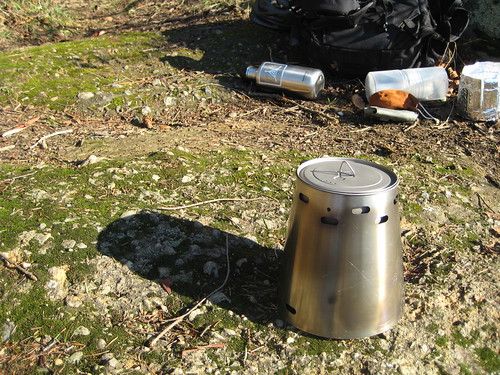
In the damper months, I like to throw a small stove in my pack. A warm cup of tea encourages further exploration of the woods, which seem to come alive after a rain.

Cedar Tea

We do not go to the green woods and crystal waters to rough it, we go to smooth it. We get it rough enough at home; in towns and cities; in shops, offices, stores, banks anywhere that we may be placed -- with the necessity always present of being on time and up to our work; of providing for the dependent ones; of keeping up, catching up, or getting left.. "Alas for the life-long battle, whose bravest slogan is bread." -Nessmuk, Woodcraft and Camping

Cedar Tea

Herbal Stye Healing

A stye is a sort of pimple on the eyelid, caused by a bacterial infection at the root of the eyelash. The common treatment for the infection is applying a hot compress to the area, which encourages the stye to drain. I had a small stye on the inside of my lower left eyelid last week and decided to see if I could speed the healing process along with herbal experimentation. It ended up healing in 2 days.

The first day I applied a thyme compress to the area twice, for 15 minutes each. The compress I made by simply making a cup of thyme tea (steeped for 20 minutes for medicinal strength) and soaking a sterile gauze pad in it (with occasional re-soaking throughout the 15 minutes process as the compress lost its warmth). Thyme contains Thymol, an antiseptic which acts as a sort of antibiotic.

Of course, with any infection, the most obvious thing to reach for is Echinacea. I was out of tincture at the time, but I made a cup of tea with some dried Echinacea purpurea root before bed the first night.

The second day I repeated the twice daily 15 minute compress, but this time with Chamomile (Matricaria recutita). Chamomile has a reputation as general-purpose healer, and is also a relaxant.

The morning of the third day, there was no evidence of the stye.

Mid-Summer

Shakespeare in the Park

IMG_1927

Hawaiian Chieftain

Recovering the Linksys WRT54GL via TFTP

Last May, DD-WRT released the (long in development) v24 of their firmware. I had been running one of the release candidates for it on my Linksys WRT54GL, but decided today to upgrade to the stable release. I downloaded the appropriate file (dd-wrt.v24_std_generic.bin), followed the instructions for flashing through the web GUI, and promptly bricked the router.

It wasn’t totally destroyed. I could still ping the router, but couldn’t access it in any other way. The power light would flash repeatedly, and no other lights came on. No amount of hard resets would fix it.

According to DD-WRT’s wiki article on bad flashes, the repetitive blinking of the power light means that the bootloader is defective, but that the problem might be solved using a TFTP recovery. The idea is that when the router first boots up, there’s a brief moment where it will accept an upload. By pushing through firmware, you are able to temporarily boot the router.

On older Linksys routers, this only works with the official Linksys firmware, so I downloaded the latest version from Linksys’ support page for the WRT54GL. Because the router will only accept the firmware at the very start of the boot process, I first unplugged the router, turning it off. To monitor the router during the process, I started a ping from my machine.

$ ping 192.168.1.1

Then, using the TFTP client that ships with OS X, I executed the upload

$ echo "put FW_WRT54GL_4.30.12.3_US_EN_code.bin" | tftp -e 192.168.1.1

and immediately plugged the router back in. In 10 seconds, TFTP reported that the file had been sent.

At this point, the router stopped responding to my pings for about 30 seconds. When it began replying again, I was able to access the default Linksys web GUI. The first thing I did in the GUI was to hit the “reset to factory defaults” button, which clears the NVRAM of my bad DD-WRT image and installs the fresh Linksys image. After that, I installed a new DD-WRT “mini” image (the WRT54GL requires you flash with “mini” before upgrading to “standard” when moving from the default firmware), by uploading dd-wrt.v24_mini_generic.bin via the upgrade page. This worked without a hitch.

In the DD-WRT web interface, I tried to flash the router with the standard firmware, but was greeted by a vague error message that told me only that the upgrade had failed. I went back to the wiki to see what the differences were between mini and standard and decided that it would be find to leave the router with mini. All I needed was for the router to act as a wireless repeater with a virtual interfaces. The mini firmware supports this, so I was able to setup the router just as before.