You are currently viewing all posts tagged with gear.

Measuring Chain Wear

A bicycle chain elongates as it is used. This elongation – commonly referred to as “stretch” – is caused by the wearing down of the pins that hold the chain links together and the enlargement of the bore hole in the inner plates that the pins are inserted through. If left unchecked, wear on the chain causes the teeth on the cassette cogs and crank chainrings to become reshaped to the point that they will no longer mesh with a new chain. To extend the service live of these more expensive components, it behooves one to replace the chain before it becomes excessively worn. For drivetrains below 10-speed, the common advice is to replace the chain when it measures 0.75% elongation. For drivetrains above 10-speed, the common advice is to replace the chain when it measures 0.50% elongation. For 10-speed drivetrains, opinion varies between the two measurements, so take your pick.

Chain elongation may be measured with a ruler – 12 complete links on a chain should measure exactly 12 inches – but performing this measurement with accuracy and precision, and identifying when the measurement is off by 0.50% or 0.75% can be difficult. Hence the market for chain measurement tools.

In the past I have used a Park Tool CC-3.2 and a Park Tool CC-2. The CC-3.2 was a simple go-or-no-go measurement tool which attempts to identify when the chain has reached the 0.50% or 0.75% limits. The gauge of the CC-2 provides a more detailed look, attempting to show you not just if the chain has reached the replacement point but also how closely you are approaching it. Both of these tools share the same weakness: they measure from opposing roller faces, meaning that when the tool is inserted into the chain it is applying pressure in opposite directions. This behaviour incorporates inconsistencies of the roller diameter into the measurement, rather than just measuring the pin-to-pin distance, which can result in the tool providing a premature indication of the chain’s wear.

Pedro's Chain Checker Plus II

Recently I purchased the Pedro’s Chain Checker Plus II. This is one of a newer generation of tools which attempts to eliminate the previous inaccuracy by measuring from the same side of the roller. The tool applies the load to the chain in the same direction during measurement, rather than pulling in opposite directions. This simulates how the cog experiences the chain when the bike is pedaled and allows the tool to more accurately gauge the pin-to-pin distance. Compared to an older style tool like the Park CC-3.2 or CC-2, it should tell you to replace the chain later. Getting more life out of the chain (without potentially damaging the other components of the drivetrain) is useful not only for your wallet, but also to reduce waste. A Duke University study claims that the manufacturing of a chain is one of the more wasteful parts of bicycle production.

The Park Tool CC-4 should provide the same measurement as the Pedro’s Chain Checker Plus II. I went with Pedro’s option because it also provides a chainring nut wrench (useful when tightening or replacing chainrings) and a chain hook tool (theoretically useful when installing or removing chains with master links, though I’ve never found a tool necessary for this).

I learned about these newer tools thanks to Dave Rome’s excellent article on CyclingTips, which includes many more details on chain wear and measurement.

Better Bondage with ROK Straps

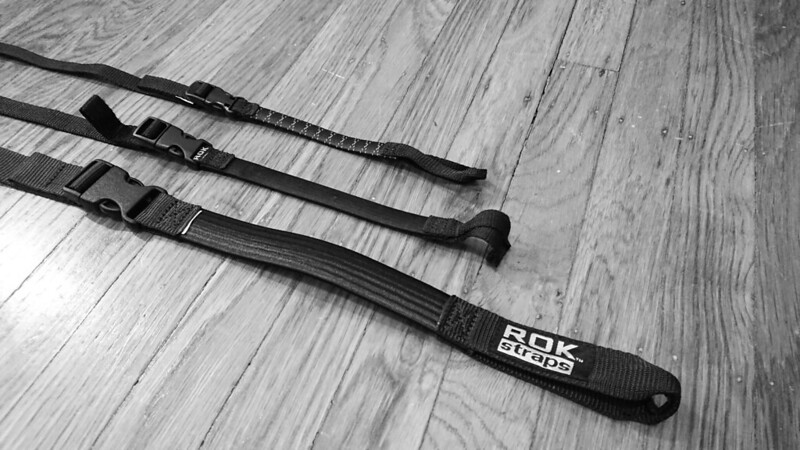
ROK Straps are superior bungie cords. They are designed to be safe and long lasting during prolonged outdoor use. Each end of the strap consists of a sewn loop, allowing it to be securely fastened to a wide variety of frameworks without concern for scratching or marring the surface, or for a hook coming released under tension and finding its way into an eyeball. Cargo secured by the ROK Strap is easily accessed via the side-release buckle. Most of the ROK Strap is simple webbing, adjustable thanks to the buckle. One side of the ROK Strap has a short segment of a durable natural rubber, giving the strap some elasticity, but not enough that unintended recoil will likely result in the strap finding its way into an eyeball. The rubber is contained in a polyester braid for UV protection and additional durability.

ROK Strap: Models

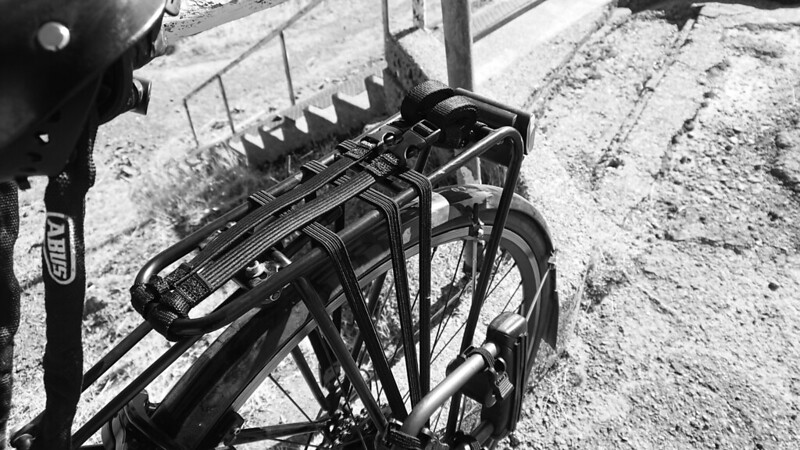
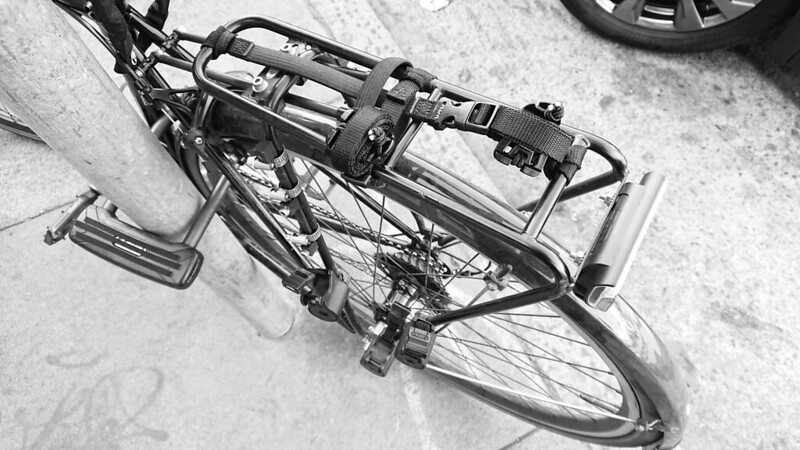
For securing cargo to a bike rack, my preferred model is the Pack Strap. These expand from 12” to 42” inches. They are 5/8” wide and are rated to carry up to 55 lbs. I find this is the right size for most cargo and have used it to transport: sleeping pads, folding chairs, toilet paper restocks, a year’s supply of paper towels, pizza, and takeout yakisoba.

  • ROK Straps: Toilet Paper Transport
  • ROK Straps: Yakisoba Transport

The smallest model is the Commuter Strap. These expand from 12” up to 28”. They are 1/2” wide and are rated to carry up to 40 lbs. If you just want to lash down a jacket or sleeping bag, these may be appropriate. They are long enough to secure common small cargo on a bike, but I would always rather have the extra range of the Pack Strap for handling awkward loads.

ROK Straps are also available in the ATV Strap model. These expand from 18” to 60”. They are 1” wide and are rated to carry up to 100 lbs. Apparently these are popular among people who ride motor-scooters. The 18” minimum length is too large for some of what I want to attach to a bike, and I’m not keen to carry cargo that would require the 60” maximum length. I saw a photo once of somebody who used these to attach a 45 gallon trash can to the back of his scooter. If that’s what you need to do, I guess consider these, but for what I find myself carrying I don’t need the extra length or weight rating of these over the 42” Pack Strap. This model stays at home in my bag of miscellaneous bondage.

The above measurements are of the ROK Straps when the rubber is at rest. When under load, all three models can stretch about an additional 4”.

The loose ends of the ROK Straps can be secured using either VELCRO One-Wrap or ITW Web Dominators.

ROK Straps: One-Wrap

ROK Straps: Web Dominators

Shoulder Mounted OC

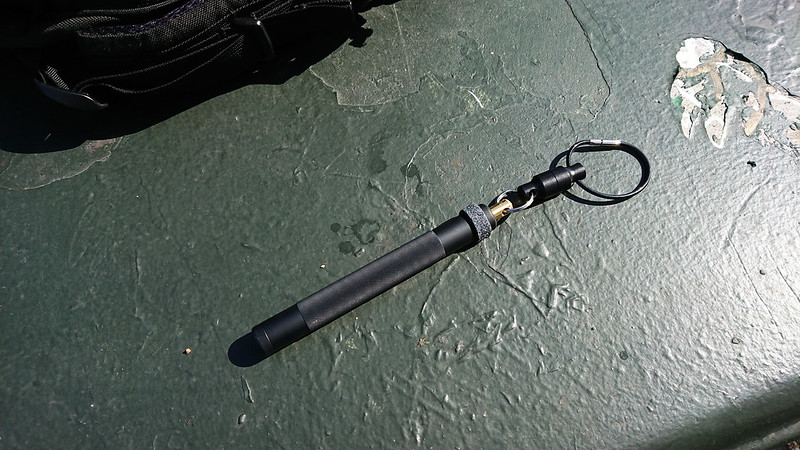
In 2014 I identified the ASP Defender series as the best pepper spray for my needs. I stand by this today, except that originally my preference was for the 4.5” Palm Defender. Over the years my preference has migrated to the 5.75” Key Defender. The Key Defender is in my pocket every day.

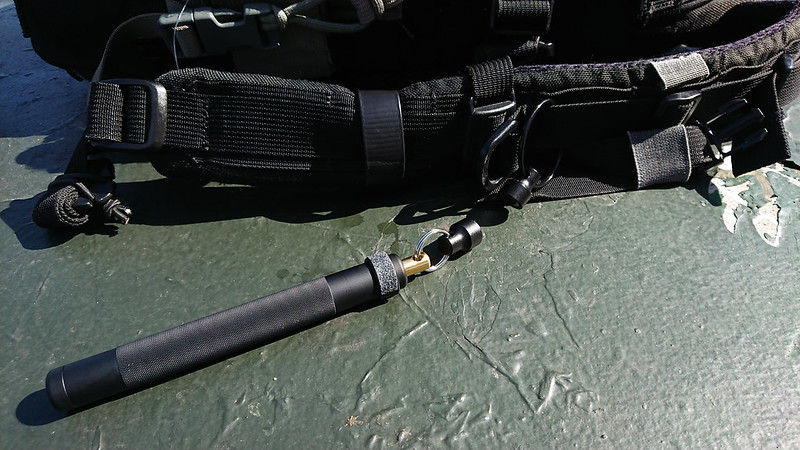
While I prefer pocket-carry for everyday, I’ve often thought about something that would allow for quicker access – especially on the bike. I’ve looked at a number of solutions for mounting a capsicum delivery mechanism to a bike, but never found one I liked. Instead, I ended up purchasing a second ASP Key Defender and mounting it to the shoulder strap of my backpack, which I wear frequently when in the saddle.

Shoulder Mounted OC

A small split ring connects the Defender to a magnetic clasp. This in turn is attached to a Lucky Line Flex-o-loc (the same thing I’ve been using on my keychain for seven years), which connects the whole setup to the webbing on my shoulder strap. To prevent the Defender from swinging around, I attach an IWB Soft Loop around the shoulder strap and shove the Defender through that.

The Soft Loop holds the Defender tight enough against the strap that it doesn’t spin around during daily carry. When mounting the Defender, I orientate it so that safety clasp (which I still cover with grip tape) is against the shoulder strap. This eliminates any chance of the safety somehow accidentally becoming released and the trigger actuating. It also keeps the safety in a known, consistent position when the Defender is drawn.

Shoulder Mounted OC

Enough of the shaft of the Defender is left below the Soft Loop that it can be easily gripped. It is deployed by simply ripping downward. The magnetic clasp breaks away and the top of the device slides through the Soft Loop. This is very quick and very easy to do, with either hand, even when wearing gloves.

Another neat benefit to the magnetic clasp is that it allows you to easily reattach the Defender, if you decide you quickly want both hands free. The magnet is strong enough that it will connect if you simply wave the top of the Defender within a couple inches of the half of the clasp still attached to the shoulder strap. This can be done without looking. Of course, the Defender will swing around as you move until you shove it back underneath the Soft Loop – a procedure which does take two hands and at least one eye.

Shoulder Mounted OC

I’m happy with this setup as a supplement to the OC carried in my pocket. It can move easily to different backpacks. It could probably be made to work with any pepper spray intended to be attached to a keychain, though it works especially well with the ASP Defender series thanks to the hammer grip used to deploy them.

Lawson Kline has been manufacturing high-quality outdoor equipment for about ten years.

He’s experimented with a wide range of products, and I’ve bought most of them. These days he’s known mostly for his cordage, which is unique and inovative, but cordage is not a topic I get overly excited about. I do get excited about stakes and Lawson’s aluminum Apex Stakes and Titanium Shepherd’s Hook Stakes are both probably the best on the planet. The titanium stakes are currently on sale, and he sent a description of how they are made to his newsletter today:

We cut, bend, and point each tent stake one at a time in our shop. I usually have to buy a very large quantity worth of Titanium, per diameter. And this is practically me begging them to sell to me. The mills I buy from require very large qty’s in order to sell to us, as they usually sell to big aerospace companies like Lockheed Martin, Boeing, United Technologies, etc, So it is very expensive to stock a product like our titanium stakes, as it is 100% an aerospace material.

The rods come to the shop in a wooden crate via motor freight. They are usually about 12 feet long. We first start off by using a rod parter to cut the stakes to length to get our blanks. If you have never seen one of these machines before they are very neat. It essentially breaks/shears the rod in a very clean and controlled manner. So they do not have to be saw cut. It’s like a sheet metal shear for round rods. Our rod parter will accurately cut rods from 1/16”-5/8”. There are two parting disc’s used to do all the of the work. They are made from hardened tool steel. So they are cutting like scissors so to speak, but the rod goes through a hole to keep the end round and to reduce the burr as much as possible. There is an adjustable stop on the machine that allows the first rod to be cut as the 10,000th one, with no real measurable difference between any of them. It is a highly precise machine.

Next, they are bent either one, two, or three at a time (depending on the rod diameter) on a custom made bender. This is a bender that I made myself over 10 years ago, and it has probably made 100,000+ tent stakes ever since. Last the stakes are pointed in another machine that I also custom-built. The stake is fixtured into a holder where it advances towards the cutting head and then puts a point on the end using a special end type mill.

There is no machine in the world that you could buy that could make a stake from start to finish, so I had to custom make two of the three machines to make these. This is the reason we are the only manufacturer in the USA making titanium tent stakes. (and probably because I am bad at bean counting…) I do know that it would be far more profitable for me to stock and sell Chinese stakes, but for me, the details matter. And I honestly love making custom machinery that can make products that not many other companies can. BUT as a result, this means I usually have way too many titanium tent stakes in stock as I have to make about a year’s supply at one time. Obviously, if I sold more stakes, then this wouldn’t be an issue, but since I don’t, this is the one product that I have a lot of my working capital tied up into.

Cloth masks are probably ineffective (at best) at preventing respiratory infection.

At worst, they may create a breeding ground for pathogens. A study of healthcare workers found that “moisture retention, reuse of cloth masks and poor filtration may result in increased risk of infection.” Stick with real N95 respirators, which may not look as hip, but do actually work.

Clothing provides shelter, cultural signaling, and the structure upon which other tools are carried.

I enjoyed EDC Part 0: The Individual Uniform at Swift, Silent, Deadly.

humangear capCAP+

Ten year ago I discussed the humangear capCAP. My conclusion was: the capitalization of the brand and product name is stupid, the cap itself is a good upgrade to any wide mouth (63mm) bottle, but it will allow a few drops to leak out of a wide mouth Klean Kanteen.

Recently I was made aware of a new model: the humangear capCAP+. This one adds silicone gaskets to both parts of the lid, and boasts compatibility with a wider range of bottles. However, humangear explicitly states that this one remains incompatible with the wide mouth Klean Kanteen.

I like to live dangerously, so I bought the new model anyway. For a couple weeks now I’ve been using it on the same Klean Kanteen Wide 27oz bottle used in the previous review. Despite humangear’s warning, I have had nary a drop leak out from the cap. I have tried to make the lid leak by filling the bottle and storing it on its side, and by balancing the bottle upside down on the cap, but no water has escaped.

humangear capCap+

Other changes in the new model include redesigned grip cutouts, which I find to have made no practical change to the functionality of the cap, and a cap retention thing that I thought would be kind of a gimmick but is actually surprisingly useful. (I will point out that the full name of this feature is the “humangear capCAP+ CapKeeper”. Someone at this brand hates English.)

humangear capCap+

The new model weighs 56 grams (2 oz), which is 20 grams (0.7 oz) more than the original capCAP.

I’m happy with the capCAP+. If you have the original capCAP, and it doesn’t leak on your bottle of choice, it probably is not worth upgrading. If it does leak, consider trying the new one. If you have neither model, but you use a wide mouth bottle and rely on something like the Guyot Designs Splashguard, the capCAP+ may improve your life.

The Casio Pro Trek PRW-3000-1A

I’ve worn the Casio Pro Trek PRW-3000-1A for the past 1,746 consecutive days. This is probably the longest I’ve worn any watch that doesn’t say “G-Shock” on it.

Obligatory Stereotypical Watch Shot

The Pro Trek performs all the basic watch functions you’d expect: it tells time, it provides the current date and day of week, it has a stopwatch, and it has a countdown timer. It supports a second timezone, which I usually keep set to UTC for quick reference but is useful if I’m briefly passing through a different region. It provides sunrise and sunset times for current, past and future dates. These are not exact, but tend to be within 20 minutes of reality, which is close enough for planning purposes. It has four alarms, which I never use.

Beyond those basic functions, the PRW-3000-1A has two characteristics that differentiate it from other timepieces. First, it is both solar and atomic: the battery never needs to be changed, and the time is always accurate. (Eventually, I’m sure, the battery will no longer charge itself, but that doesn’t seem to be imminent.)

The second characteristic is that it is an ABC watch, which means it provides an altimeter, barometer, and compass. Of these three features, the compass is the most useful. It works great for identifying the cardinal directions when you get turned around. It can also store bearings in memory, but using something other than a real compass for actual navigation strikes me as silly. The watch can be configured with declination, but I always leave this off so that the compass points to magnetic north. I apply this strategy to all compasses and GPS receivers, ensuring that they always agree.

The barometer is neat, but not especially useful. I have not found the current atmospheric pressure to be advantageous information. The watch can be told to monitor the barometric pressure over a period, and then alert the user if it sees a rise or fall in pressure, which would indicate a change in weather (very roughly: a rising barometer is good, falling is bad). This is more useful than knowing only the current value, but it only works when altitude remains constant.

The barometer screen also displays a thermometer, but because the watch is worn next to skin I find that this reading is not an accurate representation of ambient air temperature.

The altimeter mode is more useful. The reading is based on barometric pressure. The watch can either convert the barometer readings to altitude based on its stored values from the International Civil Aviation Organization’s International Standard Atmosphere, or it can calculate altitude based on a provided reference value. With the latter option, you tell the watch the current altitude (based on a map reading, survey marker, etc) and the watch then uses changes in pressure to calculate the difference as you ascend or descend. This is how I use the altimeter, and I find the results accurate enough for my purposes (which tend to be “rough navigation”).

The watch features a trip recording mode, where it will periodically record altitude readings and then report back with your maximum altitude, minimum altitude, total ascent, and total descent. I’ve never used this.

I’ve been using the same nylon band that I hacked together 4 years ago. It works great. I repaired it once with my expedition sewing kit.

The watch remains in excellent condition. The bezel is scratched, but that has no practical impact on its function. The face itself has managed to resist all scratching.

The buttons are more exposed than a G-Shock, and they will sometimes activate themselves if I’m doing something like pulling my wrist through a tight cuff. These accidental discharges happen rarely and are only a minor annoyance, but I do wish the Pro Trek was available with the thicker bumper of the G-Shock. (Casio does offer ABC G-Shocks, such as the Rangeman GW9400-1B. I’ve not looked closely at these, but they are probably worthy of consideration.)

Kikuo Ibe’s original G-Shock DW-5000 is the watch against which every other timepiece should be judged. Today I would appreciate the addition of solar atomic functionality, which is available in derivatives such as the G-Shock GWM5610. I purchased the PRW-3000-1A in 2015 for $200, which is a little over twice the common sale price of the G-Shock. I think this has been worth it for the added functionality. Unfortunately the PRW-3000-1A is no longer available. The current equivalent of it seems to be the PRW-3100Y-1. Casio’s list price for this model is $320, which is more than I think the watch is worth. If my watch was lost, I would happily purchase the newer model (or an ABC G-Shock) for $200. If they wanted more than that, I’d likely revert to the solar atomic G-Shock GWM5610 for $80-$100.