You are currently viewing all posts tagged with gear.

Impressions of the Preon P1

I use two Fenix LD20 lights mounted to my handlebars via Twofish Lockblocks as headlights. An old TAD-branded JETBeam Jet 1 MkII is mounted on my helmet. As a result, whenever I have my bike – which is the majority of the time – I have a light. When I’m not around my bike, I tend to be left in the dark. I do carry a Photon Freedom Micro on my keychain, which is a great little device, but no replacement for a hand-held torch. A more substantial light has not been part of my on-body EDC for a few years.

Last month I decided to change that. I wanted to find a small, unobtrusive LED light that I could carry in a pocket. My JETBeam helmet light is powered by a single AA battery. While the height on that light is about right, I felt the diameter was too large for what I had in mind. I decided to look for a light powered by a single AAA. Two options presented themselves: the Maratac AAA Rev 2 and the Foursevens Preon P1. They both have similar specifications and both seem to earn equally positive reviews. The Maratac light is less expensive and features a knurled body, as opposed to the Preon P1’s smooth body, which made me initially favor the Maratac. Unfortunately, both lights are twist-activated. One of my requirements for any light is that it can be activated with one hand. That necessitates a clicky tailcap.

A review of the Preon P1 on ITS presented a solution. The Preon P1 is compatible with pieces from the Preon P2, which is a double-AAA flashlight that does have a clicky tailcap. I could purchase a replacement Preon clicky tailcap and install that on a Preon P1 to get the light I wanted. The Preon P1 and the tailcap cost $45. That’s a lot for a small light, and quite a bit more than the $25 price of the Maratac light, but it would make for a system that fit my requirements. I chose to purchase the Preon.

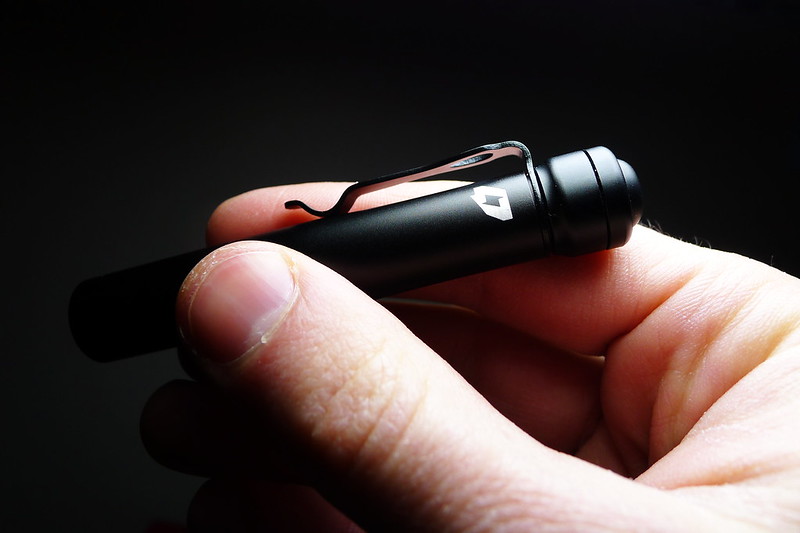
Preon P1

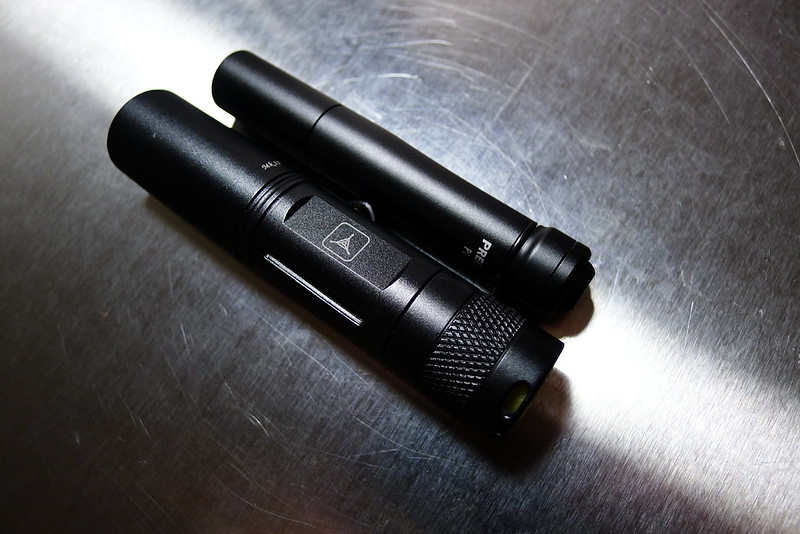
I have been carrying the Preon P1 for a couple weeks now. At a height of about 3 inches and a diameter just over half an inch, I can clip it in my pocket and completely forget that it is there until I need it, which is exactly what I was looking for. All the various modes of the light can be cycled through by clicking the tailcap, although I don’t particularly care about them – I only use the light with its standard output setting.

The clicky tailcap could be improved. I’m accustomed to tailcaps being inset into the light slightly. The Preon tailcap juts out from the top of the body of the light, which I think increases the chances of it accidentally being clicked on and draining the battery. It also has an amount of free movement in it. The button can be depressed about halfway before it actually hits the clicky part of the mechanism, which makes the button feel a bit loose. I don’t know that this affects the functionality of the tailcap, but it does make it feel cheaper.

Preon P1 (AAA) vs JETBeam Jet1 MkII (AA)

Despite the less-than-perfect tailcap, I’m happy with the light. The runtime isn’t incredible, but that’s acceptable for my use. I intend to use the light only as a backup to those on my bike. When the battery does die, I just throw it in the charger and install another Eneloop. If you’re looking for a small EDC light, the Preon P1 is worth consideration.

I've had a critical opinion of soft-shells for a number of years.

While I still maintain that their versatility and environmental appropriatedness is limited, I have been coming around to their use a bit more over the past year or so. I have a pair of pants that I am quite smitten with and have been considering giving a jacket another shot. Over at Cold Thistle, Dane Burns recently completed a series comparing different soft-shell jackets and their appropriateness for climbing. Now he has published a selection of reader comments that were elicited by the reviews.

I reviewed the Hill People Gear Kit Bag on ITS Tactical.

Read the review and then go give your money to Hill People Gear.

Kit Bag: Docked

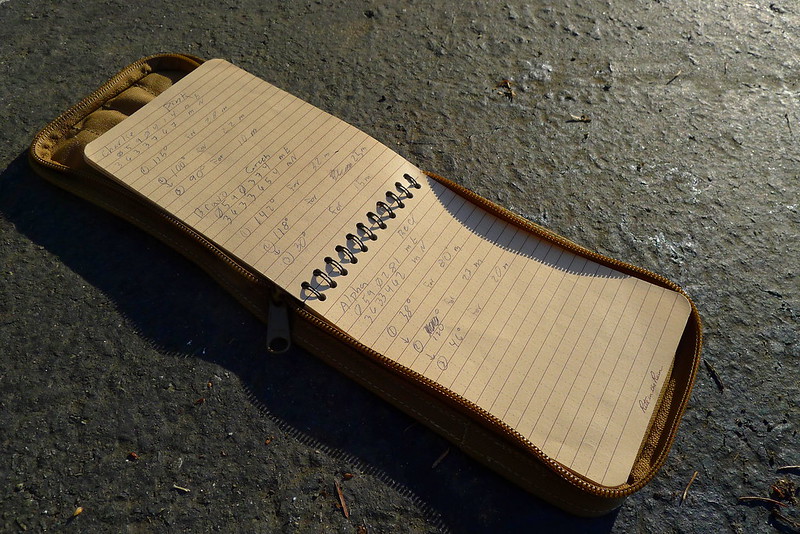
The Field Message Pad

My first experience with a field message pad was in 2005. I carried a Field Message Pad Cover by Canadian Peacekeeper – now CP Gear – filled with the Canadian military standard issue pad. I was introduced to the concept by one of the early episodes of Patrolling with Sean Kennedy. The idea of having a cover for one’s notepad, which not only protected the pad but also contained pens and the other tools necessary for a dead tree data dump, simply made sense. The system was a pleasure to use, but after filling my last Canadian pad in 2006, I left it in favour of more conventional notepads. The refill pads, being available only from Canada, were difficult to acquire, and all the cool kids were using Moleskines and similar products. I forgot about the old field message pad until this year.

I keep a box that holds all of my filled notepads. Last March I was digging through the box, looking for a particular note (sadly, you can’t grep dead trees), when I came across the Canadian pad and cover. I was reminded of the pleasure the system previously provided me, and the practicality of it. No more digging around for a pen – if you have your notepad, you have your pen. Need to toss your pad into the dirt to free both hands? No problem, it’s protected by the cover. I decided that I would like to revisit the system, but perhaps with a more commonly available pad, and a more mature eye brought to the market’s current offerings.

Graph Paper

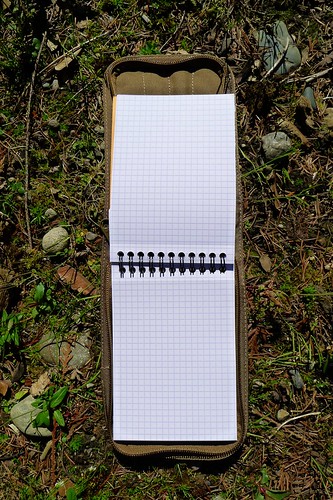
One of Sean Kennedy’s original requirements for the notepad was that the paper was gridded. I agree with that. Graph paper can be incredibly useful in certain circumstances, and the rest of the time holds no disadvantage for me. The original Canadian pads were gridded, but only on one side of the paper. That made the back of each page less useful, and seemed wasteful to me.

The size of the Canadian pad was acceptable, but a little larger than my ideal. Particularly when the cover was added, it made for just a little bit too much bulk and was sized slightly too large for some cargo pockets. I’d used plenty of the pocket-sized Moleskine notepads. Their size is also acceptable, but if I’m being picky: they’re just a tad too small. Ideally, I would like something sized in between the two.

My third requirements was the the notepad was top-bound. I prefer that over a side-bound pad, as I find them to be easier to access quickly. The binding should be spiral, as that allows the pad to lay open.

It’s a fairly simple criteria, but I was surprised at how difficult it was to accommodate.

The only pad I could find that met the requirements was from Rite in the Rain. Specifically, the 146 (or 946 or 946T for tacticool colors). It is gridded on both sides, is spiral bound on the top, and measures in at 4” x 6” – just slightly larger than a Moleskin, and a bit smaller than the Canadian pad. Rite in the Rain makes an excellent product. I always carry one of their pads when in wilderness environments, but I prefer not to carry them around town. Their waxy paper is unpleasant to write on. If I do not need to worry about the paper getting soaking wet, I prefer to carry a normal notepad. It makes the act of writing more pleasant, which encourages me to write more often.

The nice thing about Rite in the Rain pads, though, is that covers are readily available for them. Tactical Tailor makes a line of covers that Rite in the Rain sells. Maxpedition produces their own. The Tactical Tailor / Rite in the Rain cover for the 146 notepad is the C946. Maxpedition offers a similar cover. They looked great and encouraged me to revisit the notepad search, this time armed with a specific size: 4” x 6”.

Having the dimensions to narrow the search made all the difference. I quickly came upon the Rhodia 13500. It is gridded, 4” x 6”, and top-bound. The exact same as the Rite in the Rain 146, but with normal paper.

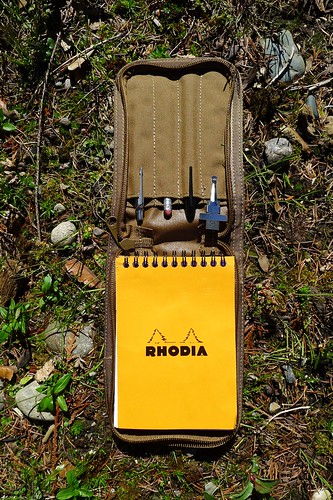
These findings allowed me to put together my new field message pad system: a Rite in the Rain pad, Rhodia pad, and a cover. I chose the Tactical Tailor cover simply because it is made about 60 miles from me, where Maxpedition claims that their covers are “imported”. With that cover and two identically sized pads, I could swap in whichever pad was more appropriate for my environment. Around town I carry the Rhodia pad. When I’m heading to the mountains I install the Rite in the Rain pad. Inside the cover I carry a pen (I’m partial to a Parker Jotter with a gel cartridge), a No. 2 pencil, a Sharpie, and a ruler. When I swap the Rhodia pad for the Rite in the Rain, I sometimes also swap the Parker pen for a Fisher Space pen, but in general I don’t like the way the ink comes out of the pressurized cartridges (and I already carry the pencil, which is field-serviceable and is able to write in inclement conditions just as well as the space pen).
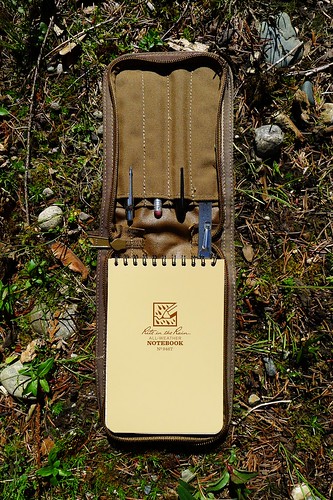
  • Rite in the Rain Installed
  • Rite in the Rain Installed: Open
  • Rhodia Installed
  • Rhodia Installed: Open

I’ve been using this system since April. It is both versatile and functional, and has proved itself perfect for my needs. It is large enough to write on without feeling cramped, and small enough to place in the cargo or ass-cheek pocket of my pants when running around the woods in the middle of the night setting up dead-drops. The cover, Rite in the Rain pad, ruler, Sharpie and pencil are all made in the US. The Parker pen and Rhodia pad are made in France.
Field Message Pad

Photo comparisons between this and the Canadian system are available on Flickr.
Dreaming of a Tactical Messenger Bag

I wish someone would make a tactical messenger bag.

Plenty of companies make what they claim to be a tactical messenger bag: 5.11, Spec-Ops, ITS, TAD, and Maxpedition to name a few. None of these fit the bill. Those bags are all what I would refer to as a side bag or a man-purse. I don’t use that term in a derogatory sense – they’re fine bags, but they’re not messenger bags.

For me, the defining characteristic of a messenger bag is that it designed to be worn on the back, not hanging down on one’s side. Timbuk2, Chrome, Seagull, and R.E.Load are examples of companies that make messenger bags. I want one of those bags, but with the excellent, so-called “tactical” features that the aforementioned companies bring to the market: appropriate use of PALS webbing1, ability to support concealed carry, a quick-access medical compartment2. (Oh, and velcro for my tacticool patches, of course.)

Try riding a bike with a tactical man-purse, and then try riding a bike with a messenger bag. It’s easy to see why anyone with “messenger” in their job title carries an actual messenger bag. The practicality of such a bag isn’t limited to just the bicycle market: try running, or performing any physical activity (particularly a violent one, as might be required by someone with “tactical” in their job title) with a bag flapping on your side. It doesn’t work. Some companies have tried to address this by adding a stabilizing strap to help lock the bag in place. That’s a fine addition, but it is no replacement for a bag that is properly designed in the first place.

I can’t recognize any advantages that the man-purse offers over the messenger bag. The messenger bag, on the other hand, offers distinct advantages over the man-purse.

Notes

  1. Don't try to reinvent the admin compartment. Everyone and their mother makes an admin panel. Just give me some PALS and allow me to mount to the admin panel of my choice to the bag.
  2. We'll agree that an armed citizen is more likely to need a blow-out kit than someone unarmed. Now just think how much more likely an armed biker is to need something of that sort!

The Micro SERE Kit

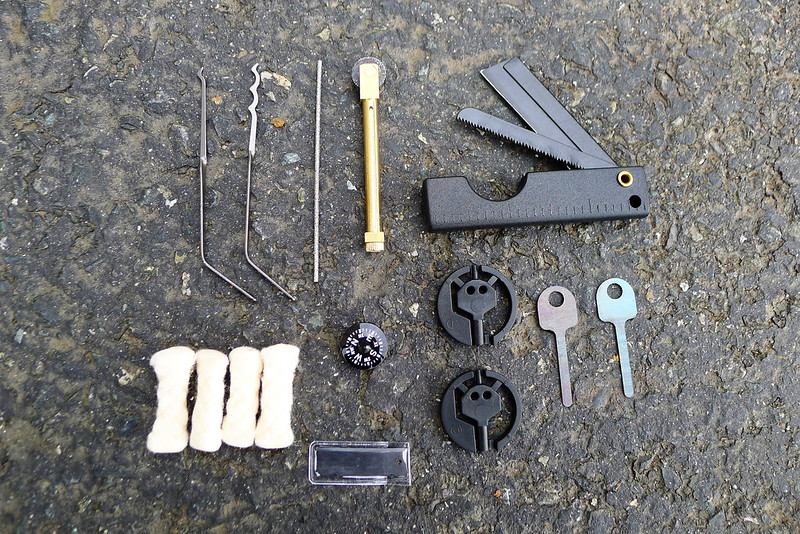
As I mentioned previously, there was quite a lot of swag given out to attendees of the ITS Tactical Muster. My favorite piece was the Micro SERE Kit put together by SerePick and Triple Aught Design.

Micro SERE Kit

Matt from SerePick donated a set of Bogota entry tools, a diamond wire blade, a folding tool that includes a saw and razor, a small button compass, two universal handcuff keys, two handcuff shims, a small ceramic razor blade, Kevlar cord, and steel wire. [The additional items were purchased by ITS for the kits, not donated by SerePick.] TAD Gear (who also provided two students, in the form of Brett, their CEO, and Anthony, their Art Director) added to this kit their brass Survival Spark and four Tinder-Quick tabs.

SERE Tools

TAD also developed a custom pouch to hold this kit. It’s similar to a bicycle tool roll, but on a smaller scale. The closure strap allows the pouch to be mounted to any webbing, whether it be a belt or PALS. I think it would be great to see this become a regular product, perhaps co-branded between TAD, ITS and SerePick, but for now the pouches are exclusive to alumni of the ITS Muster.

Micro SERE Kit

Nicholas has been detailing his bicycle touring gear.

I began to read his blog last summer, when he was riding from Anchorage down along the continental divide. It’s a great blog, and his gear is clearly heavily used and carefully chosen. Recently, he has discussed his cook kit, tools, luggage, clothing, electronics, and his bike and the changes it has gone through.

Sanyo Eneloop Rechargeable Batteries

I go through batteries at a fairly high rate. Electronic devices for the wilderness, such as my headlamp and GPS, see regular use. At home, things like my wireless mouse need power. The biggest drain are my lights – particular in the winter, when they are used to light my regular commute.

This last spring I decided to invest in a set of rechargeable batteries. Although some of my devices run on CR123 batteries, most use AA or AAAs. To start with, I was concerned only with being able to recharge the AA and AAA batteries. Years ago I had a set of rechargeable batteries, but I think the technology was not very developed back then. They seemed to drain quickly and not hold many charges. Today, the market is different. Some brief research showed that there were many options out there, with positive reviews for most of them.

What most reviews seemed to suggest was that the majority of the offerings were all of equal quality, with most differences unlikely to be noticed outside of a laboratory. The most popular, though, seemed to be the Sanyo Eneloop and Maha Powerex batteries. I found some claims that, between the two, the Eneloops held a charge longer while on the shelf.

I decided to try the Eneloop batteries, and purchased a package that included a charger, 8 AAs and 4 AAAs. The charger can charge up to four batteries at once, either AAA or AA, but it must be done in pairs. It cannot charge one battery at a time, or three. This has turned out to be an occasional inconvenience. I have some devices that use three batteries, and some that need just one. To charge the batteries for those devices I always have to give the charger an extra battery.

Sanyo Eneloop Charger

The charger takes around five hours to bring a dead battery up to a full charge. I have read that the Maha Powerex MH-C9000 charger can charge the batteries in a shorter period of time. It also gives the user more control over the charge, which has the potential of increasing the life of the batteries.

The batteries themselves I have been very happy with. I don’t have the knowledge to provide any objective information on their chemistry or electronics. Suffice it to say that they work. They seem to last longer in the same devices than their non-rechargeable counterparts did. I have not noticed any degradation in those batteries that I have recharged. That is not surprising. Sanyo claims the Eneloop batteries can be recharged 1,500 times – a number I have not come anywhere near to approaching.

Electronics Powered by Eneloops

Since the initial purchase, I have bought two more packs of AA and AAA Eneloops. All of my electronics now run on rechargeable batteries, save for those few that require CR123 batteries. The batteries themselves are an expensive investment, but they have payed off. Now that I have a good number of both AA and AAA sizes, and am happy with the Eneloop brand, I would like to purchase a more specialized charger, such as the aforementioned C9000.

If you use any non-rechargeable AA or AAA batteries in your electronics, I recommend giving Eneloops a try. The financial savings alone is enough of a benefit to justify their use.