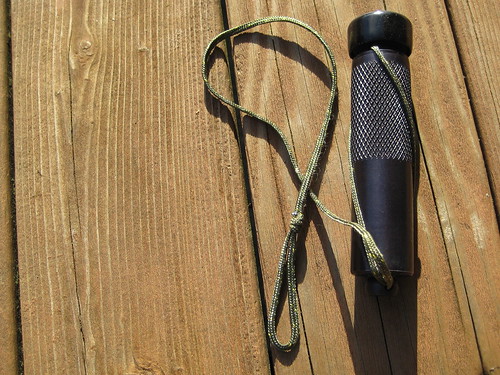
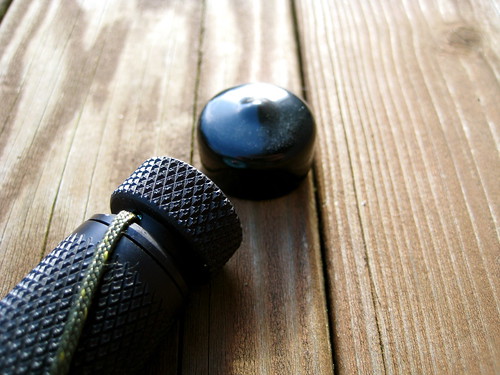
The K & M Industries Match Case has long been considered one of the top waterproof match cases available. Each case is hand made in the Elk River, Idaho garage of Keith and Marge Lunders.
The match cases are available in either brass or aluminum and come in two different sizes. The standard length cases are 3 7/8”, designed to fit 2 3/8” strike-anywhere matches. The long length cases, measuring in at 4 1/4”, are designed for REI Storm Proof Matches. Aluminum cases are available in black, silver, green, or red.
Last winter, I bought a standard length, black aluminum case. It has been part of my wilderness EDC for close to a year.
Though I don’t always use them, I always carry matches into the wilderness, in addition to at least one BIC lighter and a multitude of ferro rods. Ferro rods are my primary means of starting fire – usually with some synthetic tinder, such as Vaseline soaked cotton balls. It’s also my primary way of starting my alcohol stoves. If I’m not having luck with the rod, or all my tinder is wet, I can move to a lighter or a match to get the fire going. I’ve also found that when it gets to about 20 degrees Fahrenheit or below, denatured alcohol does not like to take a spark – instead requiring a match or lighter to start my stove.
A lighter is of course the easiest way of starting a fire, but because I carry a BIC lighter, it is not always dependable. If it was submerged, it will need some time to dry out before working. If there are high winds, the flame will no doubt get blown out. I have previously carried waterproof, windproof butane lighters, but those seem to eat through the fuel way too fast to be practical wilderness devices. It is difficult to justify the huge price increase in one compared to a BIC lighter. The other problem with BIC lighters is that it can be hard to determine how much fuel you have left. You can judge the weight, shake it around next to your ear and listen, but it’s a rough estimate at best. That’s what I like about matches: you can count how many you have. For this simple reason, I am sometimes likely to go to my matches rather than my lighter when I need ready-made flame.
Carrying the aforementioned REI Storm Proof Matches also addresses some of the other concerns of the BIC lighter: they will light when wet (if lit and then submerged, they will quickly relight themselves after you remove them from the water) and are nigh impossible to blow out. This makes them a great emergency fire source, but, like the fancy butane lighters, are relatively expensive compared to standard strike-anywhere matches. Because of this, I carry both: normal strike-anywhere matches for general use and REI Storm Proof Matches for when the elements are against me. The REI Storm Proof Matches, being pretty darn waterproof, aren’t in much need of a waterproof case (I imagine that they will get soggy and useless if they’re kept underwater for a long period of time, but if you accidentally take a bath during a river crossing and crawl out within a couple minutes, the matches should be fine). Strike-anywhere matches, on the other hand, do need extra protection. Hence why I decided to start with the standard size K & M case.
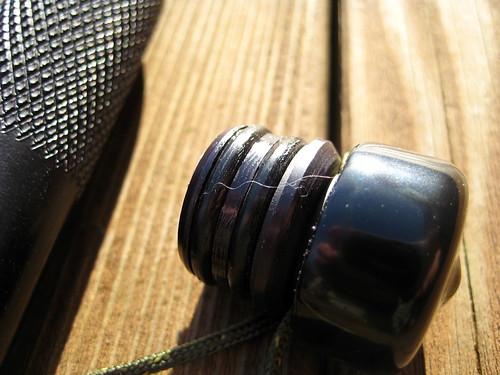
All K & M match cases feature a unique closure system. The lid itself has two o-rings on it to prevent any water leakage (guaranteed to 2000 psi of water pressure). It’s not a screw on lid, but simply pressed onto the case. After the lid is on, you then twist the cap, which in turn twists and tightens the thin nylon lanyard around the body of the case, ensuring that the fit remains tight. Ingenious, simple, and effective.
The body of the case itself is about 3” (not including the cap). The bottom half is smooth, while the top bit is etched with a pattern that ensures a good grip can be had on the case, even when you and it are soaked.
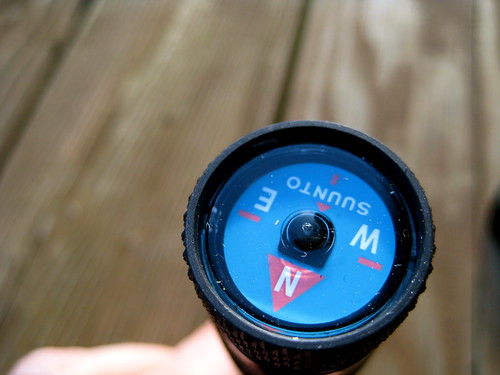
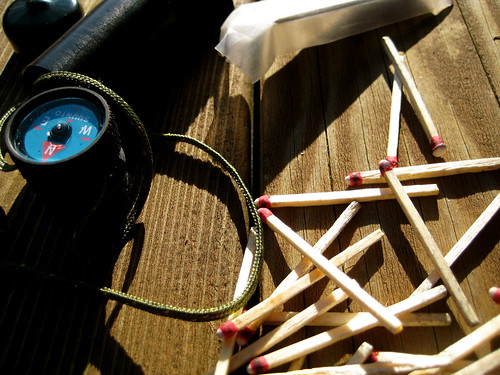
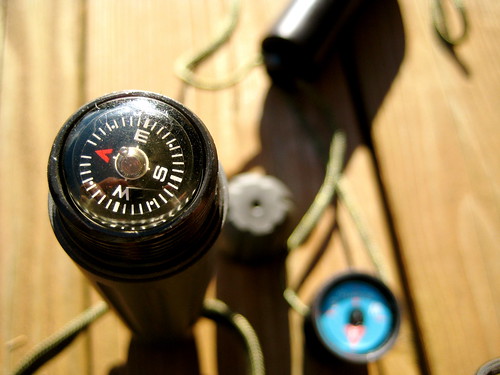
The top of the lid sports a small Suunto compass for general direction finding, greatly increasing the utility of the item. This isn’t some cheap, $1 knock-off button compass, either. Suunto compasses can be depended upon.
The outer rim of the lid has been etched in the same manner as the top half of the body for grip, but the case also comes with a small protective piece of plastic that slides snugly over the lid, protecting the face of the compass. With this installed, you loose the extra grip on the lid. This may be a problem in some conditions.
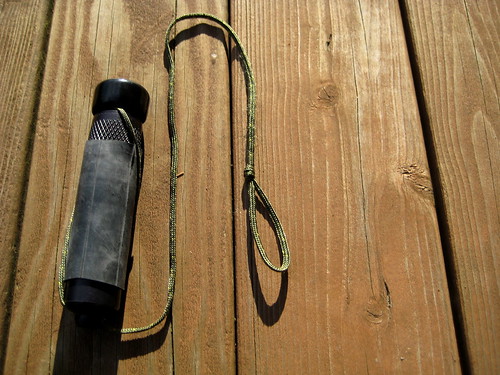
The lanyard, after it does its thing tightening the lid, extends down past the body of the case for about 12”, terminating in a loop, which allows the case to be securely fastened to your person.
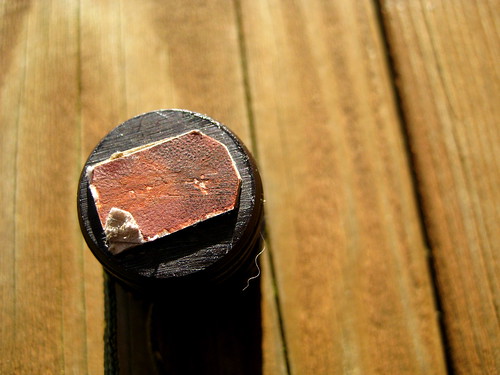
The inside of the lid is roughened, which is supposed to provide a surface for striking the matches. Perhaps I don’t know how to strike a match, but it’s never worked for me. In fact, as a general rule, I find strike-anywhere matches to actually be strike-anywhere-there-is-a-commercial-match-striking-surface matches. I never have luck attempting to strike matches on any old rough surface. But that’s not a problem: all REI Storm Proof Matches come with extra striking surfaces inside the box. They’re pretty heavy duty, work with all types of matches, and come sealed in plastic. I tend to collect them and stash them everywhere. For the K & M match case, I cut off a small piece that would fit on the bottom of the lid and super-glued it on. This guarantees me a working surface to strike my matches.
The rest of the striker I put back in it’s plastic cover and store in the body of the case, for use as a backup. The plastic prevents it from striking and lighting any of the matches.
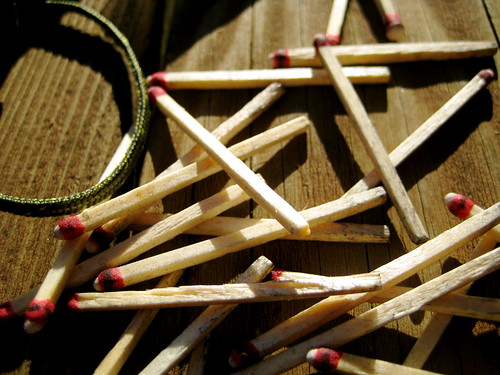
Because of the striking surface on the lid, I store all the matches tip down, so that they won’t accidentally light and turn the case into a bomb. With the the extra striker stored, I can jam in about 25 matches, give or take a few. You could fit in more if you removed the striker. The match case is also a nice place to carry a pre-threaded needle or two for emergency repairs.
Around the outside of the case, I keep a length of that same 700x35 bicycle inner-tube that I have around my BIC and a couple of my Moras. The inner-tube, along with matches that are guaranteed to be dry, gives me a sure-fire method of fire starting.
Both the brass and aluminum cases sell for $19 each. That may seem like a lot of money for a simple match case, particularly when you can pick up a cheap-o plastic one for $1.75, but I think it is well worth the money. The brass case looks a lot nicer and is more durable, but is a good deal heavier than the aluminum.
Some day I would like to acquire one of the long aluminum cases for my REI Storm Proof Matches, even though it is not strictly necessary.
I also own a TAD Gear Life Capsule O.K., which makes a good match case. The TAD Capsule is equally waterproof and also includes a compass in one end (albeit a cheaper one), but because of the significantly increased weight of the TAD capsule over the K & M case, I think the K & M is a superior product.
Another review of the case, along with some discussion of matches, can be found at British Blades. I thought I remembered Schwert doing a review of the case on the now defunct Outdoors Magazine, but I cannot find it in the archives.
My primary EDC knife for the past few years has been a plain-edge Emerson Mini-Commander. It’s a great little knife: an ideal size for EDC and extraordinarily tough for a folder. I’ve used it as a pry-bar a few different times on objects that I would be afraid to pry with some fixed-blade knives. The Mini-Commander is no worse for the wear.
Still, I’ve often thought that I would like to EDC a fixed blade. After all, despite it’s toughness, the Mini-Commander is a folder and that gives it some limitations. I’ve also found that the grind and shape of the blade is not ideal for some wood-working and wilderness survival tasks. Making feather sticks with it isn’t easy.
I have carried a small Nemesis Hellion around my neck most every day for the past couple years. It’s a fixed blade, but quite small. As I’ve stated elsewhere, I think of the Hellion as a novelty item and a fun toy more than a tool. It’s extremely concealable due to its size, but could by no means replace the Mini-Commander.
Folding knives are fairly common and tend not to frighten many people. Fixed blades, on the other hand, are not so common out of the wilderness and rural areas. Now, I’ll admit that I have no idea concerning the legality of carrying a fixed blade in urban environments. I tried reading up on knife laws a number of years ago and quickly gave up – they are so convoluted and contradictory as to be meaningless. And so, for me, they are. I ignore them. So far that seems to work out pretty well. I don’t seem to recall granting any government the right to regulate a tool such as a knife, anyways. Still, I do concern myself with other people’s feelings and, as odd as it is, some people feel nervous around folks with fixed blade knives strapped to their hips. Even something like a nice 4-5” bushcraft blade on the belt doesn’t seem to fly in a city. I needed something more concealable, but still of a size large enough to be of some use.
Two products immediately jump out as a perfect solution (well, three, but I can’t afford another Chris Reeve knife): the RAT Izula and the Becker Necker. Both knives are small and flat, which lends them to a number of different carry options, but large enough to function as utilitarian tools. The Izula is 6.25” over all, with a 2.88” blade and 3.37” handle. The Becker Necker comes in with a larger 3.25” blade and 3.5” handle for an overall length of 6.75”. For the slight difference in overall length, one would think that jumping on the Becker Necker for the larger blade would be the way to go. After all, that extra .37” of blade could equate to more utility. But in searching around the internet and reading a number of comparisons, it became evident that the RAT Izula was the favored knife. It seems to be the consensus that, comparatively, the Becker Necker has too little handle for its length of blade. I don’t consider my hands to be large, but they certainly aren’t small, and I know that having too small a handle could completely ruin a knife for me, regardless of the quality of the blade. So, I chose the Izula.
Izula Options
The Izula can be purchased in two different packages: either the standard knife and sheath, which RAT asks around $80 for (way overpriced) but can easily be got for closer to $50 (a reasonable price) or as part of a “survival kit”. The “survival kit” starts with the same knife and sheath, but also includes a MOLLE lock, paracord, cord lock, snap, split ring, ferro rod, and whistle. RAT asks $100 for this complete kit (crazy) though $60-$70 seems the going rate for most merchants. The “survival kit” did not appeal to me. I already have paracord, ferro rods, cord locks, and split rings. The only useful item in the kit seemed to be the MOLLE lock. I decided to save the money and get only the basic knife and sheath.
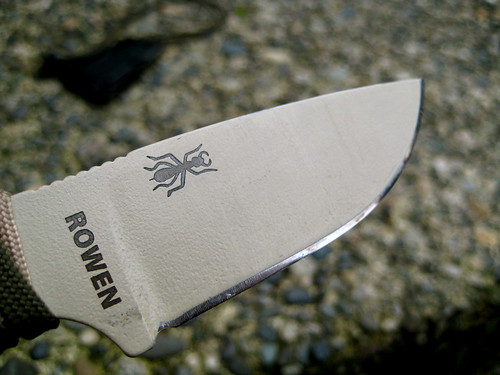
The Izula also comes in four different colors, which is a bit fun: black, desert tan, olive drab, and, best of all, pink. I was quite tempted to get the pink, especially given my concern over other people’s feelings of fixed blades. Who could be afraid of a man with a pink knife? But it turns out that I was able to find the desert tan knife for less money on eBay than I could get the pink knife for, so I went with tan.
Edge
The flat ground 1095 steel takes an edge very easily on my Japanese water stones. With the stones and a leather strop, I can get Izula as sharp as my high-carbon, scandi-grind, bushcraft blades. Scary sharp. In fact, the knife is very, very impressive in what it can do. Its only limitation is its short blade and, for longer sessions of use, the bare, skeletonized handle.
Handle
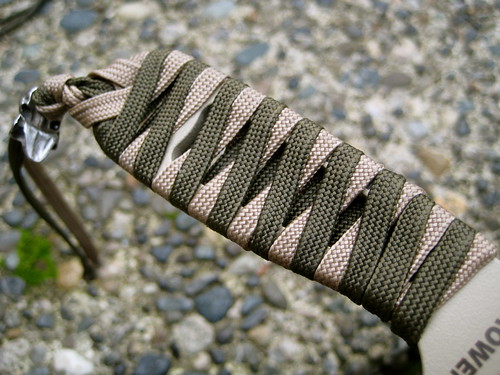
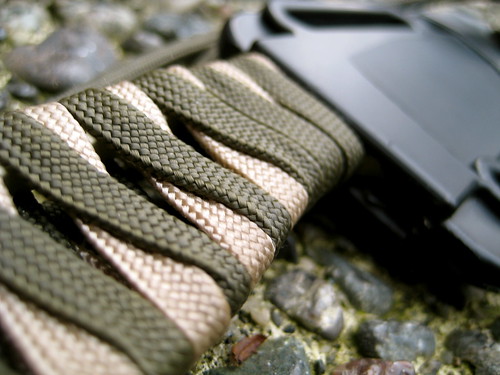
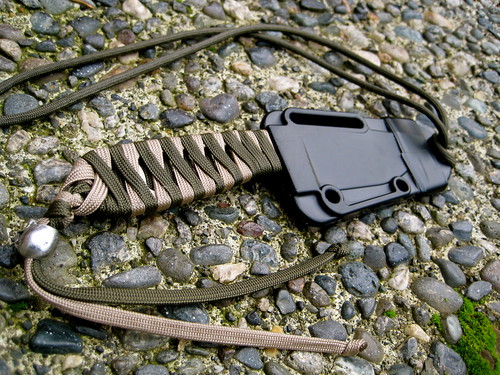
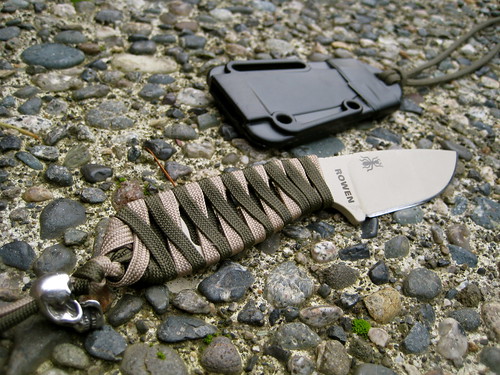
When I first got the knife, I took some olive drab paracord and wrapped it in the way instructed on the back of the Izula instruction sheet. The current paracord wrap that I have on the handle is a 180 degree katana wrap. I first did this with normal paracord, but found that it made the handle a little too thick, so I went back and did it again with gutted paracord. That worked out better, but, being gutted, the paracord does not add a whole lot of extra padding. At the end of the day, the katana wrap is more for looks. The wrap that RAT recommends is a more practical way to pad the handle and carry spare paracord, but it doesn’t look anywhere near as cool!
At the end of the handle, I finished the wrap with a simple overhand knot. I had a unused skull bead laying around, so I decided to leave the two tail ends of paracord a bit long and thread the skull bead through them. By sliding the skull bead to the end, I create a loop for my wrist. Rather than tying the ends of the cord together, I tied an overhand knot in each one separately, which prevents me from accidentally pulling the bead off, but also means that I can slide the bead to the top and just have two loose ends of cord, rather than a loop that will no doubt get caught on things. Honestly, I’m not a big fan of wrist lanyards on knives. I rarely ever use them. But I am a fan of skull beads. Like the rest of the wrap, this lanyard bit is on there just because it looks cool.
Sheath
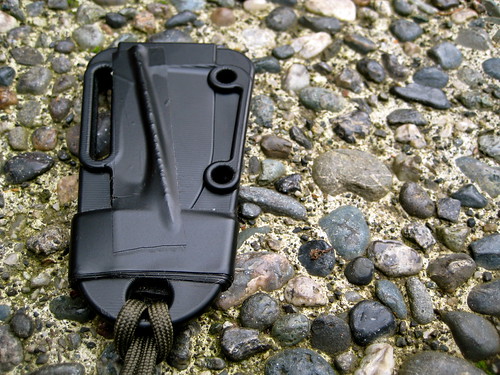
The sheath itself was the surprise in this whole package. It is some sort of “injection molded thermoplastic” that is supposed to be more cold tolerant than Kydex. I’ve never had a problem with Kydex in the winter, but apparently extreme cold makes the Kydex brittle and prone to crack. The fit of the sheath was what most impressed me. It is, without doubt, the best fitting sheath I have ever had for a knife. The knife pops right in there and is completely locked – no wiggling or movement what-so-ever.
Mods
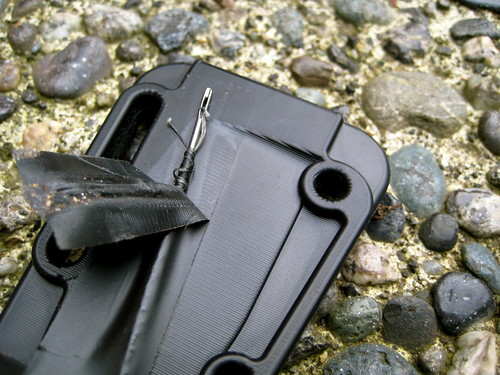
I’ve taken a size 14 sail-making needle pre-threaded with a length of black Kevlar thread and taped this to the back of the sheath with a piece of electrical tape. Dave Cantebury did this in a video on a Mora knife sheath a few months back. I thought it was a great idea.
It doesn’t add any noticeable weight. Even though I carry a sewing kit in my possibles pouch, I’ve since taped a prethreaded needle to the back of all my plastic knife sheaths. (Tape doesn’t stick too well to leather, so I haven’t figured out how to carry a needle on my leather sheaths). Around the bottom of the sheath, I wrapped a bit more electrical tape (I was out of 1” duct tape at the time). There probably isn’t more than 2 or 3 feet. It never hurts to carry extra tape!
Carry Options
Some people have complained about the sheath because it doesn’t come with a belt clip of any sort. This worried me as well. I wasn’t sure that I would want to carry it around the neck all the time and, since I didn’t go for the expensive kit that included the MOLLE clip, I did not know what other mounting options I would be able to come up with. It turns out that with only a cord lock (self supplied out of my repair box, since I didn’t get the “survival kit”) and a little over two feet of paracord, the sheath becomes remarkably configurable.
Neck Carry
To carry it around the neck, I simply slide the cord lock over both ends of the paracord, put the cord through the top hole in the sheath, and loop it through itself. The cord lock allows me to adjust how high or low it sits on my chest. As with the wrist lanyard, I put an overhand knot in each end of the paracord to prevent me from accidentally pulling the cord lock off, but refrain from tying the two ends of cord together. I don’t want to create a secondary, smaller loop on the back of my neck for things to get caught on when I adjust the cord lock up.
As I mentioned above, I initially thought that I might not want to carry the Izula around my neck. It’s a good deal bigger, heavier, and bulkier than the Nemesis Hellion neck knife that I’m used to. But I was pleasantly surprised. The profile of the knife is slim enough so that it can almost completely disappear under only a t-shirt. Unlike the Hellion, you are probably not going to forget that it’s there because of the weight, but it is by no means uncomfortable.
A lot of folks who carry a neck knife go on about the danger of using knotted paracord as a lanyard. Paracord is very strong. Someone sneaking up from behind could grab the cord and strangle the wearer rather easily. If this concerns you, you could use some weaker cord (or chain), tie a slip knot, or invest in some sort of break away device. Personally, I’m more concerned with the security of the knife around my neck (which sort of rules out slip knots) and I like the simplicity of this system. In the years that I have been carrying the Nemesis Hellion around my neck on gutted paracord, I have yet to be strangled. But it is something to be aware of – especially if you find yourself getting in a tussle fairly frequently. Do remember, though, that the paracord around you neck is attached to a knife, and knives cut things.
Front Pocket (TAD style)
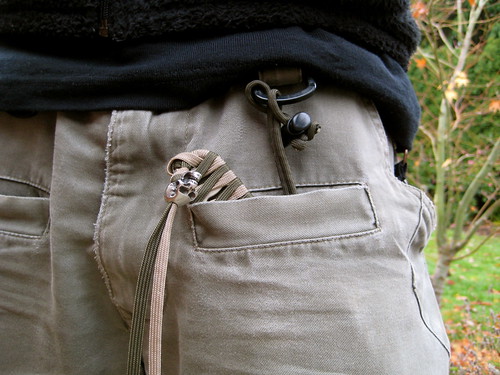
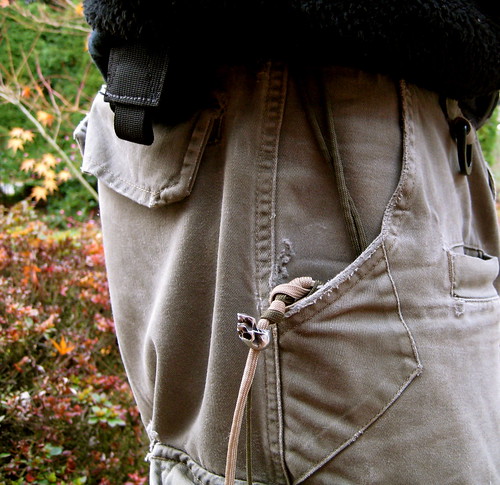
My favorite way to carry the Izula is in one of the two front pockets that Triple Aught Design places on their pants. In my Legionnaires, I carry the knife in the left front pocket. It sits in the pocket rather securely, with only the top half of the handle exposed, leaning to the right. This allows for a very fast, right-handed cross draw. I have the paracord and cord lock setup and attached to the sheath the same as in the above neck carry option, but in this setup I’ll put the cord through the plastic D-ring above the front pocket and loop it through itself so that the sheath and knife are securely attached me. Normally, when I draw from this setup, I’ll grab the handle and push against the sheath with my thumb, popping the knife free. But because the cord is attached to the D-ring, I can also just grab the handle and yank it to my right, extending the cord till it reaches its full length and pops the knife free. Personally, I feel that this is too obtuse a movement, so I prefer popping the knife free of the sheath with my thumb. If you prefer the latter option of yanking the knife, you could move the cord lock a few inches up the cord, thus shortening the distance you have to pull before fully extending the cord and popping the knife free. I will usually leave the cord lock all the way against the knots at the end of the cord and stuff the excess amount of cordage in the bottom of the same front pocket.
Side Pocket
As much as I prefer the above option, not all of us wear TAD pants every single day. When wearing another pair of pants, I will carry the Izula in the right side pocket, tip down. I found that most pockets are sized so that the tip of the sheath reaches the bottom of the pocket with only about the top 1/4” of the handle sticking out. Again, I keep the paracord and cord lock attached as before, with the cord lock slid all the way against the knots at the end, creating a big loop. This loop I run through my belt, guaranteeing the the sheath and knife are securely attached to me. To draw, I reach my hand in the pocket, grab the handle, and push against the sheath with my thumb, popping free the knife. I’m required to get my whole hand into the pocket to grasp the handle, which makes the knife slightly slower to draw than a folding pocket knife clipped into the same pocket (especially compared to an Emerson with the wave feature, such as the Mini-Commander).
Because the cord is attached to my belt I could just grab the handle and pull out or up, extending the cord till the knife pops free, but this is even more obtuse a movement than when drawing in the same manner from a front pocket. I’m not a fan.
Belt
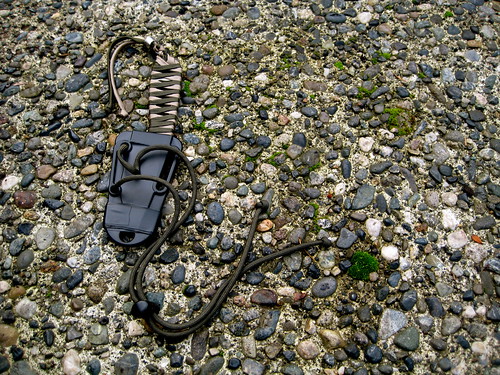
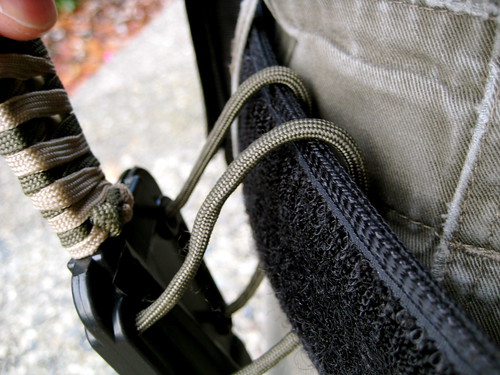
The paracord and cord lock really become useful when you decide you want to carry the Izula on your belt. The first step is to unloop the cord from the sheath. Then remove the knot in either end of the cord so that the cord lock can be removed. Next, thread either end of the cord through the two holes in the side of the sheath and the reinstall the cord lock, retying the same knot in either end of the cord to prevent the cord lock from being removed.
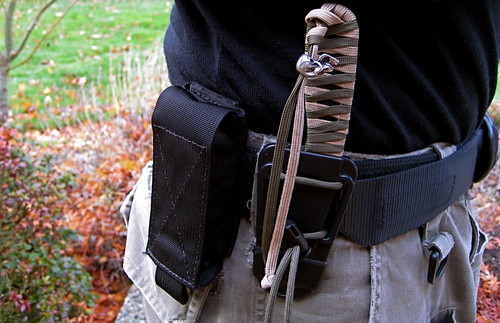
Move the cord lock about halfway up the cord, grab a bit of the cord and pull it through the large slit opposite the two holes on the sheath. What you now have on the front of the sheath is a line of paracord crossing the top horizontally and, on the bottom, the cord coming together horizontally to the cord lock. On the back of the sheath you have two vertical loops that you can thread your belt through.
With the sheath attached to your belt, you can then move the cord lock tight against the sheath, pulling as much paracord through the lock as you can. The Izula will then be mounted on your belt.
When I first saw this carry option pictured in the manual that RAT provides with the Izula, I was skeptical of using the paracord this way. I didn’t think that you could could get the paracord tight enough to eliminate any wiggling or movement. I’ve now carried the knife a good deal like this and I am perfectly happy with it. The sheath is just as secure as a sheath with a belt clip or malice clip (albeit easier to cut off). If you keep it attached to your belt consistently for a few days, the cord lock will eventually slide down a bit, loosening up the cord and causing the sheath to move a little when the knife is drawn. This can be addressed by checking the tightness of the lock once a day every time you put on your pants, which I don’t think is too much to ask.
The downside to this method is that, because we’re using the same piece of paracord as we use when wearing the knife around our neck, the paracord is necessarily long. You will have 6” or so or cord dangling below the lowest point of the sheath. This would be a problem if the two ends of the cord had been tied together, forming a loop, but because they have not been tied thusly, the two ends are loose and will not get caught on anything. They don’t bother me.
Spine
The spine itself is .156” thick, with about 1/2” of a grooved thumb ramp at the start of the blade. I’ve never found these thumb ramps to be necessary on any knife, but they don’t get in the way, either.
Initially, I found that I could not generate any sparks by sparking the spine of the Izula against a ferro rod. I know 1095 is high-carbon, so I figured it must either be the tan-colored paint that was preventing me from getting any sparks, or the corner of the spine was slightly rounded. To address both potential problems I set the spine flat on top of a coarse silicon-carbide stone and slowly ground down the first 2” from the tip. This removes the paint and squares off the edge, giving a 90 degree angle that should be ideal for striking sparks. With that change made, the Izula will throw a decent shower of sparks.
Overall
I’ve been EDCing the RAT Izula for just over two months now. So far, I have been extremely impressed with the knife. Unless I am for some reason forced to carry a folder instead of a fixed blade, I doubt that I will go back to carrying the Emerson Mini-Commander. Direct comparison between a fixed blade and a folder is not exactly fair since they have both been designed with different intentions and are markedly different tools, but I find the Izula to be a superior knife. If I woke up in the zombie apocalypse, I’d much rather find the Izula in my pocket than the Mini-Commander.
If you think you can get away with EDCing a fixed blade, I’d strongly urge you to consider the Izula. As I mentioned in the beginning, the $80 that RAT asks for the knife is overpriced, but it’s not hard to pick up an Izula for closer to $50, which I think is a very good value. (It’s certainly cheaper than a quality folder like an Emerson!)
Does the road wind uphill all the way?
Yes, to the very end.
Will the day's journey take the whole long day?
From morn to night, my friend.
But is there for the night a resting-place?
A roof for when the slow, dark hours begin.
May not the darkness hide it from my face?
You cannot miss that inn.
Shall I meet other wayfarers at night?
Those who have gone before.
Then must I knock, or call when just in sight?
They will not keep you waiting at that door.
Shall I find comfort, travel-sore and weak?
Of labour you shall find the sum.
Will there be beds for me and all who seek?
Yea, beds for all who come.
Christina Georgina Rossetti, Uphill
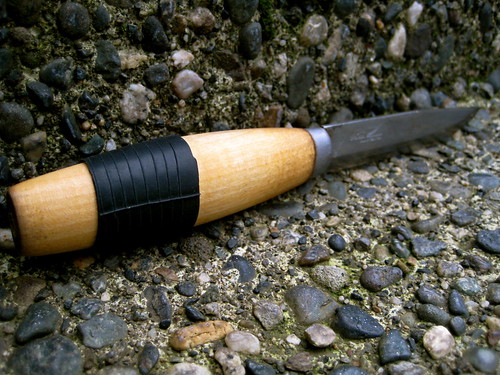
One of the pesky traits of the wooden handled Mora knives is their lack of grip when wet. One could acquire a Mora with a rubber handle, but, let’s face it: those are ugly. Instead, I cut a piece of 700x35 bicycle inner-tube about an inch wide and slide this just less than halfway on to the handle. The grip is immediately improved. If you were so inclined, you cut a piece the length of the handle and cover the whole thing, but so far it seems that this small piece is enough.
As with the rubberized BIC, this also provides another way to carry tinder that will work even when wet (though it will require a lighter or candle to start).
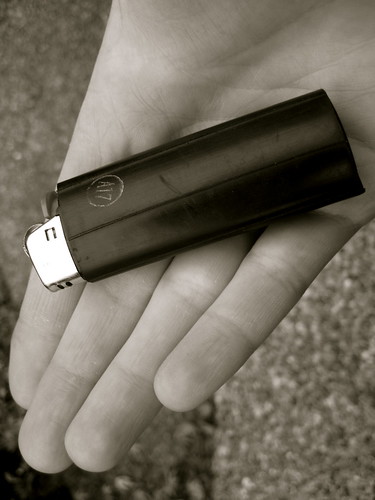
Here’s a neat trick I picked up from Dusty’s YouTube video. In the video, he shows how to use a couple of old bicycle inner-tubes to make a semi-waterproof pouch for a BIC lighter. That didn’t appeal to me too much: I always carry a BIC in my pocket and his idea added to much bulk for my liking. But, at the end of the video, he cut a smaller piece of inner-tube to make a sort of sheath for the lighter.
I thought that was a great idea. It gives you a nice, rubberized grip for the BIC and provides a simple way of always carrying waterproof tinder.
I’ve now cut off pieces from a 700x35 bicycle inner-tube and made this modification to all my lighters.
Linseed oil is a popular product used to coat and protect wooden handles on knives, axes, and other tools. I’ve tried it a couple times, but I’m not a big fan of the stuff. It takes multiple coatings over a long period of time to get a decent finish, it seems to rub off easily with use, and that whole spontaneous-ignition-of-linseed-oil-soaked-rags thing makes me a little nervous.
My preference is with Howard Citrus-Shield Premium Natural Paste Wax. I first stumbled upon this stuff in a hardware store while I was looking for linseed oil. The store didn’t seem to stock the oil, but the “Citrus Shield” can caught my eye. I remembered reading that Ragnar sometimes used some sort of orange-scented wax on certain wooden knife handles, so I brought the can home to try it out.
It turns out that the stuff works really well. All it consists of is a mixture of natural wax and oil. Initially, there is a very strong citrus scent, but this quickly wears off after application. I use it on all my wooden handled blades now, including the specially processed bamboo handle on the BCNW-O1 (which is supposed to be water resistant, but I found that it would swell some when damp before I treated it with the wax).
The application is very simple. The instructions on the can say to apply a thin coat with a clean rag, but I just use my fingers. After rubbing it into handle, I let it sit for 5 minutes before wiping it off with a clean rag. If this is the first time I’m treating the wood, I’ll apply and wipe off the wax about 3 times. After the final wipe down, I rub the handle with fine 0000 steel wool. I don’t put a whole lot of time or effort into this buffing, though. I’m not seeking a shiny finish, just practical protection.
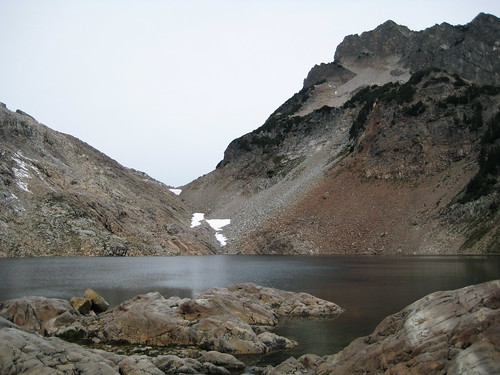
I ventured into Gothic Basin today, an impressive glacier carved wilderness of the Mt. Baker-Snoqualmie National Forest. It lies near what was once a mining area.
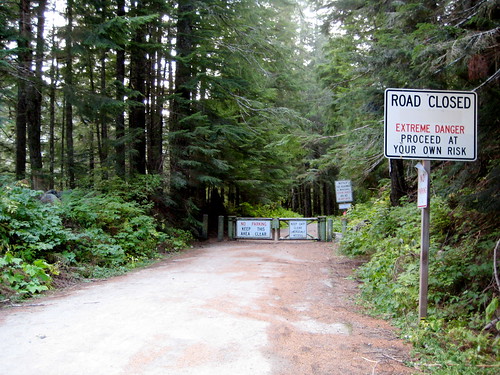
The way to the basin begins on the old, fenced-off road into the ghost town of Monte Cristo. This bit of trail is littered with signs warning of extreme danger, proceed at your own risk, hazardous materials such as aresenic in the soil, balrogs, and other such frivolities. I couldn’t see what all the fuss was about: the trail was wide, level, and well-maintained.
About 1.5 miles down the road, there used to be a bridge crossing over the Sauk River, but, some time ago, the river apparently found itself unable to suffer such indignities and washed the bridge away. At this point, my path branched off and began to climb its way to the basin along trail and old mining paths. The total elevation gain along this section is about 3,000 feet spread out over a good 4 miles or so, making it a steady, but leisurely climb – just enough to warm one’s self up on a crisp Autumn day.
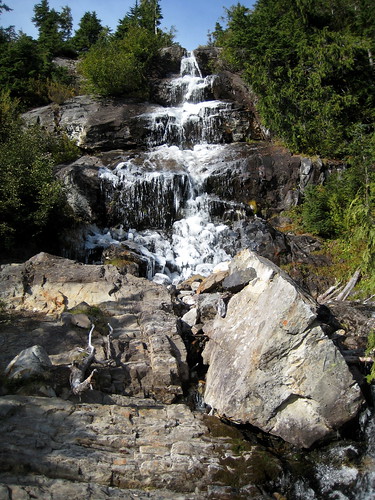
There are a number of small waterfalls that deposit their loads on the west side of the trail, allowing to the water to trickle across the path and make its way down to join the river. Earlier in the year I imagine that these crossings could be tricky, but the headwaters had frozen up by now, leaving these mostly dry. I’ve heard that one of these such falls has been wittingly dubbed “King Kong’s Showerbath,” though I saw nothing worthy of the name.
Some of the crossings higher up had not dried completely, but instead froze while crossing the trail, leaving ice covered rocks in my way. These rocks required some scrambling up, over and around, which was made interesting by the slippery ice. (I reminded myself that last Saturday’s body recovery had occurred only 20 miles east of here.)
Near the top, I stopped to munch on some granola, raisins, and dried banana slices. I did not don any further clothing upon stopping, however, and my break was thus cut short by the chill and the desire to warm up again. After resuming my walk, I pushed on over bare rock and soon thereafter found myself at a small tarn that marked the entrance to Gothic Basin.
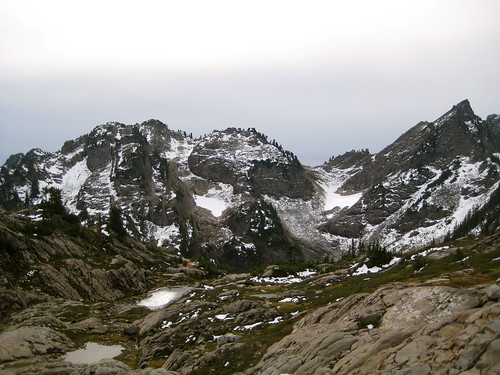
The basin is one of the more spectacular places that I have yet found myself in. In character it bears a striking resemblance to a Gothic cathedral, but larger and grander in scope, being carved out of the mountains over centuries by the minute movements of glaciers. A temple of rock.
My awe was quickly overtaken by another sensation: cold. The wind was strong up here, cutting through my clothing with ease. With windchill, the temperature hovered around 20 degrees Fahrenheit – a stark contrast even to the trailhead only 3,000 feet below, which had felt more like 45-50F. I took off my pack and put on two more light layers of wool. It was still cold. The lowlands have maintained themselves around 60F thus far which has not yet given me the opportunity to acclimatize to these lower temperatures. I also found that I had neglected to bring any gloves. No matter. The small tarn was partially frozen over and I wanted to make my way another half mile further across the rock to Foggy Lake to see how it was faring.
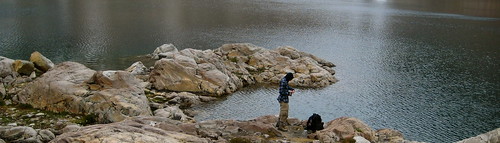
Foggy Lake proved to be moving, though I can’t imagine that it will resist the ice much longer.
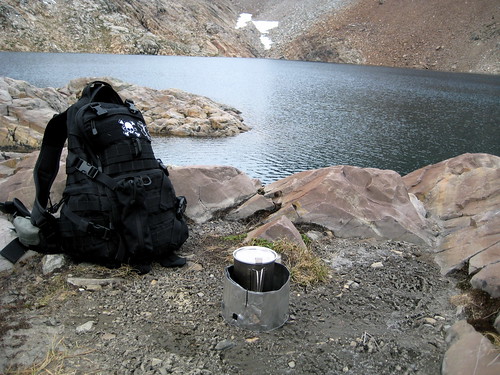
Standing by the cold water made me think of the packet of kukicha that I had in my pack. I had packed it, along with my old Vargo Triad XE stove, Trail Designs windscreen, and Snow Peak 700 mug. The package is not as efficient or versatile a stove as my Trail Designs Ti-Tri stove, but packs down much smaller. I often bring it on day hikes.
It was too cold for the denatured alcohol to light with a spark, so I used one of the matches from my EDC. Even with the screen around it, the wind blew the stove out once. I relit it and used my pack as a windbreak. As the tea brewed, I jumped around in place, trying to keep warm.
Soon I noticed blood on one of my finger tips: the skin had cracked from the dryness and was oozing a little bit. I tried to apply a bandage but it refused to stick. Must have something to do with the cold, I figured, and sliced off a piece of duct tape from the bit I have rolled around my Klean Kanteen. That held the bandage in place just fine.
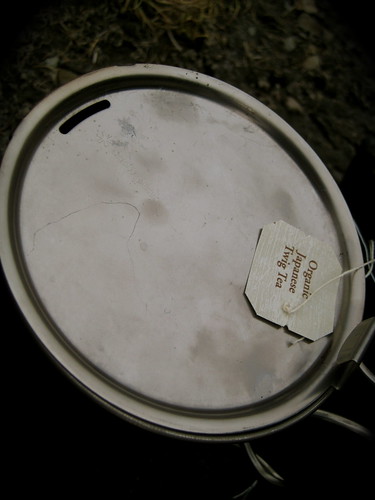
After the tea had steeped, I was cold enough to decide to pack up the stove and start making my way back down, drinking the tea as I went. With mug in one hand and a trekking pole in the other, I made my way back to the tarn, facing the icy south wind. Having downed the warm tea in a remarkably quick fashion, I decided to stop so that I could put the mug away and thus have one free hand to stick in my pocket to warm. I set down the pack and mug, digging around inside the pack for the small garbage bag that I carry, so that I could pack out the teabag. It was a bit tricky, not being able to feel anything due to numb fingers. In a minute, I found the garbage bag and opened it, then reached for the tea bag that was still sitting inside the mug. It had already begun to freeze to the titanium. I broke it free, tossed it in the garbage bag, and put bag and mug in the pack. I decided that things were starting to get a bit serious when I found that I had a lot of trouble closing the zippers on my pack. After donning the pack, I could stick one hand in my pocket to warm, but the other had to stay exposed to hold the trekking pole (which I needed even more on the descent than the ascent). Using the spare Buff I had in one of my pockets, I fashioned a mitten-like covering for the exposed hand which suited to block the wind. It really wasn’t that cold out: as soon as the fingers on both hands were out of the wind, they began to rewarm.
With that addressed, I continued the descent, making my way over scoured rock and through whispering trees back to the trailhead. (I slipped once on one of those ice covered rocks near the top, coming a little too close to the side of the mountain, but arrested myself and recovered.) The ascent took 3 hours and the descent 2.5.
Gothic Basin certainly warrants further explorations. Visually, it is one of the most stunning areas of the Cascades. I could easily spending a week just within the small area.
I have often thought about what I would do out here if I were stricken with a serious illness, if I broke a leg, cut myself badly or had an attack of appendicitis. Almost as quickly as the thought came, I dismissed it. Why worry about something that isn't? Worrying about something that might happen is not a healthy pastime. A man's a fool to live his life under a shadow like that. Maybe that's how an ulcer begins.
- Richard Proenneke, One Man's Wilderness
How does one hate a country, or love one? ...I lack the trick of it. I know people, I know towns, farms, hills and rivers and rocks, I know how the sun at sunset in autumn falls on the side of a certain plowland in the hills, but what is the sense of giving a boundary to all that, of giving it a name and ceasing to love where the name ceases to apply? What is love of one's country; is it hate of one's uncountry? Then it's not a good thing. Is it simply self-love? That's a good thing, but one mustn't make a virtue of it, or a profession... Insofar as I love life, I love the hills of the Domain of Estre but that sort of love does not have a boundary-line of hate. And beyond that, I am ignorant, I hope.
Ursula K. Le Guin, The Left Hand of Darkness