You are currently viewing all posts tagged with gear.

Navigation

One should always carry the knowledge and skill to navigate in your place. Always in my pack is a Silva Ranger CL compass – a light, compact compass, for which I can use to navigate either with the terrain or with a map. The compass is stored in a TAD Gear BC-8 pouch, which I picked up on my pilgrimage to TAD while passing through San Francisco earlier this summer. The pouch can be attached to my belt, pack, or any other piece of webbing, assuring the compass always has a place on my person, without taking up precious pocket space.

In the field, I also carry a Garmin Etrex Vista Cx GPS device. The GPS is unessential and shouldn’t be relied upon for primary navigation. Its error is larger than that of a compass; it depends upon a clear line of sight to the sky, making it more of a hassle than a help to use in forested areas; and, of course, it depends upon batteries. I’ve had one occasion this summer where the GPS insisted that North was South and South was North, implying either a sporadic pole shift or shaky satellite reception. My primary use of the GPS is the trip computer – the odometor, my moving time, my stopping time, my average speed, and elevation shift. I’ll also use it for a quick reading of my coordinates to get a rough idea where I am, and occasionally the Tracks program, which can be used to retrace my steps.

Always carry a map. USGS 7.5” topo maps are the best. On my backcountry trips here in the Park, I carry a minimum of 3 maps: a Tom Harrison Map of the entire Park, a Tom Harrison Map more specific to my location in the Park, and the USGS maps for each quadrangle I plan to walk through. The map I primary reference is the second Tom Harrison, which is clear and easy to read and has mileage printed directly on the trails. The USGS maps I carry for cross-country travel or in case I get lost. The large Tom Harrison map is carried more for a sense of place and planning other trips.

Learn to read a map. I’ve never had a class in the subject, nor read a book, but I’m confident in my ability to utilize a map. The best way to learn is practice. Here’s what to do: buy the USGS 7.5” quadrangle for the area you live in. If you live in an urban area, try to buy a quadrangle for a nearby park or forested area – someplace that isn’t flattened and paved. (But buy the maps for the urban areas too! I have the 7” quadrangles for the city I live in, covering my home and commute, taped on my wall, for exploration and post-Apocalypse survival.) Now take your new map and wander into the woods. Figure out where you are. Find a feature on the map, such as a hill or a ridge, and then find it in your place. How steep are the contours in real life? Here’s a hint: contours “V” upstream.

Even if you’re unable to triangulate your position or perform other minute calculations, you should have the confidence to read a map and have a rough idea of what that means in real life. A few weeks ago, a visitor came in to the Visitor Center in the Park while I was working. He was interested in a backcountry permit. After glancing at the map, he asked how much water he should bring. I hate giving someone like that a permit. If you’re unable to read the steepness of the trail and the locations of water sources, you have no business in the backcountry. And everybody should have business in the backcountry. So learn to read.

Pictures of my gear may be found here.

Revision Sawfly

Being a member of the genetically defective, it’s hard to find eyewear that both offers protection and allows me to see. Products from ESS, Wiley-X, and other top brands don’t fit my prescription. Frames from Oakley would kill my budget before even ordering the prescription. Most everything else in the big-wide-world-of-eyewear is concerned only with looks, not with that inevitable situation of a projectile flying at 1300 feet per second straight at you with intent to gorge your cornea.

This dilemma led me, after some time, to choosing the Revision Sawfly Military Eyewear System.

Sawfly with Rx carrier

At first, I thought the glasses had a definite I’m-going-to-kill-your-family look to them, but now I’m telling my self it’s just cyberpunk. (No word yet if Revision is planning to make mirror-shades.)

On top of the usual ANSI Z87.1 certification, the Sawflys are able to withstand a shotgun blast from 16 feet. Sure, if someone is firing a shotgun at your face from 16 feet, you’ve got other problems to worry about, but that’s quality.

There are three lenses for the system: smoke, “high contrast” (yellow), and clear. (Polarized smoke lenses, pictured above, can also be purchased). High contrast lenses, while certainly frightening the masses and screaming “shoot me first!”, are an important form of protection from advertising, mind-control, and other-world-entities.

The prescription insert is available for just $20 more. After hearing about Revision’s great customer service, I decided to take a chance and have Revision also fill my prescription. It took about 4 weeks for them to get it to me, and I’m just as happy with them as I have been with any lenses purchased from a local optometrist.

It’s too early for a review, but my first impressions are positive. The “regular” size, with the adjustable arms, is a perfect fit for my face. The coverage is excellent – my eyes no longer tear from cold air when screaming down hill at warp speed on my bike. As of yet, my only complaint is the large, plastic nosepad. It takes a little getting used to and, when sweating, I’ve found the glasses slip ever so slightly down my nose. Snapping on the included retention lanyard would fix this, but I would like to see Revision take the same rubber padding from the inside of the arms and adding this to the nosepad. I think this would increase both comfort and traction.

Nemesis Hellion

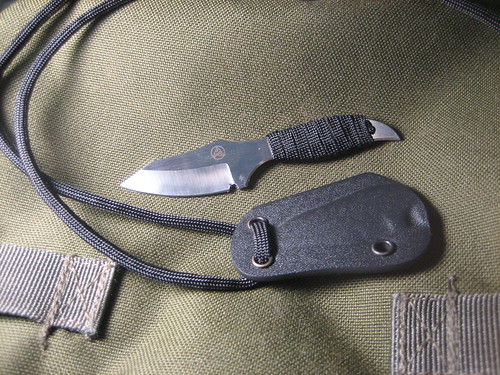
Last winter when TAD Gear had their holiday sale, I picked up a Nemesis Hellion.

It’s an nice little neck knife – though I don’t often carry it that way. I tend to tuck it away somewhere in my jacket, or sometimes a boot, as a last ditch resort for when all my other blades have receded into the void and the cardboard boxes are out for blood.

For when I do carry it around the neck, I replaced the chain with gutted paracord and wrapped the handle Atwood style (also with gutted paracord) to reduce the amount of cold metal touching my skin.

Unsheathed

The Kydex sheath is a tight fit. It takes a few wiggles to get the knife loose, and the blade often comes out with black specs cut from the inside of the sheath. (At least you can be assured the knife isn’t going to fall out and impale you in the toe.)

When it first came, the butt-end was almost as sharp as the tip. The next time I went out, I took a little sandstone to it and sanded it down.

Honestly, a knife this small doesn’t have much application (unless you’re Jack Bauer – I’m sure he could find a use for it). It’s more of a fun toy. I wouldn’t pay the $39.99 TAD currently asks for it, but if you can find it cheaper, it’s a well built blade and a worthy addition to any collection of Sharp Things.