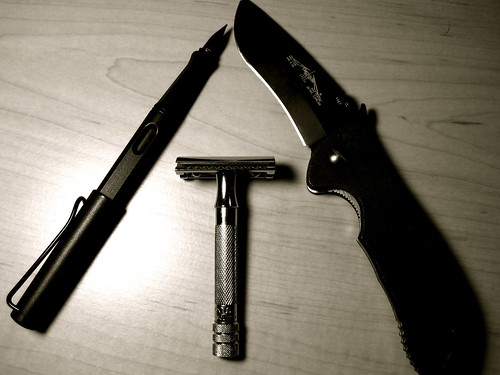
I love titanium. It’s so light, yet strong, and discolors beautifully when burned.
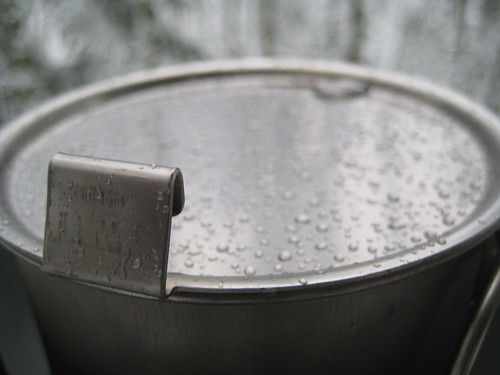
The Snow Peak Trek 700 has been with me on every foray into the wilderness for the past four years, and it’s still going strong. It’s my primary pot/mug/bowl, whether I’m cooking with a fire, canister stove, or alcohol. If I were to create a list of my top ten most valued possessions, I think this would be on it.
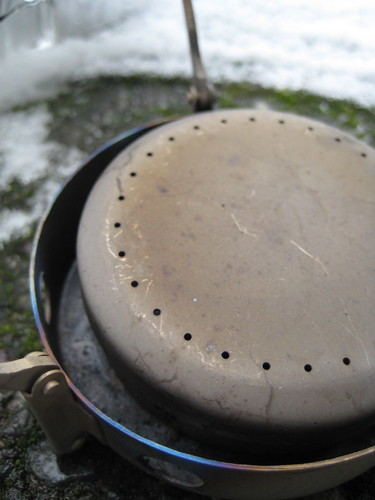
I’ve only had the Vargo Triad XE for a few months, but it’s quickly become my favorite stove. It’s far lighter and more versatile than the Esbit stove. I haven’t even looked at my Jetboil since purchasing the Triad. The stove burns both denatured alcohol and fuel tabs, giving it a wider operating potential than most stoves that burn only either one or the other. My experience with alcohol stoves is limited, so I can’t compare the burn efficiency of the Triad to its competitors, but I, so far, have zero complaints.
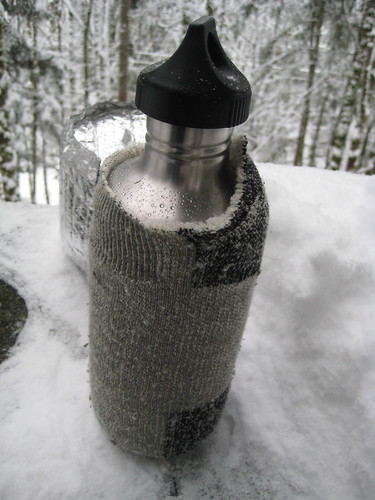
In one of my EDC photos last week, I showed that I carry a 40oz Klean Kanteen. I think the water tastes better from the stainless steel bottle than from a plastic Nalgene, and prefer carrying 40 ounces over just 32.
The main complaint many people express concerning a single-walled stainless steel bottle is that you can’t carry hot liquids in it. That’s not much of a detraction for me, since I have a different bottle for that. What does annoy me is that, in the cold, when the bottle is filled with cold water, the stainless steel can become too cold to touch without gloves. To address this, I took an old wool sock and cut it off at about the neck of the bottle. Instant insulation.
The only disadvantage is that the sock is just a little too thick for the bottle to nest inside my mug. Depending on how you carry the bottle, you might want to cut off a few inches from the bottom of the sock as well as the top.
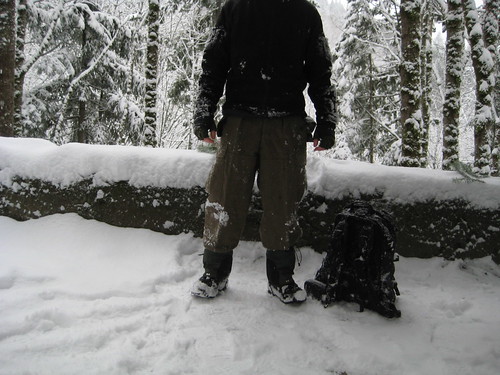
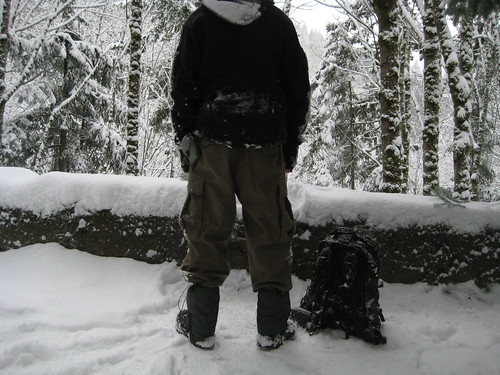
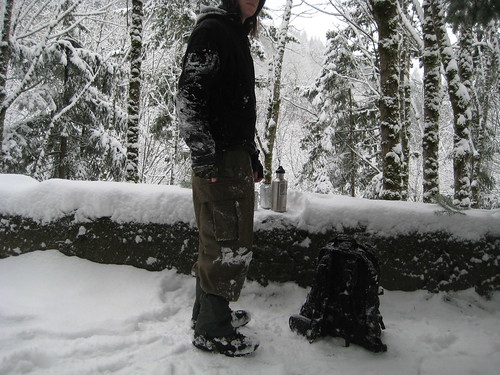
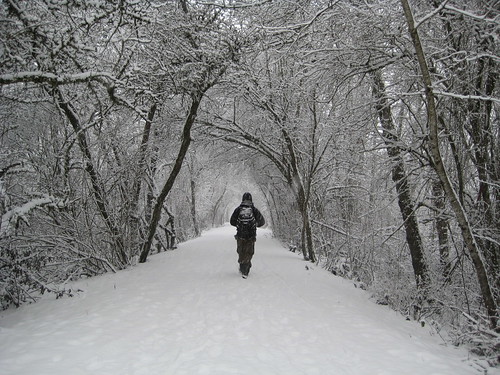
Winter arrived early last weekend, a week before the solstice. The daily temperatures have been hovering in the low 20s Fahrenheit (that’s somewhere around -5 for you centigrade folks), with high winds and plenty of snow. I’ve been out hiking every day, practicing winter fire lighting and taking advantage of the snow for tracking. It’s also provided ample opportunity to test out the wool pants I bought a few months ago.
They’re surplus from the West German army, circa 1976. I acquired them on ebay for $20.
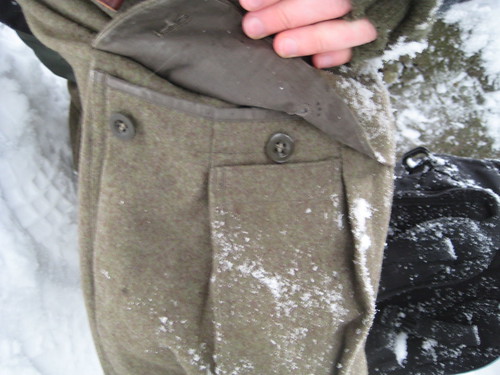
They have a standard 6 pocket design. The back pockets and two side pockets have button closure flaps. The cargo pockets have flaps with two button closures: one in the middle and one on the back. The front edge of the pocket flap is actually sewn onto the pants, which prevents the flap from, you know, flapping. It encourages the flap to stay closed, even when both the buttons are undone, providing for somewhat secure storage while still having instant access. On the outside of each cargo pocket is a smaller, 3” wide pocket with no closure. It was probably originally meant for a magazine, but is a perfect size for a cell phone or camera. It’s a little small for my compass or GPS.
The front of the pants is reinforced roughly 7” above the knee to 7” below. The butt is not reinforced
The crotch is closed via four buttons, rather than a zip. Buttons are easier to replace in the field, but makes access a little slower. Annoying when nature calls. There’s also a series of buttons along the waistband, both on the inside and the outside. Some of these can be used to make minute adjustments to the waist size, others just seem to be spares. In all, there’s probably about 10 buttons that could be salvaged to repair the crotch or pocket closures. On the inside back of the waist band, there’s also attachments for suspenders.
On the hem of each leg, there’s are snaps that allow the legs to be tightened and the excess material folded, useful for blousing the pants with boots or for wearing under gaiters.
I love these pants. I received them in new condition, and their worth could easily be placed upward of $60. My only complaint is the button crotch, which I would prefer to be zippered.
In the cold (and somewhat wet) snow, I’ve been staying perfectly warm and dry with these and a pair of merino wool long underwear worn underneath. In slightly warmer weather, I’ve found the wool to be soft enough to be worn without the underwear underneath. (I haven’t ever worn US Army surplus wool, but I’m told that the West German stuff is softer. I’ve also been told that wool from the former Eastern Bloc is the itchiest, and warned to stay well away from it.)
I’d recommend the West German wool to anyone. When passing someone on the trail decked out in plastic from head-to-toe, making that annoying swish-swish-swish sound as they walk by, you can chuckle to yourself, content in the knowledge that you are warmer, quieter and more comfortable in your wool.
I took some photos of my EDC pack today. I live in an urban area and commute on my bike, but I also use the pack during day hikes, so the pack includes an odd mix of urban, bicycle, and wilderness tools. All the items are identified by comments and notes on flickr.
The pack itself is a TAD Gear FAST Pack EDC, which is probably evident to most of you. It’s been my every day carry pack for a little over a year now. I’m very pleased with it.
The gear that I EDC on my person is probably more interesting. Maybe someday I’ll take pictures of that.
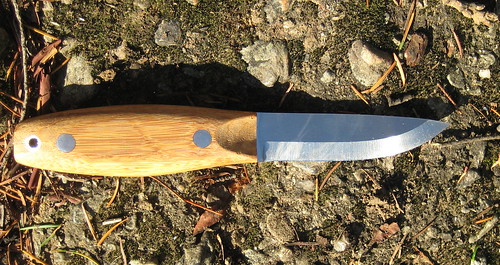
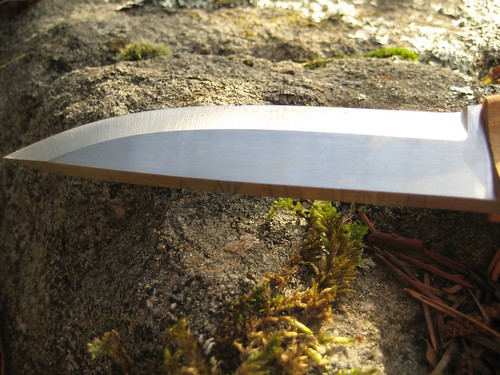
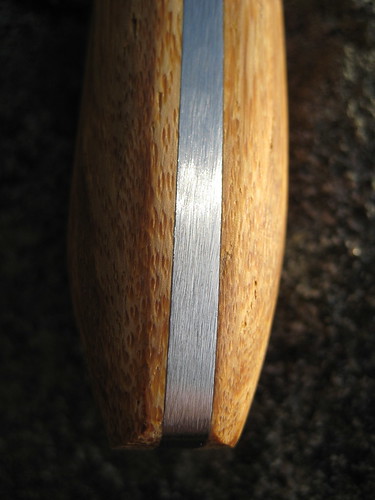
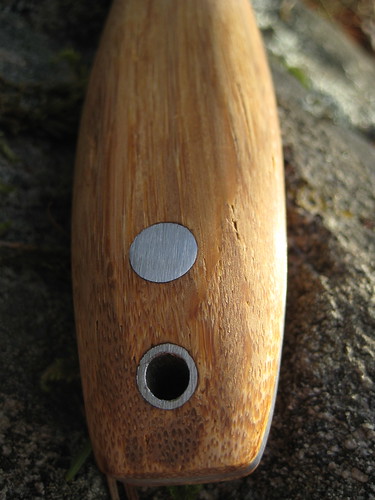
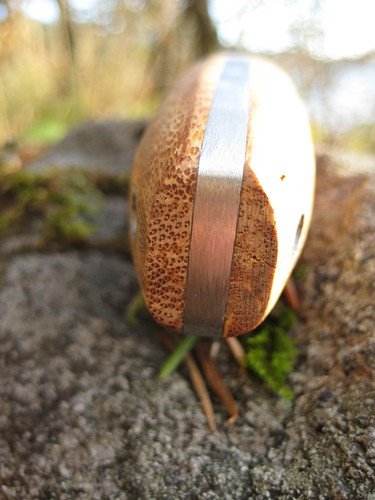
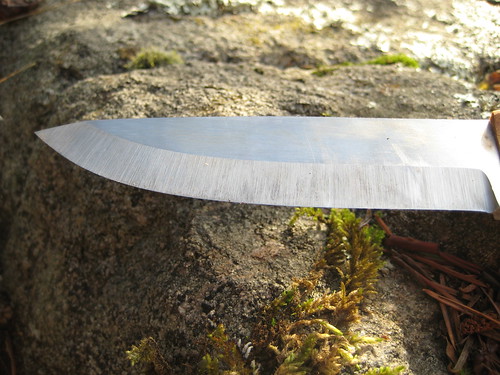
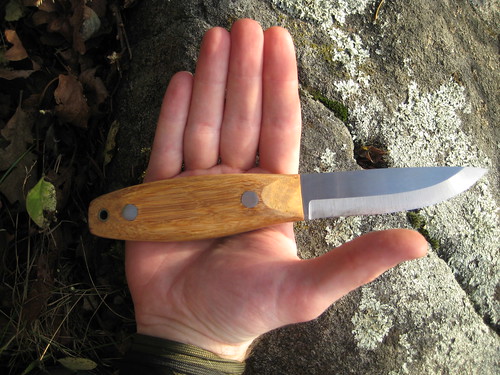
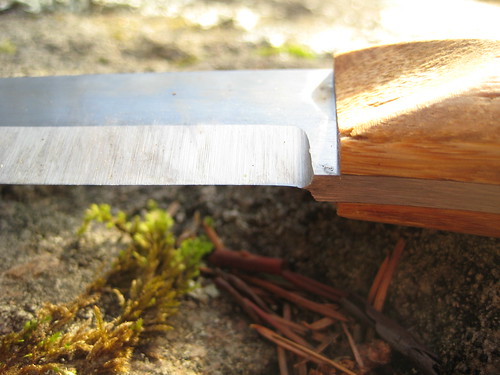
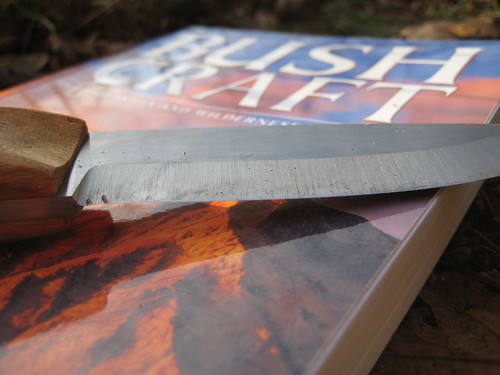
After a long wait, the end of last week brought with it the arrival of my new BCNW-O1 bushcraft knife.
In late August, I had put aside some money for a new bushcraft knife. For quite some time, I had had my eye on a Skookum Bush Tool. Yet, over the summer I discovered Mike Lummio’s Bushcraft Northwest through his YouTube channel. One of his videos features his knife, the BCNW-O1. It has a very similar design to the slightly larger Skookum, which make it difficult for me to decide which I preferred.
The knife was listed as back-ordered on Mike’s web page, so in the beginning of September I emailed him, asking when the knives would become available. My intention was that I would purchase whichever of the two knives became available first. Mike initially told me 2 weeks. That got delayed to 2 months, due to a batch of special order knives with a sharper grind coming in first and his moving the school to a new location. Still, it was available sooner than the Skookum, so I decided on the BCNW-O1.
It was well worth the wait. I couldn’t be happier with the knife.
(The plus side of the knife being back ordered is that the money had been sitting in a savings account, gaining interest since August.)
As the name implies, the BCNW-O1 is made of O1 tool steel. O1 is a relatively high maintenance material, somewhat soft when compared to other metals such as A2, and more prone to rust if not properly cared for. But the steel can be more easily sharpened to a razor edge than others, and can strike a spark off the backspine with a piece of flint (in addition to the more common ferrocerium rod). Because of this, O1 is quite popular in many bushcraft knives, including the famed Woodlore knife.
The knife is of the classic, Scandinavian design preferred by bushcrafters. The specs, taken from the product page, are as followed:
5/32" (3.9 mm) thick O1 tool steel
RC 59
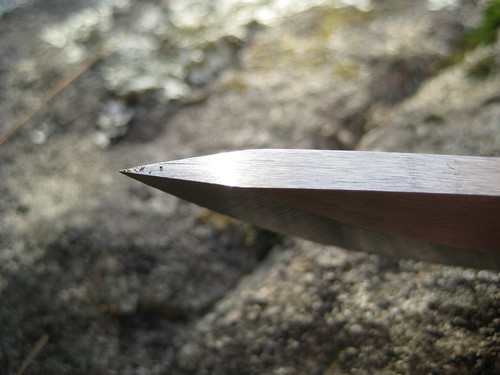
3 5/8" (9.3cm) Scandi grind blade (grind done by Daniel Koster)
8" (20.3cm) overall length
Full tang
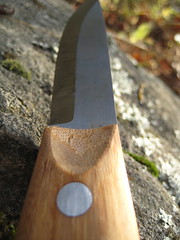
Perhaps the most unique aspect of the knife is the handle. It’s made of bamboo “that has been processed much like micarta. The individual fibers are separated and then bound together under pressure with an industrial strength, formaldehyde-free adhesive. This material can withstand 3,000 psi and is very resistant to the elements while being made from a sustainable resource.” The handle is very smooth, lacking the unique texture of micarta. It feels more like a normal wooden handle, which I love. One of the things that I don’t think is demonstrated very well by the photos on the Bushcraft Northwest site is the size of the handle. It’s a bit bigger and chunkier than what it looks like, which provides for a very comfortable grip. It fits perfectly in my hand.
(While Bamboo can be grown and harvested sustainably, many of the processing methods that go into turning it into clothing are extremely toxic and environmentally destructive. I have no idea about the process that goes into making this handle, but I don’t figure it to be any more environmentally friendly than micarta. Maybe I’m wrong, but I think you should probably avoid any synthetic or processed handle material if you’re concerned about such things.)
In addition the the handle material, the thumb scallops that are carved into either side of the handle are rather unique. This is an excellent feature that assists in certain carving grips, as demonstrated in Mike’s video.
The knife comes with a leather Scandinavian style sheath (available either with or without a firesteel holder) made by JRE Industries. I’ve used one of these with my Mora knives for a couple years and greatly prefer them over any other style I’ve tried.
Most any bushcraft knife made today owes its design, in some part, to Mors Kochanski. Though not as well known as Ray Mears, Kochanski in generally considered to be the father of modern bushcraft. In the spirit of Schwert’s introduction to the Skookum Bush Tool in Outdoors Magazine, I’ll introduce the BCNW-O1 with excerpts from the Knifecraft chapter of Mors Kochanski’s Bushcraft.
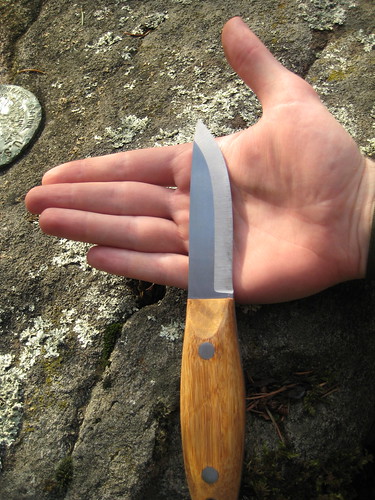
The general-purpose bush knife should have a blade as long as the width of the palm, although blades half or twice this length are within acceptable limits. A blade five centimeters long would be an excellent survival knife except for being too small to fall and limb trees of wrist-thickness. A blade 10 to 15 centimeters long will do intricate work like carving a netting needle, yet be large enough to present a good target for a baton when cutting down small trees. A blade 20 centimeters long is a superior tool for heavy work, but awkward to use for fine work.
All general-use knives should have the blade tip close to the profile centerline of the handle. The back of the handle and the back of the blade should be on the same line. The back of the blade should not be thinned down or sharpened so that a baton can be used more effectively without being cut up. There is no advantage to a two-edged blade in bush living.
The blade should be of a good quality carbon steel, from two and a half to three millimeters thick and about two to two and a half centimeters wide. This size of blade is light in weight, yet difficult to break. The steel should be soft enough to be maintained at a shaving edge with common sharpening tools, without frequent sharpening. Such steel is found in Mora (Sweden), Solingen (Germany) or Sheffield (England) knives. Carbon, unlike stainless steel, can be used as the striker in the flint and steel method of fire-lighting. Inexpensive stainless steels have had a bad reputation with respect to producing a keen edge let alone holding it. The Mora stainless steels however, are every bit as good as their carbon steels.
The metal of the knife blade should extend for the full-length of the handle (a full tang) for strength.
The handle should be a durable, water-resistant material that can be shaped to the user's hand if necessary.
The knife should have a strong pommel that will protect the handle if the knife is driven tip first deep into wood.
The curvature of the cutting edge should extend for the full-length of the blade. This cuts well and is one of the best shapes that quickly sharpens to a razor's edge. The knife blade should have a sharp enough point to penetrate deep into wood with a minimum of effort.
The knife handle should be about as long as the width of your palm. A handle that is too thick or too thin fatigues the hand and causes blisters. The cross-section of the handle should be an oval instead of round or rectangular. An oval handle provides an adequate indication of the direction of the cutting edge and raises fewer blisters than handles with angular or rounded corners.
A guard on a bush knife is in the way and detracts from many operations. It prevents the use of a simple, secure deep sheath. Some people prefer a guard for fear of slipping forward onto the knife edge, but unless the knife is used for stabbing, the hand should never slip in this way. In all my years of instructing I do not recall an injury due to the lack of a guard.
The BCNW-O1 clearly meets all of Kochanski’s criteria for the perfect bush knife, as well as introducing new innovations of its own. Though I’ve not had it long enough to perform a full review, I am extremely pleased with the knife. It has exceeded my expectations. I can safely say that I wouldn’t trade it for any other knife.
When I pulled the Green Superfeet out of my boots and attempted to install the new Sole footbeds to insure I had a proper fit, they were quite hard to insert – much harder than the Superfeet. I took them out and compared them with the Superfeet to see if they wanted trimming, but they appeared only a millimeter or so longer. They were, though, much thicker than the Superfeet – particular in the arch area – which was what, I deduced, made the fit a bit more tight.
So, I tried inserting them again, this time shoving them almost all the way in, then put in my feet to force the footbeds into place. I felt around a good deal to assure myself that there was no bunching at the toe, then took them out again and popped them in the oven.
Sole includes a sticker on the bottom of one of the pair that turns from silver to black when properly heated. They claim that 2 minutes in a 200F oven should do it, but that, if not, give ‘em 5 minutes, then assume the sticker is defective and stick the footbeds into your boots anyway. Well, it actually took 6 minutes in my oven at 200F. After the sticker had turned black, I stuck the footbeds into my boots, laced them up, and stood up straight, feet shoulder-width apart, toes pointed forward, for two minutes. The warmth was actually quite pleasant, particularly on a cold, wet day.
An aside on Superfeet:
I purchased my first pair of Green Superfeet last summer while working for the National Park Service. My footwear at the time was a pair of Merrell Sawtooth boots – easily the stiffest, most uncomfortable boot I’ve ever worn. Any more than 6-7 miles in those and my feet would start to develop an ache. And going over ridges: that was absolutely no fun. The boots were completely lacking in support during downhill endeavors – which, to be fair, was not entirely the boots’ fault. My arches aren’t completely collapsed, but I do have flat feet, which, as you may know, equals zero shock absorption. So when I traversed my way down a rocky slope in the Sawtooths, I felt it. Shortly after purchasing the boots, but long enough after that I felt I had broken them in as much as I could, I went out and bought the Green Superfeet. The difference was stark. Really quite amazing. They were hard and awkward for about the first week, but after that break-in period, the Superfeet turned the Merrell Sawtooths into completely acceptable boots. I could log far more miles, over any terrain, with any slope, all without ache. They were great. When I left the park, I bought a second pair of Superfeet, this time for my 5.11 HRT boots, in the hopes that I could breathe a little more life into them. Alas, it was for naught. Even with the Superfeet, I had to admit to myself that the 5.11s were at the end of their life.
While I would certainly call the Superfeet supportive, I’m not sure I’d term them comfortable. And in fact, Superfeet claims that the insoles should not be comfortable. If it felt like one was walking on a soft mattress, the insoles wouldn’t be giving the feet any support. I don’t know much about feet, but the argument makes sense to me. Personally, while moving with the Superfeet, I had no complaints, but standing still for more than a few minutes, they would start to become noticable uncomfortable. Not painful, but uncomfortable. The discomfort originated in the arch area of the footbed, which I felt was too high for me. A bit like if I had a small ping pong ball or somesuch under my arch. Again, I don’t know much about feet, but this made complete sense to me. My feet are flat, thus I have very little shock absorption. The Superfeet provide shock absorption, thus they must be pushing up my arch. So I couldn’t, and still can’t, complain.
While I’m here, I’d like to make a comment on Superfeet sizing. My boot size is a US 9.5. Superfeet classifies their insoles by letters. Their size E equates to shoe sizes US 9.5-11. I’ve used size E Superfeet in three different pairs of boots (all size 9.5), and it’s always been a perfect fit. No trimming necessary. Great for me, but if you happen to be size US 11, I’d be a little weary. Definitely buy them from a store with a decent return policy, as you may find yourself wanting to upgrade to size F.
But when I heard about Sole, who made footbeds that actually molded themselves to the wearers feet, and that wearers often termed them as not only supportive, but comfortable, I was intrigued. I thought perhaps they could reach a pleasant medium between pressing up the arch for support, but not pressing it up too much.
Back to Sole:
After the initial 2 minute molding process, I walked around them a short while. An immediate, very stark difference from the Superfeet was evident. The Soles were, in fact, comfortable. The level of comfort worried me, actually. I feared they wouldn’t give me any support what-so-ever.
I have by now logged enough mileage, over enough terrain, under enough of a load to over a verdict: thumbs up. The comfort, compared to the Superfeet, allows me to to travel slightly greater mileages in the same boots than before.
I still keep the Green Superfeet in my running shoes, but I, personally, find the Sole footbeds superior. I would caution that feet are extremely variable, and the merits of both Superfeet and Sole are strong, but, it would seem, complimentary to different foot types. Experiment!
There is absolutely no reason not to purchase a pair of non-standard insoles for your footwear – even with good boots. The thin, non-supportive, flimsy things that manufacturers include standard cannot match a custom pair. I expect the majority of those reading this site probably recognize their feet as extremely valuable assets, and are not unaccustomed to spending uncommonly large sums of money on a good pair of boots and socks. So do yourself a favor, take the next step, and buy decent insoles. There is little less valuable in this world than mobility, and, whatever brand they may be, custom insoles will allow you to go harder, better, faster, longer.
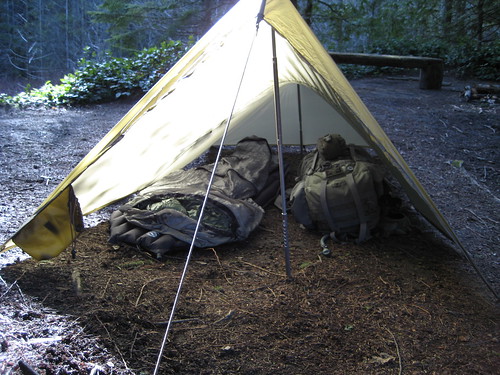
Saturday’s forecast was for 67F and sun. I’d forgotten what anything above 55F felt like, so I loaded up my ruck and hit the trails. My new Kifaru Parahootch came along for its first night out.
I’m out in this area most weekends, but hadn’t been to this lake before. It was great. Surrounded by a lot of new growth, and only a 13 mile hike. There was even a bench by the lake where I chose to make camp.