You are currently viewing all posts tagged with micro.

I soak produce in a solution of baking soda.

A study from the University of Massachusetts found that a baking soda wash can be effective at removing pesticides from the surface:

Surface pesticide residues were most effectively removed by sodium bicarbonate (baking soda, NaHCO3) solution when compared to either tap water or Clorox bleach. Using a 10 mg/mL NaHCO3 washing solution, it took 12 and 15 min to completely remove thiabendazole or phosmet surface residues, respectively, following a 24 h exposure to these pesticides… This study gives us the information that the standard postharvest washing method using Clorox bleach solution for 2 min is not an effective means to completely remove pesticide residues on the surface of apples. The NaHCO3 method is more effective in removing surface pesticide residues on apples. In the presence of NaHCO3, thiabendazole and phosmet can degrade, which assists the physical removal force of washing. However, the NaHCO3 method was not completely effective in removing residues that have penetrated into the apple peel. The overall effectiveness of the method to remove all pesticide residues diminished as pesticides penetrated deeper into the fruit. In practical application, washing apples with NaHCO3 solution can reduce pesticides mostly from the surface.

I use a dish washing basin with a drain filled with 6 liters of water (I’ve previously placed pieces of tape on the side of the basin to indicate water levels for 2, 4, 6, and 8 liters). The study’s 10 mg/mL NaHCO3 washing solution translates to 60,000 mg of baking soda for this amount of water, or about 4 tablespoons, which I dump in and swirl around a bit. Then in goes the produce. After 15 minutes I can just pull the drain, blast everything with some pressure from the faucet, and let it sit in the basin (with drain open) to dry until I get around to putting everything away. It is most important to perform this process on the Environmental Working Group’s Dirty Dozen, but the procedure requires such a low amount of effort that I soak any produce which is lacking a thick peel (like oranges) as soon as I get back from the market, regardless of its providence.
Bacteria is a different matter.

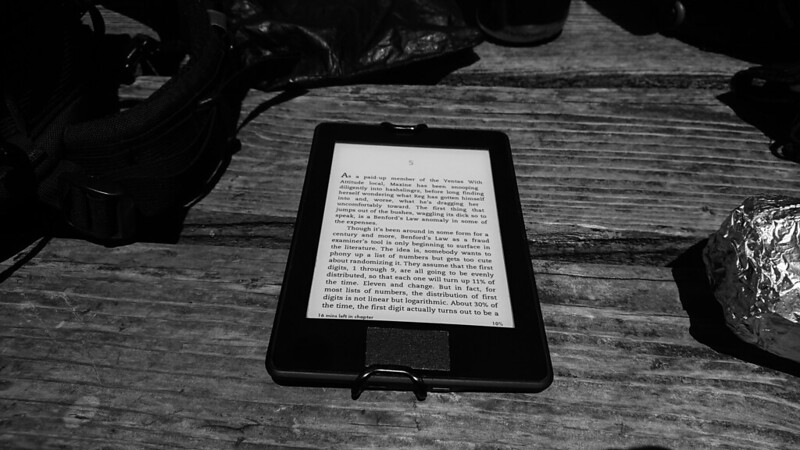
It should go without saying that I've sanitized my e-reader.

Trying to inject advertising into the reading experience is sick and sacrilegious. A privacy sticker from N-O-D-E covers the logo on the back of my Kindle, while a piece of tape sanitizes the front. Between this and my offline, DRM-free method of using the device, I enjoy the Kindle without the corporate mindshare.

Kindle at Lunch

Currently reading Bleeding Edge by Thomas Pynchon.

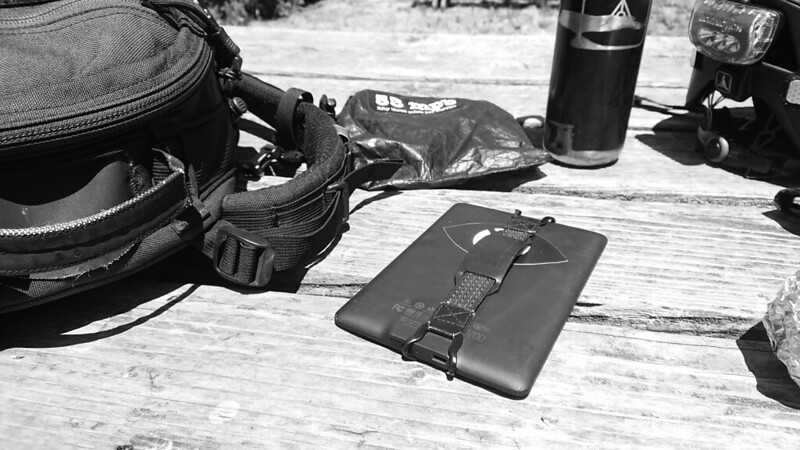
I've found a hand strap to be a useful addition to my e-reader.

I bought the TFY Security Hand Strap for my Kindle Paperwhite 18 months ago. It makes holding the e-reader for long periods of time much more pleasant – especially when reading in bed and holding the device up above my head. No pinch grip required. It doesn’t add noticeable bulk or weight to the Kindle, and I can ignore it completely when I’m not using it. Originally I went looking for some kind of case with a cover that could be folded into a more ergonomic shape to hold, but when this strap appeared in my search results I realized it was a simpler solution to the problem. The strap could probably be made with a wire hanger and some elastic webbing.

Kindle Handstrap at Lunch

Virginia Tech rates bike helmets.

The CPSC standard is of limited practicality. It seeks only to test if a helmet can prevent a skull fracture from a direct impact on the top of the head. It was refreshing to find Virginia Tech’s helmet ratings, backed by a test methodology that actually seems to appropriately model reality. I was pleased to see that my Smith Overtake scored 4/5. The Overtake is four years old and still in fine shape, but whenever it comes time to replace it I’ll use these ratings to make a purchase decision.

Hospital corners are the key to liberating your mind from the tyranny of fitted sheets.

Flat sheets with folded corners are functional mattress covers, and make every flat sheet you own twice as useful as it was before. I believe elastic-bound, fitted sheets are just a conspiracy created by the bedding industry to get us to spend more money.

I published the repository for my mobile weather solution.

Find it at geoweather. I’ve added support for Windy, but otherwise it is the same as it was back in January.

I source my linen from recovering communist states in the remnants of the Soviet Union.

Linen is my preferred material for bedding and towels (except for travel towels, where I still prefer synthetic). When purchased through normal channels, it can be prohibitively expensive. I cut out the middlemen and acquire linen directly from Eastern European makers on Esty, where it is much more affordable. My duvet cover is from Belarus. My sheets and pillow cases also hail from Belarus. My preferred towels are from Lithuania.

Identifying individuals by using a laser to record the vibrations of their heartbeat is a neat idea.

The Pentagon’s new Jetson laser sounds like a simple concept:

A new device, developed for the Pentagon after US Special Forces requested it, can identify people without seeing their face: instead it detects their unique cardiac signature with an infrared laser. While it works at 200 meters (219 yards), longer distances could be possible with a better laser. “I don’t want to say you could do it from space,” says Steward Remaly, of the Pentagon’s Combatting Terrorism Technical Support Office, “but longer ranges should be possible.”

Contact infrared sensors are often used to automatically record a patient’s pulse. They work by detecting the changes in reflection of infrared light caused by blood flow. By contrast, the new device, called Jetson, uses a technique known as laser vibrometry to detect the surface movement caused by the heartbeat. This works though typical clothing like a shirt and a jacket (though not thicker clothing such as a winter coat).

I wonder if they aim center mass, or if they can get a reading off the carotid. If it’s the former, it seems likely to be defeated by wearing plates, which is probably good life advice if the Pentagon is interested in you anyways.

The article also mentions that “[o]ne glaring limitation is the need for a database of cardiac signatures”, but I suspect they can just acquire that data from Apple, Strava, Fitbit, etc.

via Infowarrior