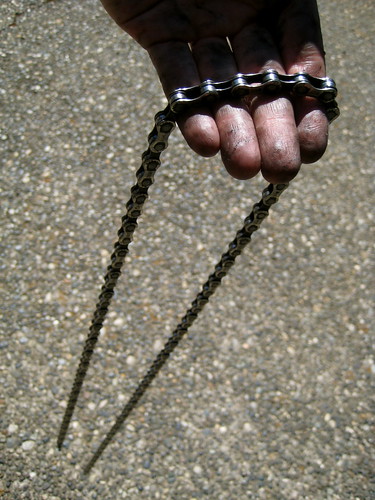
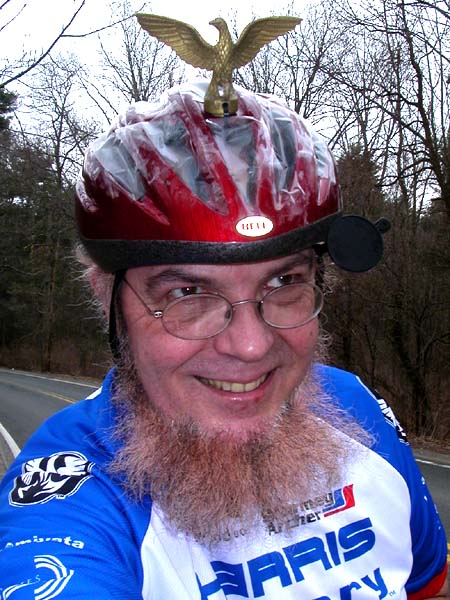
Those chain cleaning tools sold at most outdoors stores tend to pretty useless in my experience. They run around $30, but end up being cheap and ineffective pieces of plastic. I’ve given up on them in favor of cleaning my chain manually via a method discovered on Sheldon Brown’s chain maintenance page (any man with a beard like that must be infallible).
All that’s needed is a chain tool, a bottle, some sort of degrease-ing dish soap, and water.
The process is simple. Break the chain with the chain tool and drop it into the bottle. (I use an old Gatorade bottle.) Then put in a small dollop of the soap. Fill up the bottle with water, shake it around a bit, and let it sit. The water becomes black immediately. After it has sat for about 15 minutes I’ll dump it out, rinse off the chain, and put it back into the bottle with fresh soap and water. I do this until the water stays clear, which generally takes about 3 cycles.
When it’s done, you should have a chain that’s relatively clean-ish. Dry it, toss it back on the bike, lube up, and start cruising! If the chain was really dirty, you might also want a cheap brush to scrub it down.
I went on a lengthy bike ride around the Seattle area yesterday. There were a couple of errands I wanted to run in the city and I thought I’d use them as an excuse to test out Google Maps new bicycle directions feature, which I had yet to use.
The Interurban Trail runs through Snohomish and King Counties, forming a highway for human powered transport. At least, that’s the idea. Parts of the trail are on old railway routes and parts are on normal city streets. The part of the trail in King county is great, but the Snohomish county trail is very poorly signed and notoriously difficult to follow as it moves between trail sections and streets. If you’ve never ridden it before, you’re guaranteed to lose it. Since the trail parallels I-5 and 99, it’s difficult to actually get lost – just keep heading north or south and you’ll eventually get where you’re going – but it’s nice to be able to stay on the trail itself as the Interurban’s route is generally the friendliest to non-motorized vehicles.
I was very impressed with Google’s ability to keep me on the trail. The directions only once told me to turn onto a non-existent road. Other than that, they proved accurate. I also had with me photocopies of the relevant route directions taken from Biking Puget Sound. The directions from both were very similar, but where they differed, I found that Google’s route was superior.
Of course, the whole trip couldn’t be on the trail. I had to get on the Interurban at the beginning of my ride and off it at the end. For that bit, I was also happy with Google’s directions. The route on and off the trail was not as direct as the one I would have chosen myself, but Google seemed to go out of their way to keep me on smaller streets with less traffic. It’s clear that Google takes topography into account, as well, as the streets that Google suggested were flatter than those on the more direct route that I would have chosen.
The downside to Google’s route was the number of turns. The directions were 7 pages long for the full trip (both to my destination and from the destination back to my starting point). I think the longest section I had without a turn was about 2 miles. I would make a turn, pull the directions out of my pocket to see how long I had on this stretch and what the next turn would be, shove the directions back into my pocket, go on for a bit, make the turn, and repeat the process. It was a bit inconvenient, shoving the directions into my pocket and pulling them out so frequently, and the directions got crinkled and difficult to read. I need to figure out someway to mount them on my handlebars. The other problem with the directions was that, because much of the Interurban is on the old railway that doesn’t have street names, Google would occasionally give a direction like “Turn left in 58 feet”. Turn left? Turn left where? In this driveway? That business parking lot? The lake? With the infrequent signage on the trail itself, I would often miss these mysterious left turns. When that happened I would look a couple steps ahead on the directions till it had me turning onto a street with a number. I could make my way to that numbered street along normal roads and soon find myself back on Google’s route.
Overall I was pleased with the directions and will definitely be taking advantage of Google again for future trips – though if it’s in an area that I have no familiarity with, I would probably want to supplement them with a good road map for added security. I’ll also be curious to see how they do in other cities, or outside of urban areas altogether. I’m told that the team who developed the bike route feature is based in Seattle, so it would make sense that that city would have the most accurate directions.
In Seattle I made a bit of a tour. I went past Woodland Park and cruised around Green Lake a bit before stopping in the center of the universe to refuel. From there I went over the Ship Canal and decided to torture myself by pedaling up the hill to Queen Anne before heading down to Pike Place. At the market, I paid a visit to Left Bank Books to browse the zine collection before heading over to Metsker Maps. I have something of a map fetish, so Metskers is one of my favorite shops in that area. I spent 45 minutes in there pouring over various topos that are difficult to acquire anywhere else.
Outside of Pike Place I saw somebody with what looked like a TAD FAST Pack. I don’t see those around very often, so I went up to the guy to congratulate him on his taste in bags. But on closer inspection I saw it was one of those cheap Japanese airsoft knock-off designs.
After walking the bike around downtown and doing more people-watching, I started to head back north. I decided to take a different route and go the long way around Lake Union. Eventually I picked up the Burke-Gilman Trail and ended up back in Fremont. From there I made a slight detour over to Ballard (nope, it isn’t free yet) and visit Second Ascent. They’re one of the best independent (i.e. non-REI) gear shops in the area and usually have a good selection of used gear. Once there I spent another half hour looking at maps – this time aided with some of the guide books they had – and happened upon a nice 50-ish mile loop in the Glacier Peak Wilderness, which is something that I’ve been looking for lately.
From Ballard, it was back to Fremont where I made a quick stop at PCC for some dolmas and a couple of cookies before retracing my route back home.
The route that I took was supposed to be 50 miles, but for all my detours and added explorations, it was probably closer to 70. My butt cheeks hurt, despite my padded panties.
I bought one of the newer 27oz wide mouth Klean Kanteens back in March. My favorite bottle is still the old 40oz Klean Kanteen that I keep in my EDC bag, but I’ve been wanting something a bit skinnier that could fit in the bottle cage on my bike. I also was looking for an excuse to try out one of the newfangled wide mouth Klean Kanteens. I prefer a wide mouth opening on my bottles, but my 40oz Klean Kanteen (despite being beat on fairly heavily for the past few years) is in too good a shape to justify replacing it with a 40oz wide mouth. A new 27oz wide mouth bottle that would fit on my bike (not to mention in most car cup holders) and so supplement the 40oz bottle was easier to talk myself into!
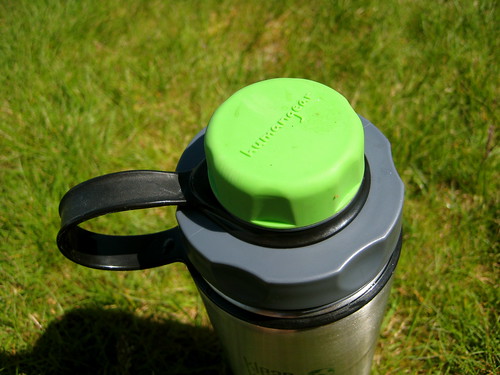
To go along with the wide mouth bottle, I also purchased a humangear capCAP. This product of questionable capitalization addresses the same problem as Guyot Design’s Splashguard: how to drink from a wide mouth bottle while moving without ending up with half the bottle’s contents on your face and the other half up your nose. The capCAP allows the user to take advantage of the wide mouth for filling and cleaning (as well as water filter integration), but also provides a smaller opening for drinking.
The wider cap has indentations on it making it easy to grab and turn. The smaller cap, in addition to the indentations of the larger cap, is made of rubber, which makes for an easy grip while wearing gloves. The rubber has a tendency to pick up small amounts of dirt and sand, but so far I have not found this to be an annoyance.
My habit in unscrewing bottle lids is to hold the body of the bottle in my left hand and unscrew the lid with my right. The problem with doing this with the capCAP is that attempting to unscrew the small lid tends to start to loosen the larger lid as well. All that’s needed to rectify this is to hold the larger cap in my left hand rather than the body of the bottle itself. This forces a change of habit, which took me a couple weeks to get used to, but I now grab the larger cap with my left hand while unscrewing the smaller cap without thinking. I haven’t had a problem with it since.
When using the capCAP with my wide mouth Klean Kanteen, I find that it does leak slightly. If the bottle lays down on its side for a bit, a couple drops of water will escape from underneath the larger cap. The threads on the bottle’s lip must not match up perfectly with those on the capCAP. If the bottle was to be thrown loosely into the body of the pack where it could shift around and potentially get a drop or two on some form of paper, I would opt for the more secure closure of the standard Klean Kanteen lid. But when the bottle is in the cage on my bike or stored upright in a pouch on my pack’s waist belt, this small leak is no problem.
The capCAP can of course be used on other wide mouth bottles. I also use it on my 32oz HDPE Nalgene as well as my 32oz Guyot Designs Backpacker and have not noticed any leaking with those bottles. It’s a pretty neat product that I think makes a great addition to any wide mouth bottle.
Here are the weights of various lids, measured on my scale:
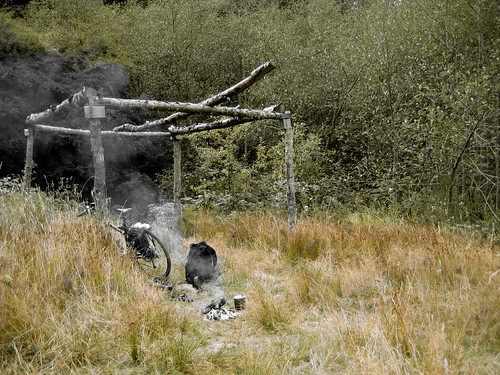
I went for a bike ride today, following a set of train tracks through the woods. Off to one side a small path led to a grassy clearing and this square structure. I stopped for a bit, processed a down log to start a small fire, and enjoyed a cup of kukicha tea while reading a book.
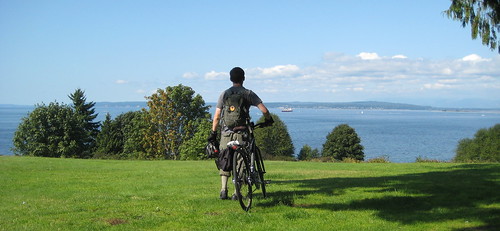
Today I went on a longer bike ride than the previous day. I didn’t want to carry the size or the weight of my FAST Pack EDC, so I grabbed the Kifaru E&E. I use the E&E as my alternate EDC bag when I need something smaller.
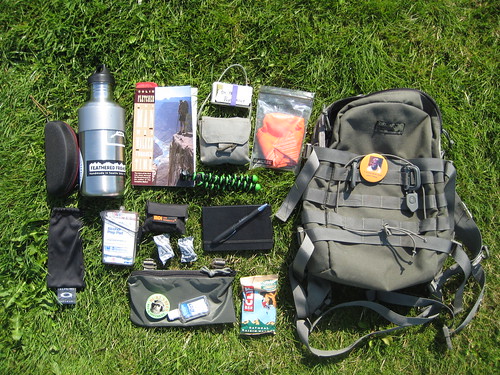
The items in the E&E are simply transferred over from the EDC items in the FAST Pack, but not every item makes the cut. This is a more minimalist setup. All level 1 and level 3 EDC items remain the same.
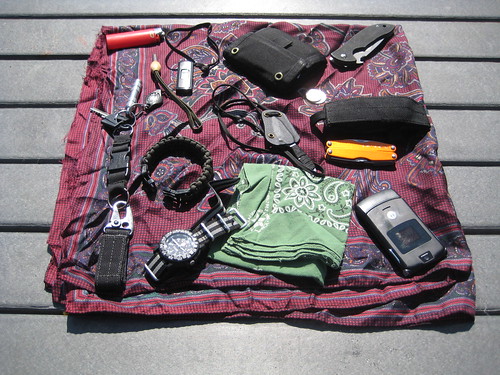
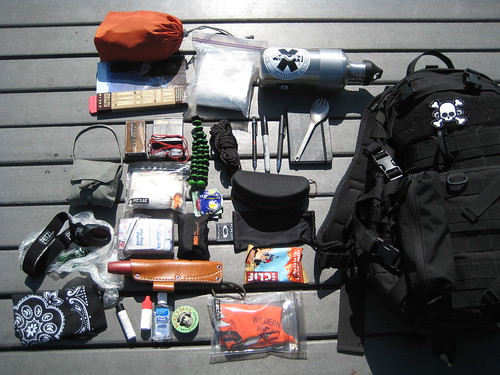
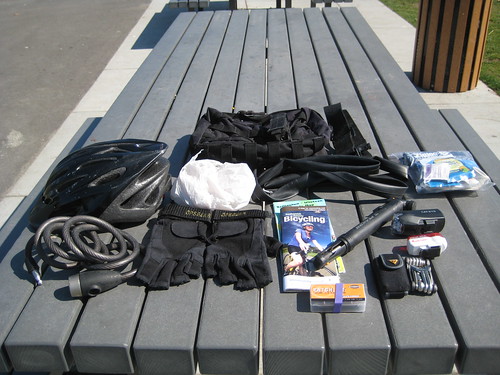
I took a break during today’s bike ride to dump out all the gear I had on me and snap a few photos. For the most part, this is representative of what I have on me every single day. There were a couple items in my pack that aren’t normally in there, but I noted those on the Flickr photo page.
I always run on Saturday morning. When my schedule allows it, I try to get in at least one additional run at some point during the week. The past few months, this didn’t happen very often. Since the new year, my schedule now allows me to run on both Tuesday and Thursday mornings, in addition to the usual Saturdays.
This morning was the first run I had taken in close to a month where it wasn’t raining (or snowing). It was so enjoyable that I decided to add something extra: at the park that marks my half-way point, I stopped and did 45 elevated push-ups off one of the benches before continuing on home. When I first started running again, it actually felt a little easier, since my legs and lungs had gotten about a minute break from the running, but soon after I discovered that my abdominal muscles weren’t too happy with me.
After running on weekdays, I only have about a 20 minute break to take a shower and break-fast before jumping on my bike and pedaling off to work. My morning commute is all up a hill that gets progressively steeper as one gets higher. Over the winter holidays, my office was moved about another half mile up the hill. Rather than riding my bike all the way up, I’ve taken to going up only about halfway, then walking up 55 stairs with the bike on my shoulder.
New streetcar tracks on Seattle’s Westlake Avenue have turned into a trap for bicyclists.
The tires on a standard road bike are narrower than the 1 3/4 inch groove that holds a streetcar wheel. If a bicycle veers into that gap, it can easily get stuck, pitching the rider onto the street.
…
Despite the goal of Mayor Greg Nickels to triple bicycle use, the new streetcar line includes long stretches of track in the curb lanes of Westlake Avenue, where bicyclists normally ride. Many riders have adapted by riding on sidewalks, to the left of the tracks – or in the left lane, which aggravates motorists.
Obviously, I agree. Though I don’t see an issue with just switching to the left lane. It may be an annoyance to those in motorized vehicles, but, honestly, that’s their problem. If they can afford to buy a car, buy insurance, buy gas, and maintain their car, surely they can afford to slow down a bit and let us pass.