The Pragmatic Bed

Five years ago I purchased the PragmaBed Simple Adjust Head & Foot bed frame. It has proved to be an excellent purchase. I can’t think of any way to improve it.

When I went to college, I spent the first year in the dorms. The bed frames provided by the university were Twin XL, so I showed up with a Twin XL mattress and bed sheets. In the subsequent years, I’ve replaced that mattress and all the sheets. But never all at once, which means I’ve just continued to buy Twin XL sized things. That was still the case when I bought the PragmaBed frame. I would be just as happy with a Twin sized bed. I’ve never been convinced of a need for something wider, but one of the things that attracted me to the PragmaBed was that, if my mind was ever changed, I could simply buy a second frame and attach it to my existing one with the attachment brackets offered by PragmaBed. Instant wide bed frame.

The legs of the PragmaBed collapse and the body folds in half, making the frame easily movable by a single individual. This is a thing I value, despite moving my bed infrequently. The frame is made of steel, with a powder coating that is reminiscent of a truck bed lining. It is a durable package that I expect to last for many years to come.

PragmaBed offers brackets that allow you to attach a normal head- or foot-board to the frame. I’ve never been sure what functionality a head- or foot-board is supposed to provide, so I don’t have these brackets. My previous bed frame also did not have a head- or foot-board, and somehow I always managed to sleep in it without falling out.

The head of the bed has a ratcheting mechanism that allows it to be raised, like a hospitable bed. This is great for lounging – I’ve never felt that the functionality offered by a couch justified the real estate required by a couch, but now my bed is a couch – or when injured. The foot of the bed can also be raised, though not as high as the head. I’ve never actually raised the foot. I imagine it is useful if you’re trying to reduce swelling in your lower legs or feet.

PragmaBed and Storage

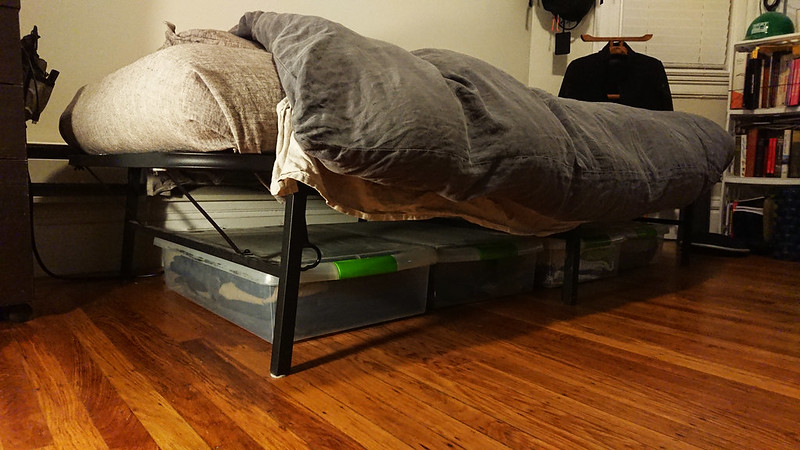
The legs raise the platform 13” off the ground. I keep four 40-quart Iris Store and Slide boxes underneath it. One holds my spare pillow and linens, one holds spare towels, one holds all of my pants, and the last holds specialized out-of-season items and a few miscellaneous items like hats.

I’ve used these same containers for eight years now. They fulfill their purpose admirably, and are the right size for my use. I’m not tempted to buy another spare set of sheets, because my spare sheets box is full. If I want to buy a new pair of pants, I first have to get rid of a pair of pants so that I have room in my pants box.

2 Meter Critical Mass

2 Meter Critical Mass is a monthly radio practice event at Spreckels Lake in Golden Gate Park. The practice grew out of the NERT community and sought to help people keep current with their handheld radios. I started attending on a fairly regular basis a couple years ago. We’d jump around to different frequencies on the 2 meter band and practice sending and receiving traffic.

Changing frequencies was sometimes the most difficult part of the practice. Most people, myself included, program their radios with software like CHIRP. When it comes time to do something like change to a frequency that is normally used for repeaters, and then remove the offset because you need to use it for simplex, it can be a struggle to remember the correct sequence of steps. But simple skills like that are critical in the field during an emergency.

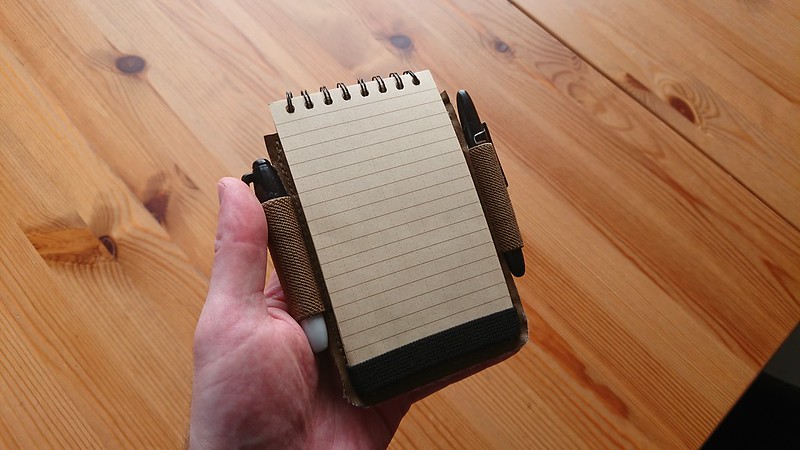
After the struggle of getting everyone onto the correct frequency, some people would start sending traffic while others would copy it down onto standardized message forms. This is the primary role of radio operators during an emergency, but is not often practiced. The messages were often lists of medicines, the Latin names of plants, or some other gibberish that would require use of the phonetic alphabet to transmit. Somebody in the group would be picked to be the net control operator, which brought with it an entirely different set of skills to practice. Somehow I always got “volunteered” for that – rain or shine (often offering an example of why you fill your field message pad with waterproof paper).

2 Meter Critical Mass

2 Meter Crical Mass was the child of Peter McElmury, AA6SF. In November there was no practice, which I thought was odd. I had never known Peter to miss a month. But he was a Marine and it was his birthday that weekend, so I figured he was just busy celebrating. The December practice was four days ago. It turns out Peter was absent in November due to a medical emergency. At this month’s event he was walking with a cane and having trouble with motor skills, like writing, but he was in a good mood and happy to be radioing, as always. Yesterday he died.

I use FeedIron to repair neutered RSS feeds.

FeedIron is a plugin for my feed reader, Tiny Tiny RSS. It takes broken, partial feeds and extracts the full article content, allowing me to read the article in my feed reader the way god intended. The plugin can be configured to extract content using a number of filters. I find that using the xpath filter to specify an element on the page like div[@class='entry-content'] corrects most neutered feeds.

I use urlwatch to monitor the global information super highway.

urlwatch is a simple program that monitors a list of URLs and sends an alert when it detects a change. It can be configured to only look for changes within certain HTML elements, or to grep for certain strings. I configure it to send me the changes via email. As with RSS-Bridge, this tool is part of my strategy to liberate content from toxic silos and Make the Internet Great Again™.

Personal Information Management

pimutils is a collection of software for personal information management. The core piece is vdirsyncer, which synchronizes calendars and contacts between the local filesystem and CalDav and CardDAV servers. Calendars may then be interacted with via khal, and contacts via khard. There’s not much to say about these three programs, other than they all just work. Having offline access to my calendars and contacts is critical, as is the ability to synchronize that data across machines.

Khard integrates easily with mutt to provide autocomplete when composing emails. I find its interface for creating, editing and reading contacts to be intuitive. It can also output a calendar of birthdays, which can then be imported into khal.

Khal’s interface for adding new calendar events is much simpler and quicker than all the mousing required by GUI calendar programs.

$ khal new 2019-11-16 21:30 5h Alessandro Cortini at Public Works :: 161 Erie St

There are times when a more complex user interface makes calendaring tasks easier. For this Khal offers the interactive option, which provides a TUI for creating, editing and reading events.

Khal can also import iCalendar files, which is a simple way of getting existing events into my world.

$ khal import invite.ics

Vdirsyncer has maintenance problems that may call its future into question, but the whole point of modular tools that operate on open data formats is that they are replaceable.

I have a simple and often used script which calls khal calendar and task list (the latter command being taskwarrior), answering the question: what am I supposed to be doing right now?

Terminal Calculations

Qalculate! is a well known GTK-based GUI calculator. For years I ignored it because I failed to realize that it included a terminal interface, qalc. Since learning about qalc last year it has become my go-to calculator. It supports all the same features as the GUI, including RPN and unit conversions. I primarily use GNU Units for unit wrangling, but being able to perform unit conversions within my calculator is sometimes useful.

$ qalc
> 1EUR to USD
It has been 20 day(s) since the exchange rates last were updated
Do you wish to update the exchange rates now? y

  1 * euro = approx. $1.1137000

> 32oC to oF

  32 * celsius = 89.6 oF

The RPN mode is not quite as intuitive as a purpose built RPN calculator like Orpie, but it is adequate for my uses. My most frequent use of RPN mode is totaling a long list of numbers without bothering with all those tedious + symbols.

> rpn on
> stack
The RPN stack is empty
> 85

  85 = 85

> 42

  42 = 42

> 198

  198 = 198

> 5

  5 = 5

> 659

  659 = 659

> stack

  1:    659
  2:    5
  3:    198
  4:    42
  5:    85

> total

  total([659, 5, 198, 42, 85]) = 989

> stack

  1:    989

Also provided are some basic statistics functions that can help save time.

> mean(2,12,5,3,1)
  mean([2, 12, 5, 3, 1]) = 4.6

And of course there are the varaibles and constants you would expect

> 12+3*8)/2
  (12 + (3 * 8)) / 2 = 18
> ans*pi
  ans * pi = 56.548668

I reach for qalc more frequently than alternative calculators like bc, insect, or the Python shell.

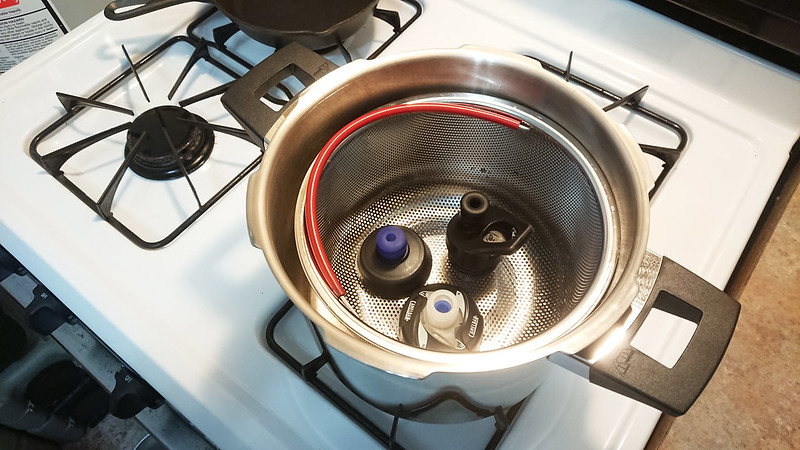
I use my pressure cooker to sterilize equipment.

Sport bottles lids often have small nooks and crannies that are excellent for growing bacteria and difficult to clean by hand. I occasionally throw these lids into my pressure cooker with a steaming basket or trivet to sterilize them. Multiple studies show that a standard pressure cooker can be an effective alternative to an autoclave in austere environments. The general rule of thumb seems to be about 15 psi for 15 minutes, though 30 minutes may be a safer bet for medical instruments.

Poor Man Autoclave

Titanium Teaware

I keep a Snow Peak H450 Mug at work. This is double-walled titanium and as such is expensive and entirely unnecessary. But it is a luxury I enjoy, and I expect that (like most Snow Peak titanium products) it will last approximately until the heat death of the universe. As the name implies, it has a capacity of 450mL. It has an outer diameter of 86mm and a height of 97mm. This is the mug I use for my daily oatmeal and miso.

Tea is brewed in the mug using a FORLIFE Brew-in-Mug Tea Infuser, which fits perfectly in the H450. It is easy to clean, allows the tea to breathe, and lives up to its name as being something that ought to last for life.

Snow Peak H450 and FORLIFE Infuser

The Snow Peak MGC-053 Lid fits on the H450 mug and provides a cafe style lid. A better option is the old, discontinued Klean Kanteen Pint Lid. Klean Kanteen made this for their pint cup, but it fits perfectly on the H450. It gives you a cafe style lid, and has a rubber piece that rotates into place to cover the hole that you sip out of. There’s also a sealed hole for a straw, though I’ve never used this (maybe you could use it for your bombilla if you were into such things). I would prefer the lid to be deeper, like the MGC-053, so that liquid that does splash up out of the hole has a better chance of being contained within the dish of the lid and then running back into the mug. However, the rotating cover of the old Klean Kanteen lid reduces the chance of liquid escaping in the first place. Neither lid is leak proof, and I rarely use either because I’m generally not moving around while drinking tea, but the Klean Kanteen Pint Lid lives in the small pouch of tea supplies that I keep at my desk. It will get slapped on if I’m walking someplace.

Snow Peak H450 Lids

At home I keep a Keith Titanium Ti3521. Keith is a Chinese brand that previously was only available direct from the People’s Republic on AliExpress. In the past couple of years I’ve seen them start to be distributed directly stateside. The Ti3521 has a capacity of 450mL, an outer diameter of 78mm and a height of 125mm. Compared to the Snow Peak mug, it’s a little skinnier and a little taller. What makes this product unique are the lids. It has a silicone cafe style lid with a sippy hole that fits tightly over the rim of the mug. As with the lid options for the Snow Peak H450, this lid is adequate to protect from spills while walking with the mug. The Ti3521 also has a titanium lid. This can be placed directly on the mug, but it isn’t a tight fit and is mostly useless here. It is intended to be placed over the silicone lid, covering the hole you drink out of and providing further protection. The titanium lid has a small pin hole in it to allow heat to escape, so the setup isn’t waterproof – you certainly wouldn’t want to put it in a pack when it had liquid in it – but it will probably keep you from scalding yourself on a bumpy car ride.

The Ti3521 includes its own titanium infuser. The infuser inserts into the silicone lid and hangs down into the mug. The infuser is small, with a diameter of 42mm and a height of 78mm. Some teas, I find, need a bit more room to breathe. For those teas, the FORLIFE Brew-in-Mug Tea Infuser does fit in the Ti3521. But the Keith infuser works well enough for many teas. It has a larger volume than your typical tea ball or stick infuser, so if you are happy with those you’d probably be happy with this.

Keith Ti3521 Infuser

When new, the silicone lid did impart a strong silicone taste. Since I purchased the product direct from China, I have no way of knowing if the silicone is what the USA FDA would consider “food grade”. When I first received the Ti3521, I made a number of different attempts to reduce the silicone taste from the lid – boiling water, baking soda and vinegar, lemon juice, etc. Nothing really helped, but after just using it for a few months the taste finally went away.

I use the silicone lid to hang the infuser basket, and I use the titanium lid as a dish to place the infuser on when I’m done with it. I rarely drink through the silicone lid.

In addition to its use at home, the Ti3521 is the mug I’ll usually grab when travelling. I find that its skinnier-but-taller form factor tends to be slightly easier to slide into a pack than the Snow Peak mug, and I like that all of the components are more tightly integrated than the H450 and FORLIFE infuser.

I own a few other Keith Titanium products in addition to the Ti3521. My experience with them is that they are of a perfectly acceptable quality, though not quite as nice as Snow Peak. The Ti3521 is exemplary of this. When boiling water is poured into the Snow Peak H450, the outer wall is warm but comfortable to hold. When the same water is poured into the Keith Ti3521, the outer wall is hot. Not too hot to hold, but certainly hotter than the Snow Peak mug. I don’t know if this is because the Keith titanium is thinner, or because the walls are closer together, or because the vacuum between them is imperfect.

The Snow Peak H450 is part of a three piece set of nesting mugs. The H200 is the smallest of the set. I’ll sometimes use it if I have brewed tea in a pot and I want a cup that just holds a small amount, but otherwise it is not very useful. The middle-sized H300 is more interesting. It holds a full cup of tea and is a nice size to drink out of. It also just so happens that the 23.7 oz Smartwater bottle that I like to use as part of my backcountry hydration setup with the Sawyer Squeeze fits perfectly inside the H300 mug. By perfectly I mean that if the mug were a millimeter narrower the bottle would not fit. So if I want the luxury of backcountry tea brewed in something other than my cook pot, my setup is the Smartwater bottle, inside the H300 mug, inside the Hill People Gear 3” Bottle Holster.

For brewing, the lower portion of the FORLIFE Brew-in-Mug Tea Infuser does fit in the H300. But this is far too bulky for me to ever want to pack into the backcountry. A tea ball works, but those are always cheaply made with soft walls that flatten and small hinges that break. They don’t survive long in a pack. A stick infuser is too tall. I’ve successfully used a Tuffy Steeper with the H300 (an idea from Backpacking Light). When collapsed this is small and easily packable. When fully expanded it is roughly the size of the FORLIFE Brew-in-Mug Tea Infuser, though it tapers toward the bottom. However, it can be used when only partially expanded, which allows it to fit better into the H300. As with the silicone lid on the Keith Ti3521, the Tuffy Steeper imparted a strong silicone taste when I first bought it. Over time this has diminished, but I still sometimes notice it. Another option is the House Again Tea Ball Infuser. This is a bit larger than the typical tea ball, and much more robust. It fits in the H300 and packs well separately. Usually this is the option I’ll choose.

If I want to brew a pot of tea, I use the Fire Maple Titanium 1L Kettle – another AliExpress purchase. There is absolutely nothing special about this pot, except that it is titanium, and thus cool. It is single-walled, so it can be used on a stove or over a fire. I bought it after breaking a glass teapot and vowing Never Again. It also features some neat knot work on the handle, which I assume was tied by the deft hands of small children who sleep on the cold concrete underneath their workstations, piss in buckets, etc.

Fire Maple Kettle

The Fire Maple kettle does have an extremely coarse strainer in the spout. If you’re brewing some sort of blossoming tea, it may work, but it isn’t great for the teas I typically enjoy. Instead I use the FORLIFE Capsule Infuser, which is a great big infuser that is meant to be used in a large pitcher. It is a good size for a 1L pot, and the lid will still fit on the teapot while the strainer is inside.