As part of a growing state rebellion, Gov. Christine Gregoire today signed a bill rejecting REAL ID, a new federal identification system that would create a de facto national ID card. Legislatures in four other states -- Maine, Idaho, Arkansas and Montana -- also have adopted measures opposing REAL ID, and lawmakers in more than 20 other states are considering similar action.
State government needs to stand up to the feds more often.
I was waiting at the bus stop today when a construction worker walked up to me. He stared at me for a few moments and said “Wow, you look impressive. Cargo pants and everything.” I chuckled, told him thanks, and he went on his way.
About a minute later he came back and said “I don’t want to bother you or anything, but I got to thinking a guy dressed like that could use some wheels.” He handed me a business card and walked away. On the back was written:
The strange part is, this bus stop was in the middle of a large parking lot with no construction site around. When I turned around to see where he walked off to, he was gone.
I went to the opening of the farmer’s market today. It seems to be smaller this year. A whole row of vendors was missing, and the vendors that are there are mostly crafts – much less produce.
My favorite apple stand was missing.
Hopefully the farmers will return and reclaim their market as the season continues.
On the plus side, my honeystock is replenished and I’m sitting here with a bag of salmon jerky.
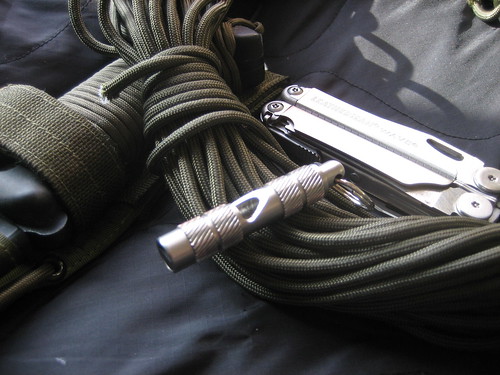
Most folks who would otherwise put Batman’s belt to shame tend not to carry a whistle.
Can you really blame them? Honestly, a whistle won’t do you much good when you’re being mauled by shambling hordes of the undead. The experienced Zombie Hunter would opt for a pair of khukris instead.
But the whistle does present some application to the aspiring survivalist. It serves as a possible deterrent to rapists (yes, guys get raped, too). Tooting on one helps rescuers locate your lost self.
Sure, you could pick up one of those cheap plastic ones, but that doesn’t really fit the bill. The level we’re going for is thus: If you were to pull a Rip Van Winkle in the middle of a perpetual war-zone, would your kit be undamaged upon awakening?
Plus, we all know stuff is better when it has “tactical” in the name.
The bottom line is, the thing is made by someone who crafts custom knives. Knives kill people.
Can you kill someone with your whistle?
(Note: As I hope you gathered, this review is a bit tongue-in-cheek. Honestly, it’s a fucking whistle. Yeah, it’s a good piece of kit, but is it really worth the price difference over a Fox 40? Having never used one, I can’t say, but I doubt it.)
As the train pulled into Portland last week, two ladies were having a discussion in the back of the car. One had a 3-4 hour layover before continuing her journey. She was discussing what she could do near the station to kill time. The other would not shut-up about how dangerous Portland was, especially around the station, where the homeless shelters are. “All those street people, you know. You never know what’s going to happen.” She talked of the rampant crime, the daily shootings that were reported when she lived in the city. She made it out to be ripe for one of the top positions in DP.
It’s this sort of mental constraint that I can’t understand.
Yes, Old Town is rife with society’s undesirables. The Salvation Army, the Sisters of the Road, street churches and other soup kitchens and shelters are all contained within a few blocks. But there’s no more danger there than any other part of the city. I walked through the area a number of times. I stopped and chatted with people. They tended not to be as open or as friendly as the homeless up here, but they’re not going to rob you or shoot you.
The vast majority of homeless are not there by choice, but, still, they are performing a rebellious act.
Without a home, a mortgage, contracts and other debt to tie them down, they are free to move about on a whim. This is about control. About keeping the populace in a box. Literally.
Jeb and his ilk see the shelter, the soup kitchen, not as a means for the homeless to ‘elevate’ themselves ‘up’ to the status of home-owner (direction is relative), but instead as a means of perpetuating their rebellious status. (And for some – perhaps too few – it is.)
This, like the current wars in the Middle East, are but a continuation of the farmer’s fight with the nomad. Instead of hunting game and gathering roots, the modern nomad scavenges dumpsters and asks for loose change. Instead of carrying shelter and supplies on pack animals, the modern pastoralist lives in his van or rides the two-wheeled steed.
Nomadism represents freedom. The ability to get up and leave with the changing of the season. It represents diversity; dependence not on a handful of crops, but on an eclectic plethora of subsistence.
For thousands of years the nomad has been the bane of the farmer – the farmer who is immobile, tied to his place. Who is dependent on his technological mastery of the land and his homogeneous crop. The Chinese built and rebuilt the Great Wall to seperate themselves from the nomadic pastoralists of the Steppes.
The Middle East, once a great, thriving civilization of farmers, was leveled by the nomad Chinggis Khan. It still has not recovered. No modern farming culture has built an ocean-less empire equaling the size of the Mongol World Empire at its peak.
Nomadism is power. Self empowerment.
The nomad is only ever defeated when he accepts the way of the farmer, settles down and is absorbed into the culture.
The nomad’s power lays in his ability to survive with in the farmer’s culture, or with out it.
I don’t mean to hold the pastoralist nomad of the Steppes up as an ideal – or any other culture – but his ways must be studied. Learnt. Mastered. Melded together with each other and with the Other, and mutated into something for this day.
Something new and powerful and better.
Something to free us the shackles of the caste and the class.
Kamana One introduces the student to the ideas and style of teachings that will form the base for the rest of the program. It’s divided into two sections. The first, the “Nature Awareness Trail” devotes itself to the psychological aspects of the modern primitive. It deals with awareness; directions, surroundings, details. I was surprised at the remarkable similarities between it and vipassana.
The second part, the “Resource Trail” deals with the other half of naturalist training. Mammal and plant identification, bird language, and field guides are just a few of the topics covered. This part is often referred to as “the field guide for field guides” because of it’s ability to decrypt the otherwise esoteric manuals.
In addition to the text book, Kamana One includes Jon Young’s Seeing Through Native Eyes audio set. This is definitely the best part of the course. It’s best described as all of Jon Young’s vast knowledge squeezed down and compressed into 8 CDs, covering both psychological and physical aspects.
In the end, I don’t feel that the program (with the exception of the audio portion) gave me much new. The ideas presented in the “Nature Awareness Trail” I had already developed through my own readings and practice. The ideas in “Resource Trail”, too, I had already discovered through my own study, including the Learning Herbs kit. The course is better suited for one who is new to all of this. Someone who perhaps has an interest in the outdoors, in survival, but is looking to take that interest a step forward.
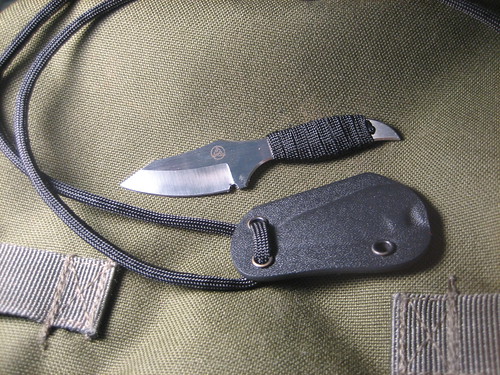
Last winter when TAD Gear had their holiday sale, I picked up a Nemesis Hellion.
It’s an nice little neck knife – though I don’t often carry it that way. I tend to tuck it away somewhere in my jacket, or sometimes a boot, as a last ditch resort for when all my other blades have receded into the void and the cardboard boxes are out for blood.
For when I do carry it around the neck, I replaced the chain with gutted paracord and wrapped the handle Atwood style (also with gutted paracord) to reduce the amount of cold metal touching my skin.
The Kydex sheath is a tight fit. It takes a few wiggles to get the knife loose, and the blade often comes out with black specs cut from the inside of the sheath. (At least you can be assured the knife isn’t going to fall out and impale you in the toe.)
When it first came, the butt-end was almost as sharp as the tip. The next time I went out, I took a little sandstone to it and sanded it down.
Honestly, a knife this small doesn’t have much application (unless you’re Jack Bauer – I’m sure he could find a use for it). It’s more of a fun toy. I wouldn’t pay the $39.99 TAD currently asks for it, but if you can find it cheaper, it’s a well built blade and a worthy addition to any collection of Sharp Things.
If anyone has suggestions for that which must be done or seen, let me know. I head home Friday.
Public transportation here seems to be overpriced, but I can rent a bike for $15, so I think I might do that tomorrow. Walking around today, it looked this area was bike-friendly, but the other side of the Willamette River… not so much.