Gear Tracker

Gear Tracker is an open-source inventory system for wilderness travel gear.

When I first bought my scale, I started a spreadsheet containing the weights of various pieces of gear. It seemed like a good idea – I knew I wanted some sort of database to store my measured weights and other notes in – but I never got around to updating it. Data in a spreadsheet is too static. You can’t do much with it. I think that characteristic contributed to my disinterest with the spreadsheet.

So for a while now I’ve had the idea of writing a web application to track my gear. Over the past week, I finally got around to doing it.

Gear Tracker is built on Django, a web application framework. (If you’re not familiar with Django, and you have anything to do with making websites, it’s probably worth your time to learn a thing or two.)

Gear

Gear Tracker’s primary purpose is to track gear.

Screenshot of item admin

Each item has a weight and acquisition date associated with it. It can be categorized, tagged, and related to other items. There are fields to input size, a link to the manufacturer’s page, a link to a review, and to upload an image. A text area allows the user to store any notes related to the item.

Items can be archived. This provides a way to not list gear that the user no longer owns, but to keep it in the database for future reference of its weight or other attributes.

Weights

Weights are always input in grams.

The metric system makes the most sense and is the easiest to work with. An item’s weight can be displayed in grams or, if the item weighs more than 1,000 grams, kilograms. But because some of us are crippled and still like to see imperial weights, Gear Tracker can also display the item’s weight in ounces or pounds.

Gear Lists

Gear Tracker can also generate gear lists.

One of the things that has prevented me from doing many gear lists in the past is that they’re a pain in the rear to create. It takes a while to manually write out every item of gear that I take on a trip. If I want to add the weight of each item – well, that’s asking too much! It’s not worth it.

Screenshot of gear list admin

Now, making gear lists is easy. Gear Tracker already has detailed knowledge about each piece of gear. All it takes to create a gear list is to select the item, specify how many of that item I took, and whether the item was packed or carried. The result is an organized, detailed gear list for every trip. Total weights are calculated, of course, and can be output in either metric or imperial units.

Private Gear Lists

Gear lists can be made private.

I generally create gear lists when I’m packing before a trip. But I don’t like to publish the lists until I actually return from the trip and also have a report and photos for people to peruse. So, Gear Tracker allows a gear list to be marked as private.

Download It, Hack It, Use It

I’m running Gear Tracker at /gear, but if you want to grab your own copy and run it yourself, you can! I’ve open-sourced the code under a BSD-license. You can find it at GitHub.
Solstice Ramble Along Deer Creek

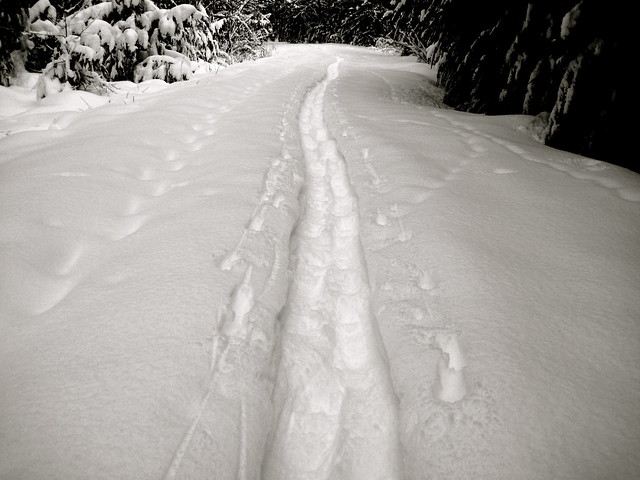
I can’t think of a better way to spend the winter solstice than breaking trail in fresh powder.

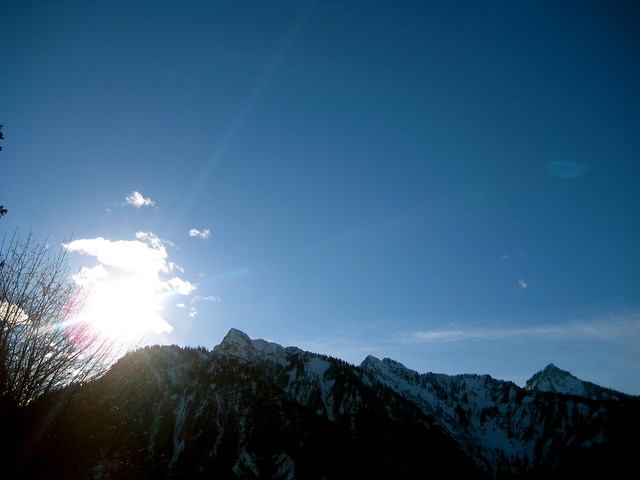
Blue Sky

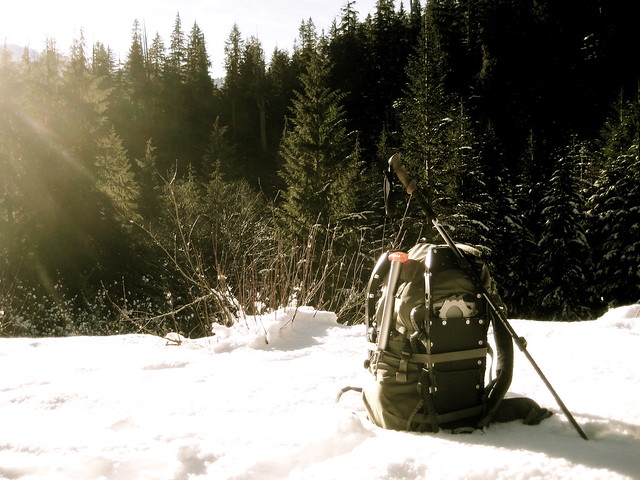
Winter Loadout

Trail

Days and months are the travelers of eternity. So are the years that pass by... I myself have been tempted for a long time by the cloud-moving wind -- filled with a strong desire to wander... I walked through mists and clouds, breathing the thin air of high altitudes and stepping on slippery ice and snow, till at last through a gateway of clouds, as it seemed, to the very paths of the sun and moon, I reached the summit, completely our of breath and nearly frozen to death. Presently the sun went down and the moon rose glistening in the sky. - Basho

Relative Warmth of Synthetic Puffy Pants

A CLO value is a measurement of the warmth provided by a garment. It serves as a means of comparing the relative warmth of various clothing insulated with synthetic materials.

A good explanation of CLO values can be found on Adventure Network:

Developed in 1941, [CLO] was the first real attempt to explain the insulation value of clothing so people would know how much clothing they might need to stay warmer or cooler in a given temperature environment. A CLO value of 1 is defined as the amount of clothing required by a resting human (in other words, sitting, lying down or standing, but not moving) to be comfortable at a room temperature of 21 degrees C, or approximately 71 degrees F. That single value of CLO is equivalent to a typical business suit worn by a man -- shirt, undershirt, trousers and suit jacket. The higher the CLO number, the more insulating value is provided.

I recently put together a list comparing the CLO values of various synthetic puffy pants for a forum that I belong to. Some of you may find it useful as well, so I’m posting it here.

All of the weights given are manufacture weights. They might not be entirely accurate. I found the CLO values for the various insulating materials by searching online. Some of them are provided by the manufacturer, some by third parties.

Kifaru PackLock Pants (Arctic)

Weight
27 oz
Shell
RhinoSkin (.9 oz/yard2)
Insulation
6 oz Climashield Combat (CLO: .79/oz)
CLO
4.74

Patagonia Micro Puff Pants

Weight
17.4 oz
Shell
Ripstop polyester (32-denier, 1.5 oz/yard2)
Insulation
3.2 oz of PrimaLoft One (CLO .84/oz)
CLO
2.69

Rab Photon Pants

Weight
15.8 oz
Shell
Pertex Microlight (30-denier nylon, 1.3 oz/yard2)
Insulation
3.5 oz of Primaloft Sport (CLO: .74/oz)
CLO
2.59

Backpacking Light Cocoon Insulated Pant

Weight
7.3 oz
Shell
Pertex Quantum (.9 oz/yard2)
Insulation
Unknown (Polarguard Delta?)
CLO
2.5

Integral Designs PLQ Pants

Weight
11.4 oz
Shell
Pertex Microlite (30-denier, 1.3oz/yard2)
Insulation
3 oz of Primaloft Sport (CLO: .74/oz)
CLO
2.22

782 Gear Smokin' Chaps

I previously had 782 Gear's Chaps listed as using Climashield Combat. Now I'm told by a retailer that they actually use Primaloft (what type of Primaloft wasn't specified). This agrees with 782's technology page, which lists Primaloft as one of the products that they use. Yet 782 has recently updated the Chaps' product page to specify that the pants use "Climashield" (what type of Climashield isn't specified). Until this is cleared up, I'm leaving the Smokin' Chaps off this list.

Kifaru PackLock Pants (Standard)

Weight
17 oz
Shell
RhinoSkin (.9 oz/yard2)
Insulation
2 oz Climashield Combat (CLO: .79/oz)
CLO
1.58

Montbell U.L. Thermawrap Pants

Weight
10.2 oz
Shell
Ballistic Airlight (15-denier nylon, .9 oz/yard2)
Insulation
1.6 oz of Exceloft (CLO: .683/oz)
CLO
1.09