The truth is that for the first time we are bereft of a positive vision of where we are going. This is particularly evident among kids. Their future is either Road Warrior post-apocalypse, or Blade Runner mid-apocalypse. All the futuristic computer games are elaborations of these scenarios, heavy metal worlds where civilization is crumbling into something weird and violent (but more exciting than now).
The Afterculture is an attempt to transmute this folklore of the future into something deep and rich and convincingly real. If we are to pull a compelling future out of environmental theory and recycling paradigms, we are going to have to clothe the sacred in the romantic. The Afterculture is part of an ongoing work to shape a new mythology by sources as diverse as Thoreau and Conan and Dances with Wolves and Iron John. The Afterculture is not "against" the problems of our times, and it's not about "band-aid solutions" to the grim jam we find ourselves in. It's about opening up a whole new category of solutions, about finding another way of being: evolved, simpler, deeper, even more elegant. Even more cool. Even very cool.
(Did you know 60% of anything you put in your skin will go into your bloodstream?)
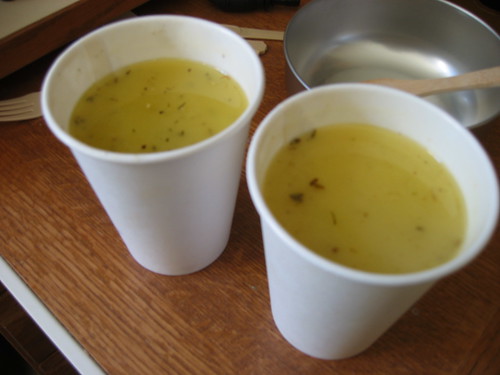
Today was my Soap Alchemy class. We made cold process soap with palm oil, coconut oil, and olive pomace oil. One batch we put in lavender, the other peppermint. Right now, the soap looks like this:
In 48 hours it will harden and I’ll take it out of the mold (paper cup). Then, in 30 days, the lye will have completed mixing with the oils and I’ll have soap.
Cold Process SoapMaterials:
-Stainless steel pot (8-12 qt, no aluminum)
-Scale (measuring in ounces preferred)
-Glass jar (gallon size -- check for cracks before use) or 4-8qt stainless steel pot
-Wooden spoon (used for soap only)
-Soap molds - no aluminum, cast iron, or teflon
-Soap base oils, lye, water, herbs, spices, essential oils.
Directions
-Measure lye and place into glass jar or small stainless steel pot. Add cold water and stir until lye is dissolved. You may choose to wear eye protection and rubber gloves. The water will get very hot (180F). Be careful of the rising steam, as it is caustic and irritating to the throat and lungs. Set aside to cool to room temperature (may put container in tub of cold water).
-Melt oils together on high heat in stainless steel pot. Remove from heat (do not let smoke), set aside to cool to room temperature (may put pot in tub of cold water).
-Pour lye solution slowly into oils when the lye solution and fats are room temperature.
-Stir constantly until mixture is thick and creamy with a "pea soup" consistency: approx 15-20 minutes
-Stir in essential oils (1/2~1 1/2 oz) and dried herbs and spices with the amounts to your preference.
-Pour into molds.
-Cover and keep warm. Place in a draft free warm area for 48 hours.
-Remove the soap from the molds. If there is any difficulty removing the soap from the molds, place them in your freezer for 24 hours. Run warm water over the bottom of the molds, the soap will slide out easily.
-Cut and let cure in the open air for 30 days.
2 Basic Soap RecipesRecipe #1
40 oz. Palm Oil
25 oz. Coconut Oil
20 oz. Olive Pomace Oil
32 oz. Cold Water
10 1/2 oz. Lye
Recipe #2
40 oz. Coconut Oil
45 oz. Olive Pomace Oil
32 oz. Cold Water
10 1/2 oz. Lye
The above is for cold process soap. Hot process soap – which we didn’t make in my class today – takes a little more effort up front, but is usable in a few hours, instead of 30 days.
The recipes will make about 25 bars of soap.
It’s important that you acquire Olive Pomace Oil – not just Olive Oil or Pomace Oil. This is the third pressing of the olive.
Suzanne, my instructor, uses an oak mold which she first lines with parchment paper.
Lye, contrary to Fight Club, will not burn you. It dries your skin, which will cause itching. Simply rinse it off with water and pat dry.
...collapse strips us of who we think we are so that who we really are may be revealed. Civilization's toxicity has fostered the illusion that one is, for example, a professional person with money in the bank, a secure mortgage, a good credit rating, a healthy body and mind, raising healthy children who will grow up to become successful like oneself, and that when one retires, one will be well-taken-care of. If that has become your identity, and if you don't look deeper, you won't discover who you really are; and when collapse happens, you will be shattered because you have failed to notice the strengths, resources, and gifts that abide in your essence which transcend and supersede your ego-identity. In a post-collapse world, academic degrees and stock portfolios matter little. The real question, as Richard Heinberg so succinctly puts it is: Do you know how to make shoes?
...
..collapse will decimate our anti-tribal, individualistic, Anglo-American programming by forcing us to join with others for survival. You may own a home outright with ample acreage on which you have produced a stunning organic garden, have a ten-year cache of food and water, drive a hybrid car, and live a completely solarized life, but if you think you will survive in isolation, you are tragically deluded. Collapse dictates that we will depend on each other, or we will die.
...
For millennia, many indigenous people have described the demise of civilization we are now witnessing as a purification process: a time of rebirth and transformation. Their ancient wisdom challenges us to face with equanimity the collapse that is in process; that is, to hold as much as humanly possible in our hearts and minds, the reality of the pain the collapse will entail, alongside the unimaginable opportunities it offers.
I’ve been messing with rsnapshot for the past couple days. The config file is really picky about the differences between spaces and tabs, but, other than that, it’s a great tool.
A Declaration of the Independence of Cyberspace
by John Perry Barlow (barlow@eff.org)
Governments of the Industrial World, you weary giants of flesh and steel, I come from Cyberspace, the new home of Mind. On behalf of the future, I ask you of the past to leave us alone. You are not welcome among us. You have no sovereignty where we gather.
We have no elected government, nor are we likely to have one, so I address you with no greater authority than that with which liberty itself always speaks. I declare the global social space we are building to be naturally independent of the tyrannies you seek to impose on us. You have no moral right to rule us nor do you possess any methods of enforcement we have true reason to fear.
Governments derive their just powers from the consent of the governed. You have neither solicited nor received ours. We did not invite you. You do not know us, nor do you know our world. Cyberspace does not lie within your borders. Do not think that you can build it, as though it were a public construction project. You cannot. It is an act of nature and it grows itself through our collective actions.
You have not engaged in our great and gathering conversation, nor did you create the wealth of our marketplaces. You do not know our culture, our ethics, or the unwritten codes that already provide our society more order than could be obtained by any of your impositions.
You claim there are problems among us that you need to solve. You use this claim as an excuse to invade our precincts. Many of these problems don't exist. Where there are real conflicts, where there are wrongs, we will identify them and address them by our means. We are forming our own Social Contract . This governance will arise according to the conditions of our world, not yours. Our world is different.
Cyberspace consists of transactions, relationships, and thought itself, arrayed like a standing wave in the web of our communications. Ours is a world that is both everywhere and nowhere, but it is not where bodies live.
We are creating a world that all may enter without privilege or prejudice accorded by race, economic power, military force, or station of birth.
We are creating a world where anyone, anywhere may express his or her beliefs, no matter how singular, without fear of being coerced into silence or conformity.
Your legal concepts of property, expression, identity, movement, and context do not apply to us. They are all based on matter, and there is no matter here.
Our identities have no bodies, so, unlike you, we cannot obtain order by physical coercion. We believe that from ethics, enlightened self-interest, and the commonweal, our governance will emerge . Our identities may be distributed across many of your jurisdictions. The only law that all our constituent cultures would generally recognize is the Golden Rule. We hope we will be able to build our particular solutions on that basis. But we cannot accept the solutions you are attempting to impose.
In the United States, you have today created a law, the Telecommunications Reform Act, which repudiates your own Constitution and insults the dreams of Jefferson, Washington, Mill, Madison, DeToqueville, and Brandeis. These dreams must now be born anew in us.
You are terrified of your own children, since they are natives in a world where you will always be immigrants. Because you fear them, you entrust your bureaucracies with the parental responsibilities you are too cowardly to confront yourselves. In our world, all the sentiments and expressions of humanity, from the debasing to the angelic, are parts of a seamless whole, the global conversation of bits. We cannot separate the air that chokes from the air upon which wings beat.
In China, Germany, France, Russia, Singapore, Italy and the United States, you are trying to ward off the virus of liberty by erecting guard posts at the frontiers of Cyberspace. These may keep out the contagion for a small time, but they will not work in a world that will soon be blanketed in bit-bearing media.
Your increasingly obsolete information industries would perpetuate themselves by proposing laws, in America and elsewhere, that claim to own speech itself throughout the world. These laws would declare ideas to be another industrial product, no more noble than pig iron. In our world, whatever the human mind may create can be reproduced and distributed infinitely at no cost. The global conveyance of thought no longer requires your factories to accomplish.
These increasingly hostile and colonial measures place us in the same position as those previous lovers of freedom and self-determination who had to reject the authorities of distant, uninformed powers. We must declare our virtual selves immune to your sovereignty, even as we continue to consent to your rule over our bodies. We will spread ourselves across the Planet so that no one can arrest our thoughts.
We will create a civilization of the Mind in Cyberspace. May it be more humane and fair than the world your governments have made before.
Davos, Switzerland
February 8, 1996
I talked to my computer science professor today and discovered that, if I email him my program the night before, I don’t have to attend lab. I don’t want to make a habit of it, but not having to wake up at 7AM on Tuesdays for lab is awesome – and I always write the code for lab assignments the night before, anyways.
By Dr. Lawrence Britt
Dr. Lawrence Britt has examined the fascist regimes of Hitler (Germany), Mussolini (Italy), Franco (Spain), Suharto (Indonesia) and several Latin American regimes. Britt found 14 defining characteristics common to each:
1. Powerful and Continuing Nationalism - Fascist regimes tend to make constant use of patriotic mottos, slogans, symbols, songs, and other paraphernalia. Flags are seen everywhere, as are flag symbols on clothing and in public displays.
2. Disdain for the Recognition of Human Rights - Because of fear of enemies and the need for security, the people in fascist regimes are persuaded that human rights can be ignored in certain cases because of "need." The people tend to look the other way or even approve of torture, summary executions, assassinations, long incarcerations of prisoners, etc.
3. Identification of Enemies/Scapegoats as a Unifying Cause - The people are rallied into a unifying patriotic frenzy over the need to eliminate a perceived common threat or foe: racial , ethnic or religious minorities; liberals; communists; socialists, terrorists, etc.
4. Supremacy of the Military - Even when there are widespread
domestic problems, the military is given a disproportionate amount of government funding, and the domestic agenda is neglected. Soldiers and military service are glamorized.
5. Rampant Sexism - The governments of fascist nations tend to be almost exclusively male-dominated. Under fascist regimes, traditional gender roles are made more rigid. Divorce, abortion and homosexuality are suppressed and the state is represented as the ultimate guardian of the family institution.
6. Controlled Mass Media - Sometimes to media is directly controlled by the government, but in other cases, the media is indirectly controlled by government regulation, or sympathetic media spokespeople and executives. Censorship, especially in war time, is very common.
7. Obsession with National Security - Fear is used as a motivational tool by the government over the masses.
8. Religion and Government are Intertwined - Governments in fascist nations tend to use the most common religion in the nation as a tool to manipulate public opinion. Religious rhetoric and terminology is common from government leaders, even when the major tenets of the religion are diametrically opposed to the government's policies or actions.
9. Corporate Power is Protected - The industrial and business aristocracy of a fascist nation often are the ones who put the government leaders into power, creating a mutually beneficial business/government relationship and power elite.
10. Labor Power is Suppressed - Because the organizing power of labor is the only real threat to a fascist government, labor unions are either eliminated entirely, or are severely suppressed.
11. Disdain for Intellectuals and the Arts - Fascist nations tend to promote and tolerate open hostility to higher education, and academia. It is not uncommon for professors and other academics to be censored or even arrested. Free expression in the arts and letters is openly attacked.
12. Obsession with Crime and Punishment - Under fascist regimes, the police are given almost limitless power to enforce laws. The people are often willing to overlook police abuses and even forego civil liberties in the name of patriotism. There is often a national police force with virtually unlimited power in fascist nations.
13. Rampant Cronyism and Corruption - Fascist regimes almost always are governed by groups of friends and associates who appoint each other to government positions and use governmental power and authority to protect their friends from accountability. It is not uncommon in fascist regimes for national resources and even treasures to be appropriated or even outright stolen by government leaders.
14. Fraudulent Elections - Sometimes elections in fascist nations are a complete sham. Other times elections are manipulated by smear campaigns against or even assassination of opposition candidates, use of legislation to control voting numbers or political district boundaries, and manipulation of the media. Fascist nations also typically use their judiciaries to manipulate or control elections.
Despite the fact that small children lose body heat faster than adults, they often survive in the same conditions better than experienced hunters, better than physically fit hikers, better than former members of the military or skilled sailors. And yet one of the groups with the poorest survival rates is children ages seven to twelve. Clearly, those youngest children have a deep secret that trumps knowledge and experience.
Scientists do not know exactly what that secret is, but the answer may lie in basic childhood traits. At that age, the brain has not yet developed certain abilities. For example, small children do not create the same sort of mental maps adults do. They don't understand traveling to a particular place, so they don't run to get somewhere beyond their field of vision. They also follow their instincts. If it gets cold, they crawl into a hollow tree to get warm. If they're tired, they rest, so they don't get fatigued. If they're thirsty, they drink. They try to make themselves comfortable and staying comfortable helps keep them alive... The secret may also lie in the fact that they do not yet have the sophisticated mental mapping ability that adults have, and so do not try to bend the map. They remap the world they're in.
Children between the ages of seven and twelve, on the other hand, have some adult characteristics, such as mental mapping, but they don't have adult judgment. They don't ordinarily have the strong ability to control emotional responses and to reason through their situation. They panic and run. They look for shortcuts. If a trail peters out, they keep going, ignoring thirst, hunger, and cold, until they fall over. In learning to think more like adults, it seems, they have suppressed the very instincts that might have helped them.
Last night I went to a showing of Trudell, a film about John Trudell, the Native American poet/activist. He lead the Native American occupation of Alcatraz Island for 21 months, and, following that, was the National Spokesman of the American Indian Movement during the Pine Ridge Shootout. After burning an American flag on the steps of the J. Edgar Hoover FBI Building, his pregnant wife, three children, and mother in law were burned alive in a suspicious arson fire. In the words of the FBI “He’s extremely eloquent… therefore extremely dangerous.”
Speaking of the FBI: he’s said to have one of the longest FBI files in history, at over 17,000 pages.
His music is interesting – it’s spoken word poetry set to traditional Native American music, with a little blues guitar thrown in for good measure.
He’ll be here speaking today, but I can’t go, as the pre-trip meeting for this weekend’s snowcamping trip is at the same time.