The ideal off-road journey? I'll tell you: under water. I would like to see every four-by-four on earth, every three-wheeler, every dirt bike, trail bike and Big Foot truck driven straight into the Marianas Trench, three thousand feet below the surface of the Pacific Ocean, and parked there -- left there -- for the duration.
For the duration of what? For the duration of this techno-industrial-commercial slime-mold that is transforming our planet into one vast battleground of Cretins against Nature. With the Cretins winning.
What's wrong with the horse? Or the burro? Or the bicycle? Or even, God help us, the human foot? Why should not Americans especially learn to walk again? There is this to be said for walking: it is the one method of human locomotion by which a man or woman proceeds erect, upright, proud and independent, not squatting on the haunches like a frog.
Little boys love machines. Grown-up men and women like to walk.
-Edward Abbey
I tossed another 10lb weight in my pack and headed out to the Mount Pilchuck area. I ended up walking out to (the creatively named) Lake Twenty Two at the base of Pilchuck and bushwhacked around the research natural area a bit.
There was very little snow. It’s going to be a dry summer.
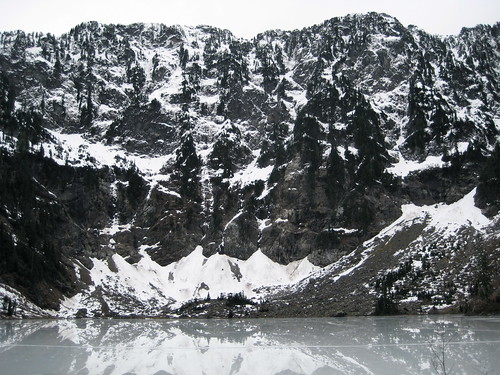
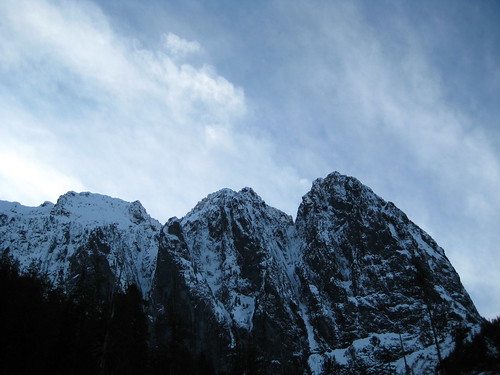
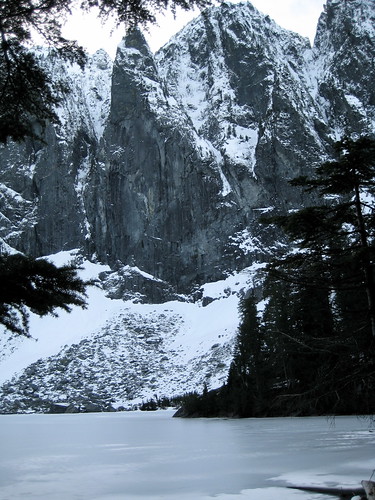
I’ve been doing a few training hikes lately: loading the old rucksack up with 55-60lb, walking through forests and scrambling up peaks. The winter has been unusually warm, which has allowed me to access places that are usually off-limits this time of year without technical equipment. Yesterday I ventured out to Lake Serene, at the base of Mt. Index (just the other side of the Skykomish valley from Baring Mountain).
At a little over 7 miles (round trip) and only 2,000 feet elevation gain, this was a relaxing walk; a bit of an award to myself for completing the other, more difficult climbs.
The trail was snow free till about a mile or so before the lake. After that, there was a dusting of crusty snow – no more than an inch – and quite a bit of ice.
I ate lunch at the frozen lake, watched an avalanche on Index’s north peak, and raced the sun back home.
"...a well-lived life means striving for personal, moral, and physical autonomy: self-direction, intellectual and spiritual independence, self-control, self-responsibility -- in sum, self-realization through self-determination. As a dues-paying member of this unintentionally masochistic minority, I can testify that the price of personal freedom and soulful individuality today -- the cost of living a self-determined life -- is often social, material, physical, and even geographical marginalization all of which can act themselves out in a big city as well as a small town or a rural homestead and must be construed as culture's punishment for being different. Or perhaps, as some will say, such are the just deserts of freaks and other sinners. Humankind, said Henry through its own inventions and lust for comfort is invariably driven to desperation. Misery loves company and the dominant culture, jealous of those who evade desperate angst, is never happy with mavericks, those of us who, even in the most liberal social realms, are barely tolerated."
-David Peterson, On the Wild Edge: In Search of a Natural Life
This past summer, I reviewed the StickPic, which Rodney Java, the inventor, was kind enough to send me. Last week Rodney sent me one of his new and slightly improved StickPic models.
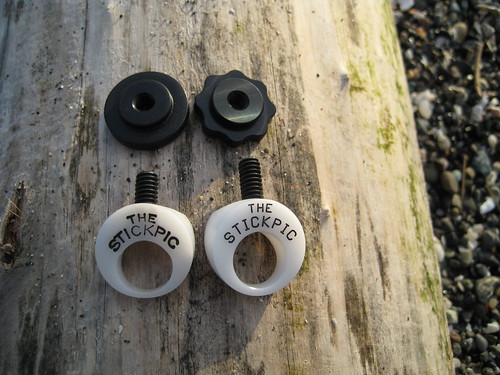
The first change is in how the markings are applied to the StickPic. According to Rodney,
We now have a new machine shop producing the StickPic who cnc engraves our name and model numbers. In the past, we used a metal die stamp and stamped every StickPic by hand. This produced inconsistent results.
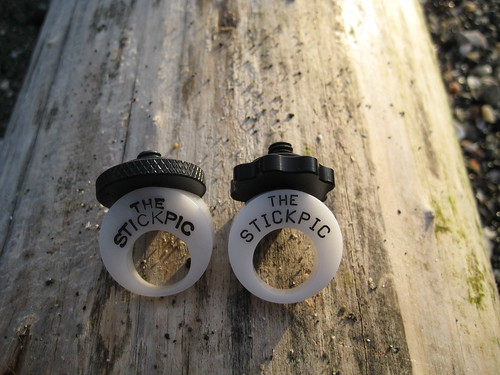
The difference is noticeable. In the old model, pictured on the left, you can see how the thickness of the lettering varies. The new engraving looks more professional, but this is only a cosmetic difference, and not one that I think really matters.
The next immediately noticeable difference is the nut:
A new 8 star jam nut is now used which allows the user, while wearing gloves, to easily attach the StickPic to the camera.
This is certainly a more significant change than the engraving. I find that it makes the StickPic easier to both attach and deattach even when not wearing gloves. The new nut is not only easier to grab, but it also spins more freely than the old.
The third and final change is the hole itself:
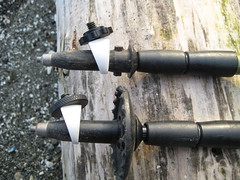
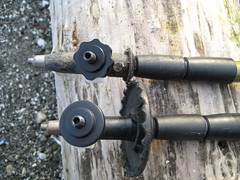
The through hole on the new model is also slightly tapered to ensure it stays on the trekking pole more securely; it wedges in a little better.
You can see in the photos that the new Stickpic slides much further down the tip of the pole than does the old one. I’m not sure how much this contributes to security: I installed both StickPics on either one of my poles and shook them around violently. Neither came off. Granted, I didn’t have the extra weight of a camera attached to either StickPic. But I’ve also never had my camera fall off the pole during normal use with the old StickPic.
The weight of the new StickPic has been slightly increased – probably due to the winged nut. My scale puts the old model at 8 grams and the new one at 10 grams. (Though my scale is only accurate down to 1 gram, so it isn’t the best for measuring such lightweight items.) Personally, I think the new nut is worth an additional 2 grams!
I think that all three changes to the StickPic are marked improvements, with the new nut being the most significant of the lot. I do not think that any of the changes are enough to warrant purchasing the new model if you are happy with the old one, but they will improve the device for new users.
Note:
In the above photos, the new StickPic is installed on a trekking pole without a basket. It is not necessary to remove the pole’s basket to use the StickPic. I simply lost the basket for that pole a while back and never replaced it. Even though it slides much further down the tip of the pole than does the old model, the new StickPic will fit on the other pole without interfering with the basket.